|
This is a text reader for the article below:
Getting your Trinity Audio player ready...
|
Wednesday 12/17/25
Thru the Bible: Proverbs 25
Message Video Player
Message Audio Player:
Podcast: Download (Duration: 1:17:15 — 86.8MB)
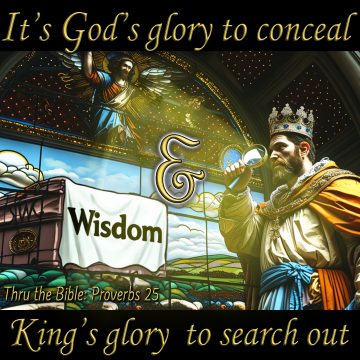
***Video is HERE***It’s God’s glory to conceal & a King’s glory to search out
Proverbs 25,- Chapters 1-9 were more proverbial stories, than condensed sayings of wisdom and are generally believed to have been authored by Solomon, though some of them may be ones he collected which is something he alluded to in Ecclesiastes.
- These contain much in the way of describing the ways of wisdom as opposed to the ways of folly. The primary example of folly being sexual promiscuity.
- Chapters 10-29 are definitely from Solomon and are short statements of wisdom. These are designed for meditation and contemplation. They practice an economy of words yet say so much that one has to ponder them and mull them over in the mind to extract the wisdom they teach. This one division is sub-divided up into 4 sections, the fourth and final of which we are beginning tonight.
- Section 1: Proverbs 10:1-22:16 contain 375 sayings that contrast the wise and the foolish, or the righteous and the wicked.
- Section 2: Proverbs 22:17-24:22 supply moral discourses under the heading of “The words of the wise“.
- Section 3: Proverbs 25 begins a set of four chapters written by Solomon, but compiled By King Hezekiah and his sages. Afterwards it was placed in the ever growing book of Proverbs which would later be canonized. As such, our opening verses say, “These also are proverbs of Solomon, which the men of King Hezekiah of Judah copied:” – Prov. 25:1. Since this compilation happened under the rule of King Hezekiah who between 715-687B.C., King Solomon himself had no knowledge that they ever made it into a book of proverbs later on.
“(1) These also are proverbs of Solomon which the men of Hezekiah king of Judah copied. “(2) It is the glory of God to conceal things, but the glory of kings is to search things out. (3) As the heavens for height, and the earth for depth, so the heart of kings is unsearchable.”I find these verses intriguing because they point to an aspect of the Godhead I find compelling, interesting, insightful and rather personal regarding Their heart and Their unique intentions with us, Their creatures who are the most like Them. So far as we know, mankind are the only ones of God’s creation who spend the initial part of their existence without ever directly seeing Him. There are of course examples of those who have seen a vision in which God reveals Himself to some degree. Some have been taken in the spirit to the spiritual realm and even to Heaven where they have seen God revealed to them by degrees. However none of these have EVER been a full on revelation of the person of the Father, openly and involving all of their natural senses. We have it on the authority of scripture and specifically Jesus Himself that no man has ever seen God at any time (John 1:18, 1 John 4:12). Now we can speculate as to the reasons for this – only a few of which we know for certain and I due to the impact they have on understanding these verses to any depth at all, I will briefly mention three of them.
- God’s dignity and majesty
- God’s purpose
- Faith
Notice that after all these insights regarding man, their creation, their high purpose and yet their being less than the angels – the Psalmist is brought to the recognition of God’s Majesty! So it is that one of God’s intentions in shielding His full dignity and majesty from being openly known without search or inquiry to man and His purpose in the creation of mankind seem tied at the hip. Finally and in many ways, center stage to all the above is faith! One reason we were created naturally blind to God’s majesty and splendor is because if mankind had seen God for Who He fully is from the beginning and THEN fell, there would have been no redemption. This is why both satan and angels cannot be redeemed. Theirs was the highest expression of the unpardonable sin. Apostasy is to know God in some form of intimacy through revelation and faith, and then to turn from Him in animosity with eyes wide open to Who and what you are rejecting. This is NOT done in a fit of anger or through a misunderstanding of God and His actions (like a parent grieving and angry over the loss of a child). God understands this grief and treats such anger with mercy for a time. Apostasy is an open faced, knowing of God and out of some consideration of self (like satan) to rebel against Him in open defiance. It is unpardonable due to the nature of the sin. So, God in His mercy and in His wisdom, has chosen to reveal Himself by degrees to humanity that they might choose to love, trust and serve Him of a freewill, before being exposed to the totality of His person and majesty. This was the point of the trees of knowledge and life. This was also done for the opposite reason. God desires to be loved and admired for WHO He is, not what He is alone. We will see some of this in the story of the Song of Solomon. If God were to show up in all His splendor. Riding into town, as it were, in all His pomp and circumstance who wouldn’t believe? It would not be like the silly superficial displays we humans use to show off to each other in vain attempts to inspire awe. Trust me, if God were to reveal all He is to humanity – every person would believe in Him and no one would initially even think to distrust Him. Why would a God of this magnitude need deception? Deception is for protecting oneself from being exploited and who could exploit God? But if our belief and trust in God were due to this, all such beliefs would be superficial and almost forced. Who could resist Him? On the other hand, if God were to veil Himself so that we only know Him from observing His self revelations in the things He has made, the results would be far more authentic! Paul tells us in Romans 1:18-20, that God has in fact revealed Himself through His creation. So much so that any failure to desire or pursue Him is inexcusable! The suggestions God speaks into every human heart and the influence of His Spirit upon ours, requires that we FIRST come to know Him by heart and not by outward appearances. This is so our love and devotion of Him will be authentic, rather than coerced and forced. Thus, it answers the question behind the rebellion of the angels in heaven. After all, God has told us that the angels are watching us. That we need to be careful to maintain respect for authority in human relationships due to their observing us – especially in our church gatherings. We are told that our redemption is something they desire to better understand and look into. That God’s original intent was to reveal His many sided wisdom to the angels THROUGH the church. He also told us that in the end, we will be their judges! So to think, our creation was not directly tied to their rebellion is just to lack common sense revealed in God’s stated purposes in scripture. Now, that all seems a fair piece away from this simple set of verses, but I assure you it is NOT! We are NOT being told simply that God hides and kings seek, but that glory is somehow attached to this truth. It is a GLORY for God to do the hiding and it is the GLORY of kings to do the seeking! Now first off, you need to realize that the hiding and seeking are referring to issues of ruling and reigning as a king does. So WHAT God is hiding is His wisdom, His plans and His purposes regarding a nation. That is why it is Kings who are doing the seeking in this case. So, by extension, it is God’s glory to do ANY hiding of any of His wisdom, plans and purposes in each life and sphere of authority and it is each person’s glory to seek! And that is where the wisdom for application in our lives comes in! The word Glory here is kāḇôḏ and means “weight,” “honor,” “splendor,” or God’s visible presence. It is THE defining term for glory in the Hebrew Bible, encapsulating Divine weight, presence, honor, and majesty, though it is also used in a limited fashion for human esteem as well. While other concepts exist (like shekinah for divine indwelling), kāḇôd is the foundational word for “glory” and “honor” in the scriptures, appearing from Genesis to Malachi to convey God’s worth and manifest presence. Kāḇôdcomes from a root meaning “heavy” or “weighty,” signifying significance, importance, and substance, not just fleeting fame. So applied to these verses, we are being told that it is in keeping with God’s splendor, significance and importance to conceal matters pertaining to the rule of nations and it is the honor and weighty obligation of kings to search them out. Now apply this to your own life. You may not be a king, but you do have a place in God’s kingdom. A role to play, and obligation to fulfill and a sphere over which God has given you some authority and responsibility. So in these it is in keeping with God’s splendor, significance and importance to conceal His purposes, plans and wisdom but it is your honor and weighty obligation to seek them out – to Seek Him! I’ll leave this segment with this passage for your further consideration and study.Psalm 8:3-9,“(3) When I look at your heavens, the work of your fingers, the moon and the stars, which you have set in place, (4) what is man that you are mindful of him, and the son of man that you care for him?
(5) Yet you have made him a little lower than the heavenly beings and crowned him with glory and honor. (6) You have given him dominion over the works of your hands; you have put all things under his feet, (7) all sheep and oxen, and also the beasts of the field, (8) the birds of the heavens, and the fish of the sea, whatever passes along the paths of the seas.
(9) O LORD, our Lord, how majestic is Your Name in all the earth!”
John 2:23-25,“(23) Now when he was in Jerusalem at the PassoverFeast, many believed in His name when they saw the signs that He was doing. (24) But Jesus on His part did not entrust Himself to them, because He knew all people (25) and needed no one to bear witness about man, for He Himself knew what was in man.”Proverbs 25…
“(4) Take away the dross from the silver, and the smith has material for a vessel; (5) take away the wicked from the presence of the king, and his throne will be established in righteousness.”This has application for all of us and requires very little in terms of explanation. One additional thought though is if God is OUR king, then when He removes the dross from us, His throne is established within and among us. Even as that example we offered a few months ago. A silversmith knows when silver is purified when he sees his image in the silver.
“(6) Do not put yourself forward in the king’s presence or stand in the place of the great, (7) for it is better to be told, “Come up here,” than to be put lower in the presence of a noble, whom your eyes have seen.”Now many translations make the breaking point between verses in different places here. The majority make the break so that “what or whom your eyes have seen” appears at the end of verse 7. I’m inclined to accept this even though I think it makes less sense only because most ancient documents agree with it including the Septuagint and Masoretic text both.
“(8) Do not hastily bring into court, for what will you do in the end, when your neighbor puts you to shame? (9) Argue your case with your neighbor himself, and do not reveal another’s secret, (10) lest he who hears you bring shame upon you, and your ill repute have no end.”The situation here is clearly between you the reader and your neighbor. We are being encouraged to settle things outside of court if you can. This is ALWAYS good advice since it attempts to work through issues relationally rather than legally. Even if such does not solidify a friendship or agreement, it is still less likely to make a bitter enemy. Verse 8 opens with the initial advice to not go to court in haste against your neighbor for they are likely to know as many of your faults and you do of theirs. The Hebrew verb for “court” or “litigation” רִיב (riv) is often used in legal contexts; here the warning is not to go to court hastily lest it turn out badly. Instead, take it to your neighbor in private. Don’t bring an entourage of family or friends to support you or intimidate them. Keep the issue as private as possible. The reasons for this are many, but that which is offered is that things may very well be revealed about you, that you will never outlive!
“(11) A word fitly spoken is like apples of gold in a setting of silver. (12) Like a gold ring or an ornament of gold is a wise reprover to a listening ear.” “(13) Like the cold of snow in the time of harvest is a faithful messenger to those who send him; he refreshes the soul of his masters.”You cannot look at this one too closely, because on the surface it makes little sense for most people. Even those who love the cold, probably would find little joy attempting to harvest in the slush of snow. Furthermore, it is unlikely that such would do the harvest any real good. Many attempts have been made to “right the text” so as to make it more sensible. These range from snow brought down from mountain tops and held in reservoirs for general cooling on hot harvest days – to cool breezes coming down from snow capped mountains. Some English versions replace “snow” with “water” (cf. TEV “cold water”; CEV “cool water”). These are attempts to explain the simile, but the point is clear enough! The idea is that of refreshing – to relieve heat and exhaustion during a time of labor. A similar effect on the heart of a master is a faithful servant who can be trusted to convey messages on their behalf. Some of the following are very simple and obvious in their meaning…
“(14) Like clouds and wind without rain is a man who boasts of a gift he does not give.” “(15) With patience a ruler may be persuaded, and a soft tongue will break a bone.” “(16) If you have found honey, eat only enough for you, lest you have your fill of it and vomit it.”This is true both on the surface and in what it can represent. The idea is to not overindulge in any good thing. This includes the acquisition of wealth, or goods or even friends and family. Too much of a good thing is still too much!
“(17) Let your foot be seldom in your neighbor’s house, lest he have his fill of you and hate you.” “(18) A man who bears false witness against his neighbor is like a war club, or a sword, or a sharp arrow.” “(19) Trusting in a treacherous man in time of trouble is like a bad tooth or a foot that slips.”Meaning it is never good or wise, but in a time of trouble it can be particularly dangerous, painful or even deadly!
“(20) Whoever sings songs to a heavy heart is like one who takes off a garment on a cold day, and like vinegar on soda.”The second simile mentions pouring vinegar on soda. The LXX has “scab,” but that does not fit as a sensitive thing. The reference is to sodium carbonate (natural in Egypt) which can be neutralized with vinegar. I’m not personally connecting with the vinegar and soda analogy myself, but the point is made clear enough just by the initial conditions of a song to a heavy heart.
“(21) If your enemy is hungry, give him bread to eat, and if he is thirsty, give him water to drink, (22) for you will heap burning coals on his head, and the LORD will reward you.”Reading the notes from the New English translation finally made this passage clear to me, but here and where it is repeated in the New Testament. I never bought the party line that being kind would just anger them, because such behavior is never rewarded by God and could hardly be condoned! I once read a rather elaborate explanation for the New Testament usage of this passage. It said that “heaping burning coals” was actually a good thing in that in the ancient world fires were maintained and never allowed to go completely cold, since starting a fire was not as easy as it is today. When people did allow this to happen it was often an embarrassing thing to go to a neighbor to collect some hot coals with which to reignite their fire. Such coals were typically carried upon one’s head in earthen vessels which did not convey heat. So the person who gives the coal would be like one who gave cold water to someone who was thirsty or bread to one who was hungry. But that did not seem to fit the analogy of the recipient of the kindness being one’s enemy. The New English notes makes this small, yet helpful observation –
The imagery of the “burning coals” represents pangs of conscience, more readily affected by kindness than by violence. These coals produce the sharp pain of contrition through regret (e.g., Prov. 18:19; 20:22; 24:17; Gen 42-45; 1 Samuel 24:18-20; Romans 12:20). The coals then would be an implied comparison with a searing conscience.The second consequence of treating enemies with kindness is that the LORD will reward the act.
“(23) The north wind brings forth rain, and a backbiting tongue, angry looks.”This is a bit of a conundrum since typically in Israel any wind bringing rain came from the West NOT the North. Some suggest this Proverb originated in Egypt, which would make sense in that location. So the proverb was understood in meaning though in practice did not make literal sense in all geographical locations. This IS possible since we know some of the proverbs are Egyptian in origin. Solomon himself admitted that the book of Proverbs is a collection of wise sayings, some from other sources.
More than likely this is talking about the rare occasions when a north wind DID bring rain, such rain would be cold and miserable. Therefore making it an apt analogy for the effect a back-bitting tongue has on people!“(9) Not only was the Teacher wise, but he also taught knowledge to the people; he carefully evaluated and arranged MANY PROVERBS. (10) The Teacher sought to find delightful words, and to write accurately truthful sayings. (11) The words of the sages are like prods, and the collected sayings are like firmly fixed nails; they are given by one shepherd.”– Eccl. 12:9-11
“(24) It is better to live in a corner of the housetop than in a house shared with a quarrelsome wife.” “(25) Like cold water to a thirsty soul, so is good news from a far country.” “(26) Like a muddied spring or a polluted fountain is a righteous man who gives way before the wicked.” “(27) It is not good to eat much honey, nor is it glorious to seek one’s own glory.” I’m not sure what it is about people today, but they seem to gravitate towards people who do this. Those who are self-promotional seem to attract many followers and I am not initially referring to social media in this, though that most certainly applies. It is as if people lack discernment. If someone IS self-promoting, they often are not of the type of character one should be following. Nevertheless, people ARE sheep and at the end of the day, most sheep just want to be told what to think, rather than think for themselves! “(28) A man without self-control is like a city broken into and left without walls.” Man is this a great one to end on! If or to the degree that a person lacks self control they are their worst enemy. Not only are they easy prey from the outside, but they don’t even need an enemy to hurt them since they oppose themselves through their wantonness!
Tri
Blessings!