|
This is a text reader for the article below:
Getting your Trinity Audio player ready...
|
Sunday 12/21/25
Title: The Living Bread in the House of Bread
Click for Message Video
Message Audio Player:
Podcast: Download (Duration: 1:33:12 — 99.5MB)
The Living Bread in the House of Bread
Psalm 34:4
“(4) I sought the LORD, and He answered me and delivered me from all my fears.”
“(9) ear the LORD, you His saints, for those who fear Him lack nothing.”
For the past few weeks we have been reexamining faith in the light of all we have learned in more recent years and I think the takeaway is just SO natural, so non-forced as to be almost intuitive and almost obvious and that is one of the many reliable litmus tests for identifying truth.
God has so baked into our physical reality all that is necessary to reliably identify and recognize truth in relation to God.
God is relational. The Tri-unity has eternally existed in perpetual intimacy and relationship. Therefore, creating worlds and beings devoid of relationship would be not only foreign to Them, it would be contradictory and therefore a lie – and God CANNOT lie.
No before we dive in today, I want to go back over our list of bedrock truths about faith…
Reverence for God is foundational to faith.
- Faith is NOT difficult or hard to come by.
- Faith isn’t conjured, it comes!
- Faith is automatic if your heart is open and unprotected.
- Faith’s motive is always pure.
- Primarily this truth begins with the fact that Faith is God focused not ME focused.
- Faith is always IN God as a person, not in what we know ABOUT His will.
- Faith is always IN God and not FOR a thing or outcome.
- Faith ALWAYS bears fruit – has correlating action.
- “We believe THEREFORE we speak!” – 2 Corinthians 4:13, meaning that sincere faith in the person and character of God FIRST fills the heart to the point of satiation. Once it is the abundance of the heart – the mouth WILL ALWAYS speak the truth of its inner conviction. We don’t MAKE “faith confessions”, we confess because we are replete with faith. The difference is profound! Our hearts literally cannot help but give testimony to its deep spiritual convictions and expectations of God.
- Faith doesn’t need a shield, it IS one.
Last week we spent time examining Romans 10 which not only reveals many of these truths but does so in the relational context of God’s provision of salvation which He communicated beforehand through His prophetic promises to Israel over the centuries!
It is in that passage we learned the fact that Faith is conjured, it comes – by hearing and hearing by God’s revealed word. This “hearing” is either through the things He has created which place us in the position of having no excuse for our lack of trust. Or He does it by His Spirit directly in the reading of the scriptures or through those He called and anointed to speak His word.
We also learned that Israel (as a nation), although the recipients of all the above – did not believe! All of this did not result in faith being formed in their hearts.
Who can remember why? Flesh borne expectations.
Flesh has ALWAYS been a veil. It was created FOR that very purpose. If you remember, Adam and Eve never saw God directly. They only heard His voice walking and talking with them in the cool of the day.
This was intentional as we learned. So it isn’t sin that makes the flesh a veil, it was CREATED to be one. Nevertheless, fallen flesh – meaning flesh which still contains the tendency and inner influence of sin and death is made even more impervious to the Divine voice.
So we discovered that the fear of the Lord and Seeking HIM rather than His promises alone, safeguards us from much of that dissuading influence.
Thus the two wonderful verses we opened up with this morning… I will read them again.
Psalm 34:4
“(4) I sought the LORD, and He answered me and delivered me from all my fears.”
“(9) Fear the LORD, you His saints, for those who fear Him lack nothing.”
We all love the victories of the Noahs, Abrahams, Sarahs, Moses’ & King David’s the scriptures are replete with, but where we have failed is going to what God said to THEM and trying to rub those words on our problems. In doing this we make the monstrous substitution of seeking to apply to us, what they gained through relationship.
As I have grown fond of saying over the years, if we want the results our forefathers in faith had, we must do what they did!
Taking what God said to Abraham, Moses or David and attempting to superficially apply it to our problems is to unwittingly repeat the error of Israel at the mountain. “Go!” They said to Moses, “up on the mountain and hear from God FOR us. Write it down and bring it to us and we will obey. But do not let God speak to us directly ever again.”
When we take the words God spoke in promise to our patriarchs as if He had spoken it to us, we make the exact same mistake. David did not turn to the Pentateuch to obtain faith for living, he went to God. Now the scriptures played a part didn’t they?
What did we learn the scriptures are in our relationship to God? Remember Jesus told the religious elite that they searched the scripture THINKING the contained eternal life. What was their mistake?
The scriptures are the handshake which introduces God TO US. THAT is not the source of faith, our subsequent encounter with God is the source of Faith!
So if I want the results David got, I must do what David did! David learned the scriptures and pondered them. He talked to God about them while he was tending sheep, and mulled them over in his mind. It was then that God revealed to him that if He had been the shepherd of Israel, then by extension He was also David’s personal shepherd! THAT was revelation! It was THAT which made a David who could stand before Goliath while the trained warriors of Israel, huddled in their tents! David didn’t get that kind of faith by reading his bible every day – he didn’t even have one. I mean, he knew the scriptures and took them to heart, but like Jesus, David’s encounters with God were mostly when he was off alone on the hillside. That is where he obtained the audacious revelation that God was not just the God of the nation, He is MY God as well!
So, do you have respect for God this morning?
Are you hungry for HIM, and not just what His hand can provide?
Then let’s dive into HIM this morning by the aid of the Holy Spirit of Truth. Not just to be fed, but empowered for living out our union with Him in faith and sincerity!
I want you to turn to Genesis 3:16-19. Today we are taking communion, something I am dedicated to you before God that beginning this year, we will do more often than we have before. I have been negligent in this and I am sorry for that. My focus on feeding you what I perceive to be God’s manna for us every week, praying for and overseeing your growth and application of that manna, has superseded other obligations of which communion is a major not a minor part.
It may not seem that important to a 21st century believer. After all, we are not under the delusion that it is any more than a symbol of something we believe and live from the heart. But our Master and Savior told us, “as often and you eat this bread and drink this cup”.
Now the words hosákis án “hoh-SAH-kees ahn“ translated as “as often as” in reference to partaking communion does not imply urgency or frequency, but I dare say the early church observed this more than a few times a year. In fact, extra-biblical writings, such as the Didache (c. 100-150 AD), together with early Church Fathers like Ignatius of Antioch, confirm the 1st-century church practiced communion, often weekly!
In fact, it is speculated that this is what “breaking of bread” may have meant when used in reference to time of fellowship among early believers. I’m not certain I believe this since it is the same phrase used for meals shared by the men who walked and talked with Jesus on the road to Emmaus. It isn’t impossible that such was the meal they ate, it just seems forced and unlikely.
The difficulty I think is the tight-rope between frequency and over familiarity. I believe we need to do this much more often, but in the doing of it, we MUST be careful not to allow it to lose its significance and impact upon us. For even though on one level it is a symbolic exercise, even still it is a place where we legitimately meet with Him in a literal and cogent way.
Now, in saying all of this I’m giving you a bit of a preview of our message today right from the onset, but this simple meal of bread and wine is also called our koinonia with Him – our sharing with Him in His death and resurrection!
It is a return to our walks and talks in the garden but the door to the garden is through the tomb!
Remember that the word koinonia means joint participation with. In fact a more complete understanding of the word is a shared experience, shared resources and a shared life! Don’t lose that as we read – it is of vital importance to us this morning!
I’ll repeat it so you can write it down – koinonia means joint participation with. In fact a more complete understanding of the word is a shared experience, shared resources and a shared life!
In 1 Corinthians 10:14-23, Paul was addressing the believers in Corinth regarding the duplicity of claiming to participate in the Body of Christ and union with Him while still living in sexual vice and various forms of idolatry. He did this as a DIRECT preamble into our communion with Christ at the table of communion. Since I have you in Genesis I will read this to you.
It says,
“(14) Therefore, my beloved, flee from idolatry. (15) I speak as to sensible people; judge for yourselves what I say.
(16) The cup of blessing that we bless, is it not a participation(koinonia) in the blood of Christ?
The bread that we break, is it not a participation(koinonia) in the body of Christ?
(17) Because there is one bread, we who are many are one body, for we all partake of the one bread. (18) Consider the people of Israel: are not those who eat the sacrifices participants in the altar? (19) What do I imply then? That food offered to idols is anything, or that an idol is anything? (20) No, I imply that what pagans sacrifice they offer to demons and not to God. I do not want you to be participants with demons. (21) You cannot drink the cup of the Lord and the cup of demons. You cannot partake of the table of the Lord and the table of demons. (22) Shall we provoke the Lord to jealousy? Are we stronger than he? (23) “All things are lawful,” but not all things are helpful. “All things are lawful,” but not all things build up.”
Now have you found Genesis 3:17-19 yet?
I wanted to begin in verse 16 which introduces death before life in the curse placed upon Eve, but that would take our lesson this morning even deeper than we efficiently have time for, so we are sticking with the more obvious basis for the bread of communion.
Let’s read it together…
“(17) And to Adam He said,
“Because you have listened to the voice of your wife and have eaten of the tree of which I commanded you, ‘You shall not eat of it,’
cursed is the ground because of you; in pain you shall eat of it all the days of your life; (18) thorns and thistles it shall bring forth for you; and you shall eat the plants of the field.
(19) BY THE SWEAT OF YOUR FACE YOU SHALL EAT BREAD, TILL YOU RETURN TO THE GROUND, for out of it you were taken; for you are dust, and to dust you shall return.”
The words “in pain you shall eat of it” can also be rendered “in sorrow” you will eat of it and in many of the ways that matter most, I believe this to be a deeper and perhaps even the most literal understanding of God’s words to Adam.
Something previously given to Adam as an occupation of joy and delight, would now become a laborious necessity just to live and that life, by comparison to life in the garden, could hardly be called “living” anymore – thus, “eat your bread in sorrow”.
We see a graduation of this curse enacted upon Adam’s firstborn who also was a tiller of the ground. For Cain, the ground would not just resist him and yield thorns and thistles along with its precious fruit – it would never produce any life for him ever again!
Adam’s sin was to esteem his wife higher than God. Cain’s sin was to seek acceptance with God by the works of his hands rather than upon the sacrifice God’s nature and character demanded.
Has anyone here ever picked your own fruits or vegetables, cleaned and prepared them for use?
Now how many have ever killed and field dressed an animal in preparation for use? How about even a fish?
Can anyone describe the difference between the two – especially the first time you ever did it?
Killing is no fun! To those still sensitive in heart, it is one of the hardest things you ever have to do. To have to sacrifice a life for your own – is hard – and it was meant to be!
Hold on to that sense you have in your heart right now, as we continue this morning. Don’t lose it, for in it is life – your life in God.
So we see from the beginning, bread (which by extension included all food) was reduced to life gained by labor producing sorrow.
Now turn with me to Deuteronomy 8 to consider the manna God fed Israel with in the wilderness.
The first mention of this is in Exodus 16 where God fed Israel between Elim and Saini in the Desert of Sin. All of this very likely has symbolism in it since God doesn’t miss a beat, but some of it is subjective in interpretation so I want to be cautious.
I will say that if you turn the proper names of these places into their meanings it says that God fed them in the wilderness of clay located between the palms and the mountain of thorns. The imagery to me is very consistent with what happened at the fall in the garden.
Nevertheless, Deuteronomy 8:1-3 says,
“(1) The whole commandment that I command you today you shall be careful to do, that you may live and multiply, and go in and possess the land that the LORD swore to give to your fathers.
(2) And you shall remember the whole way that the LORD your God has led you these forty years in the wilderness, that He might humbleyou, testing you to know [to be made known – a.k.a. reveal] what was in your heart, whether you would keep His commandments or not. (3) And He humbled you and let you hunger and fed you with manna, which you did not know, nor did your fathers know, that He might make you know that MAN DOES NOT LIVE BY BREAD ALONE, BUT MAN LIVES BY EVERY WORD THAT COMES FROM THE MOUTH OF THE LORD.”
Now you do see it don’t you? How does faith come? Every word that comes from the mouth of God is what causes life!
Passover:
Unleavened bread was eaten in haste with bitter herbs and the paschal lamb.
This was the very bread of the seder meal which Jesus converted into the bread of koinonia– or communion and participation with Him.
It was referred to in Deuteronomy 16:3 as the “bread of affliction”. The affliction was a dual reference to their lives in Egyptwhich represented the world we come out of in the New Birth. In the very first message preached on the Day of Pentecost (First Fruits) Peter told the crowd by the Spirit’s influence to “Save yourselves from this perverse generation” – Acts 2:40. The word perverse is the Greek word skoliós from which the English word “scoliosis” is derived. It means twisted or perverted. Though not in any way a direct synonym for the Hebrew word for affliction, the idea of evil and moral poverty in the world is not a far cry from the general idea of affliction which includes suffering, poverty and trouble.
The idea being that one of the things pointed to in the bread of affliction was the affliction suffered in slavery to Egypt which is a type of our suffering in the world under the bondage of sin before coming to Christ.
The secondary idea behind “the bread of affliction” was that it was the type of bread baked and eaten quickly to make no delays and suffer any adversity in our haste to depart from the world. Not in literal death, but in a symbolic death.
To be Lot rather than his wife who looked longingly back towards Sodom and Gomorrah. Jesus drew a similar comparison between those who come to Him and longingly look back to the world they left, as a man who puts his hand to the plow and looks back. Jesus said, such a person is completely unworthy of Him.
All who would depart this world in favor and pursuit of a godly life in Christ will suffer persecution. – 2 Timothy 3:12.
Showbread (Bread of the Presence or Bread of the Face)
The showbread in the tabernacle were 12 loaves representing the twelve tribes of Israel placed before the Lord as symbolizing a perpetual covenant with God (Leviticus 24:5-9).
It is interesting that these loaves were also unleavened (sin or doctrinal corruption). They were covered in fresh olive oil and frankincense. The oil of course represents the person of the Holy Spirit and the frankincense which seems to symbolize holiness, God’s pleasure in His communion with His people through prayer & worship. It also represented God’s perpetual presence.
In the Old Testament, God provided specific instructions to Moses about frankincense, which hinted at its symbolic, yet sacred meaning.
- Frankincense was a key ingredient in the holy incense burned daily in the Tabernacle and Temple (Exodus 30:34-36).
- The rising smoke and sweet aroma symbolized the prayers of the people ascending to God (Psalm 141:2).
- It was included in grain offerings as a “pleasing aroma to the Lord,” symbolizing holiness, dedication, and the setting apart of gifts for divine purposes (Leviticus 2:1-2).
- It was a “holy spice” meaning it was set apart for a unique purpose. Its use was restricted to priestly rituals and unauthorized use was strictly forbidden. This underscored its association with God’s divine presence, the temple, priestly duties and the sanctity of worship.
Additionally, each of these twelve loaves were pierced before placing them on the showbread table in the Tabernacle of Meeting or “holy place”.
When the bread was replaced with fresh bread every Sabbath, the old bread was given to the priests as food to eat IN THE HOLY PLACE or Tabernacle of Meeting.
So this bread, like salvation, was FIRST for God and secondarily for man with God. The entire affair was dripping with intimate relationship which was holy – in that it was separated from everything outside in every way possible.
The priests ate the Bread of the Presence, in the Holy Place or tabernacle of meeting, signifying it as a consecrated space for priestly service, separating the sacred from the common and symbolizing God’s continuous provision and presence. It emphasized a communion meal with and before God in reverence and separation from the profane world. Just like Peter’s inspired word to the Jews on Pentecost.
Finally we have the communion meal which represents Jesus; body and blood offered up for us. In this way, it was partaken of, by God BEFORE US. But in which we participate not only in the sacrament of communion, but more importantly in our lives as holy consecrated unto Him.
Now the passing affiliation this has with Christmas is of course known to you.
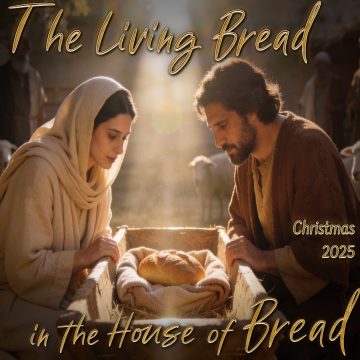
Jesus Himself being the true bread from Heaven, was born in “the house of Bread” the meaning of the town name Beth lehem.
Like the showbread, or the Bread of the Presence or the Bread of face – He was pierced being both God and man – being both Priest and of the house of Judah (the Tribe facing the rising sun whose symbol was a Lion of Gold on a field of blue.
We are told in John 6 that Jesus taught that the manna given to Israel in the wilderness, though real and tangible food, was more importantly a type and shadow of His very person and body.
Let’s read it…
John 6:25-71,
“(25) When they found Him on the other side of the sea, they said to Him,
“Rabbi, when did You come here?”
(26) Jesus answered them,
“Truly, truly, I say to you, you are seeking Me, not because you saw signs, but because you ate your fill of the loaves.”
So… what was their motive in coming to Him?
Remember I taught you that in faith, motive is everything and it speaks to your expectations. Faith is the foundation of your hope or expectation. If therefore, your expectation is inconsistent with God – His person, character and purpose – your faith is false as well!
Jesus lovingly pointed this out to this crowd, not to condemn them, but to encourage a faith that is real!
So He said…
“(27) Do not work for the food that perishes, but for the food that endures to eternal life, which the Son of Man will give to you. For on Him God the Father has set His seal.”
(28) Then they said to Him,
“What must we do, to be doing the works of God?”
(29) Jesus answered them,
“This is the work of God, THAT YOU BELIEVE in Him Whom He has sent.”
(30) So they said to Him,
“Then what sign do You do, that we may see and believe You? What work do You perform? (31) Our fathers ate the manna in the wilderness; as it is written, ‘He gave them bread from heaven to eat.’”
(32) Jesus then said to them,
“Truly, truly, I say to you, it was not Moses who gave you the bread from heaven, but My Father gives you THE TRUE BREAD FROM HEAVEN. (33) For the bread of God is He Who comes down from heaven and gives life to the world.”
(34) They said to Him,
“Sir, give us this bread always.”
(35) Jesus said to them,
“I am the bread of life; whoever comes to Me shall not hunger, and whoever believes in Me shall never thirst.
(36) But I said to you that you have seen Me and yet do not believe.
(37) All that the Father gives Me will COME TO ME, and whoever comes to me I will never cast out.”
All who believe in HIM will do what? Come to Him!
Again, in our list of faith fundamentals, Faith ALWAYS bears the fruit of correlating actions!
“(38) For I have come down from heaven, not to do My Own will but the will of Him Who sent Me. (39) And this is the will of Him Who sent Me, that I should lose nothing of all that He has given Me, but raise it up on the last day. (40) For this is the will of My Father, that everyone who looks on the Son and believes in Him should have eternal life, and I will raise him up on the last day.”
(41) So the Jews grumbled about Him, because He said,
“I am the bread that came down from heaven.”
(42) They said,
“Is not this Jesus, the son of Joseph, Whose father and mother we know? How does He now say, ‘I have come down from heaven’?”
(43) Jesus answered them,
“Do not grumble among yourselves. (44) No one can come to Me unless the Father Who sent Me draws him. And I will raise him up on the last day.
(45) It is written in the Prophets,
‘And they will all be taught by God.’
Everyone who has heard and learned from the Father comes to Me— (46) not that anyone has seen the Father except He Who is from God; He has seen the Father.
(47) Truly, truly, I say to you, whoever believes has eternal life.
(48) I am the bread of life. (49) Your fathers ate the manna in the wilderness, and they died.
(50) This is the bread that comes down from heaven, so that one may eat of it and not die.
(51) I am the living bread that came down from heaven. If anyone eats of this bread, he will live forever. And the bread that I will give for the life of the world IS MY FLESH.”
(52) The Jews then disputed among themselves, saying,
“How can this man give us his flesh to eat?”
(53) So Jesus said to them,
“Truly, truly, I say to you, unless you eat the flesh of the Son of Man and drink His blood, you have no life in you. (54) Whoever feeds on My flesh and drinks My blood has eternal life, and I will raise him up on the last day.
(55) For My flesh is true food, and My blood is true drink.
(56) Whoever feeds on My flesh and drinks My blood abides in Me, and I in him.
(57) As the living Father sent Me, and I live because of the Father, so whoever feeds on Me, he also will live because of Me.
(58) This is the bread that came down from heaven, not like the bread the fathers ate, and died. Whoever feeds on this bread will live forever.”
(59) Jesus said these things in the synagogue, as He taught at Capernaum.
(60) When many of His disciples heard it, they said,
“This is a hard saying; who can listen to it?”
(61) But Jesus, knowing in Himself that His disciples were grumbling about this, said to them,
“Do you take offense at this?
(62) Then what if you were to see the Son of Man ascending to where He was before?
(63) It is the Spirit Who gives life; the flesh is no help at all. The words that I have spoken to you are spirit and life. (64) But there are some of you who do not believe.”
(For Jesus knew from the beginning who those were who did not believe, and who it was who would betray Him.)
(65) And He said,
“This is why I told you that no one can come to Me unless it is granted him by the Father.”
(66) After this many of His disciples turned back and no longer walked with Him.
(67) So Jesus said to the twelve,
“Do you want to go away as well?”
(68) Simon Peter answered Him,
“Lord, to whom shall we go? You have the words of eternal life, (69) and we have believed, and have come to know, that You are the Holy One of God.”
(70) Jesus answered them,
“Did I not choose you, the twelve? And yet one of you is a devil.”
(71) He spoke of Judas the son of Simon Iscariot, for he, one of the twelve, was going to betray Him.”
So as we have the bread and the grape juice passed around I want you to consider how faith was so vividly depicted today in the teaching of Jesus. In fact, other than His body being the bread from heaven, faith was the most central part of His teaching. That coming in trusting surrender to Him – entering into His sacrifice with Him – as Paul said, “I see it this way, that if One died for all, then all died.” That having entered into and partaken of His death and burial we are to rise in New Life with Him.
THAT is the message of the bread in the manger!
Let us read my favorite Christmas passage before we enter once more symbolically into our union with Him in His death and resurrection.
Knowing as we do that Jesus Himself defined life as “intimate union and knowing of God the Father and the Son” let’s read…
John 1:1-18,
“(1) In the beginning was the Word, and the Word was with God, and the Word was God. (2) He was in the beginning with God.
(3) All things were made through Him, and without Him was not any thing made that was made.
(4) In Him was life, and the life was the light of men. (5) The light shines in the darkness, and the darkness has not overcome it.
(6) There was a man sent from God, whose name was John. (7) He came as a witness, to bear witness about the light, that all might believe through him.
(8) He was not the light, but came to bear witness about the light.
(9) The true light, which gives light to everyone, was coming into the world.
(10) He was in the world, and the world was made through Him, yet the world did not know Him. (11) He came to His Own, and His Own people did not receive Him. (12) But to all who did receive Him, who believed in His name, He gave the right to become children of God, (13) who were born, not of blood nor of the will of the flesh nor of the will of man, but of God.
(14) And the Word became flesh and dwelt among us, and we have seen His glory, glory as of the only Son from the Father, full of grace and truth.
(15) (John bore witness about Him, and cried out,
“This was He of Whom I said, ‘He Who comes after me ranks before me, because He was before me.’”)
(16) For from His fullness we have all received, grace upon grace.
(17) For the law was given through Moses; grace and truth came through Jesus Christ.
(18) No one has ever seen God; the only God, who is at the Father’s side, He has made Him known.”
1 Corinthians 11:23-34,
“(23) For I received from the Lord what I also delivered to you, that the Lord Jesus on the night when He was betrayed took bread, (24) and when He had given thanks, He broke it, and said,
“This is My body, which is for you. Do this in remembrance of Me.”
(25) In the same way also He took the cup, after supper, saying,
“This cup is the new covenant in My blood. Do this, as often as you drink it, in remembrance of Me.”
(26) For as often as you eat this bread and drink the cup, you proclaim the Lord’s death until He comes.
(27) Whoever, therefore, eats the bread or drinks the cup of the Lord in an unworthy manner will be guilty concerning the body and blood of the Lord.
(28) Let a person examine himself, then, and so eat of the bread and drink of the cup. (29) For anyone who eats and drinks without discerning the body eats and drinks judgment on himself.
(30) THAT IS WHY many of you are weak and ill, and some have died.
(31) But if we judged ourselves truly, we would not be judged. (32) But when we are judged by the Lord, WE ARE DISCIPLINED so that we may not be condemned along with the world.
(33) So then, my brothers, when you come together to eat, wait for one another— (34) if anyone is hungry, let him eat at home—so that when you come together it will not be for judgment.”
Blessings!
Tri