|
This is a text reader for the article below:
Getting your Trinity Audio player ready...
|
Wednesday 1/28/26
Thru the Bible: Proverbs 28
Message Video Player
Message Audio Player:
Podcast: Download (Duration: 1:06:49 — 107.0MB)
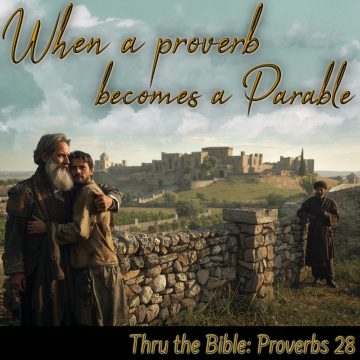
When a Proverb becomes a Parable
It isn’t the first time this has happened, but this chapter offers a lot of side-by-sides of the poor and the rich and I need not tell you which one always comes out on top! No wonder Jesus and the New Testament writers spoke with such favor over the poor but offered such grave warnings regarding the rich.
Proverb 28:1-28
“(1) A wicked person fled, though no one was pursuing, but the righteous person can be as confident as a lion.”
When the only security you have is yourself, paranoia is almost inevitable. If in addition you are self-serving you will see threats where none exist.
The proverb presents this portion as a past event which has happened and is prototypical of what can be expected. It contrasts what a wicked person feels compelled to do with what a righteous person can choose to do.
The righteous, who seek to find favor with God and man, have a clear conscience and do not need to look over their shoulders for avengers or law enforcers. Their position is one of confidence, so that they do not flee.
“(2) When a country is rebellious it has many princes, but by someone who is discerning and knowledgeable order is maintained.”
The Septuagint reads differently and that may be due to having a different underlying Hebrew text from which to work, It has,
“It is the fault of a violent man that quarrels start, but they are settled by a man of discernment.”
This last line is difficult. The Masoetic Text having (ken yaʾarikh) which is the verb form meaning “to prolong,” but כֵּן (ken) is open to several possibilities.
- H. Greenstone’s interpretation of it as a noun from the Hollow root כּוּן (kun) instead of כֵּן (ken) carries the meaning of “established order”.
In either case the idea seems to be that when a man of discernment is in governing authority order is both established and maintained!
“(3) A poor person who oppresses the weak is like a driving rain without food.”
The meaning of this verse is a little challenging due to two things:
- If this IS a reference to an actual poor person, it would be the singular mention of the poor possessing enough power to oppress anyone, so it seems inconsistent with the rest of the Proverbs.
- The Septuagint translates this as “A courageous man oppresses the poor with impieties.”
Now that is an interesting translation to be sure. Rather than attempting to choose between these two options, lets consider both.
If the Septuagint is correct, and we have some good reasons to accept that it is, then we’ll have to adopt a different meaning for the word “courageous” than we are typically familiar with but which is still true to the meaning of the word.
While typically considered a positive virtue, “courageousness” can carry negative connotations depending on whether the action is reckless, unwise, or serves a harmful purpose.
I play a game online with a relative of mine and every time he is about to do something stupid which will likely get him and even myself killed, he say, “I’m going to do something brave” which is to say “courageous”, to which I reply, “you mean something stupid and wreckless”. So that is a possible meaning here.
In this case a person who would antagonize, influence and even generate a type of peer pressure to take God lightly, would be one who oppresses the poor recklessly, unwisely, with deviant intent and with harmful results.
If the standard reading is to be accepted then it simply reveals how truly dark of a world it is in which we live, where even among those who should console one another, being cut from the same social, political or economic cloth – are still capable of oppressing each other.
Regardless of which of these two you land on, they are compared with “driving rain without food”.
Notwithstanding the lighthearted children’s story by Ron and Judi Barrett, “CLOUDY WITH A CHANCE OF MEATBALLS” – rain is not typically a carrier of food. So it is that another, perhaps less obvious explanation must be sought.
It has been suggested that food is being used as a poetic metonymy of “effect” here which somehow seems forced to me due to the need for too many assumptions. Nevertheless, the idea is that at the right time of year and with the correct crops, a driving rain causes crops to grow – so as to (effect) produce harvests used for food.
Some English versions assume this idea, but further read into the illustration that the crops are destroyed instead.
In the end, the point of this proverb, if taken this way, is that a show of strength may produce nothing but ruin.
“(4) Those who forsake the law praise the wicked, but those who keep the law contend with them. (5) Evil people do not understand justice, but those who seek the LORD understand it all.”
The proverb gives the outcome and the evidence of those who forsake the law – they “praise the wicked.”
This may mean:
(1) calling the wicked good or
(2) justifying what the wicked do
For anyone who was at one time close to the law and comes to such a hardened condition of heart, is no longer sensitive to evil. Their discernment has left them.
“(6) A poor person who walks in his integrity is better than one who is perverse in his ways even though he is rich.”
This proverb is simple enough on the surface and it also offers a bit of an indirect challenge to my observations regarding the poor from the last verse.
If the poor are never cast in an evil light, then the rich should never be considered in a good light.
Yet, here, the verse ends with a clause which implies that good is to be found there – perhaps even expected. Otherwise this really doesn’t serve as a proverb but a clumsy illustration of what is obvious.
The word “ways” is dual, implying duplicity or hypocrisy.
Regardless of the monetary status of an individual, integrity is to be preferred above perversion. So mentioning the poor with integrity and the rich with perversity serves no purpose – especially when the words “even though” are added.
However, in the Hebrew the words “though he is rich” is actually presented as “AND he is rich”.
So Solomon is therefore not setting forth a proverb to no avail. Though it presents opposites this is not a comparative proverb, but rather a progressive one. It is saying “this” is objectively better than “that”!
A poor person who walks in his integrity is better than a person who is perverse in his ways and is rich.
Now verse 7 alone, make studying this chapter MORE than worth it!
“(7) The one who keeps the law is a discerning child, but a companion of gluttons brings shame to his parents.”
This is another obvious statement but contains a twist.
The word “glutton” is simply one word choice out of several possibilities which include vile, frivolous and worthless. Nevertheless, even if “gluttony” is the attribute of choice here, it only serves as a placeholder example of every manner of vile behavior.
Now this is the interesting bit…
Let’s consider the whole of this proverb,
- A child who keeps the law is discerning
- But a child who keeps company with the gluttonous or vile brings shame.
For me this conjures images of a very famous parable!
Interestingly, the word “gluttonous” in the Strong’s includes the possible definition of a prodigal.
Oh God this is too beautiful!
It seems not too much of a leap to assume it was this very proverb which served as the source material for Jesus’ impassioned parable of the prodigal son (which I call typically call the Parable of the Misunderstood Father.)
It also serves to deepen the reasons for the rebuffing reaction of the Jewish crowd to Jesus’ parable.
If you recall, the parable had two sons.
You have the one older son, who was presumably wiser and who stood to inherit the greatest portion of the inheritance. This one stayed home and obeyed. He would be the one who in this proverb “keeps the law out of a discerning heart”. Jesus however, presents this one obeying out of grudging obligation.
The second, younger son, who was presumably less favored and less wise, left home and family with his allotment of the inheritance. He wasted it on “gluttonous” or prodigal living dragging himself and his father’s name through the mud thus bringing “shame” as is the word used in our Proverb. Jesus goes so far as to make this “proverbial mud” – PIG mud of all things!
No doubt this proverb was traditionally taught to Jewish children from the perspective Solomon clearly sets forth in this proverb. Which reveals a truth all its own – that the good, law keeping son is discerning while any child who rejects God’s law brings shame.
Nothing about this proverb, nor Jesus’ use of its constituents to teach an altogether different truth are in conflict. Both are true! Sin DOES bring shame and forgiveness brings a crown of honor.
But if I am correct that this served as the source material for Jesus’ parable, then Jesus took a sledge hammer to the pompous, religiously held interpretation of this proverb and revealed a God Who SO loves the world.
For the Jews of Jesus’ day, to keep the Law was often not so much a matter of “discernment”, but rather pride both religious and national in nature.
Jesus presents a Jewish father not only receiving this prodigal back home, but embracing him and smothering him with kisses notwithstanding the shame of his being covered in dried pig mud!
But Jesus does not forget the “law abiding” son in His parable either.
Consistent with the rejection these notions would bring among the crowd He spoke to that day, Jesus has the outwardly compliant and obedient son, complaining at the acceptance of this Ninevite son come home (if you will forgive the embellishment).
This father turns to this son who, like Paul, could not see the beauty of the Law, due to the demands it made upon his behavior. All this “obedient” son had was pride that he had been the “good son”, but this means nothing when the “bad son” appears so rewarded!
So it embittered him just as the repentance of Nineveh embittered Jonah.
The father wanting to bring home this son who also had left home in his heart long ago – said to him nearly the same thing God told Jonah “should I not”?
He then tells this son that the rules were never really about rules to begin with, they were about character – about assuming the nature, temperament and constitution of his father before he received his inheritance.
Furthermore, all his labors were not building an estate for his father alone, they were also investment in his own inheritance.
Jesus has this father telling this son who was drowning in self imposed legalism, “son all I have is yours and it always has been.” Revealing God’s heart WAY back on the Mount of Sinai who wanted to know and be known, but was met with the fear and withdrawal of his children.
So this proverb stands on its own in saying, “The one who keeps the law is a discerning child, but a companion of gluttons brings shame to his parents.” But in traditional parakletos fashion Jesus reveals in His parable that you cannot always judge a book by its cover. Just because someone is keeping the Law, their heart might be more miles away from their father than the son who left home long ago.
“(8) The one who increases his wealth by increasing interest gathers it for someone who is gracious to the needy. (9) The one who turns away his ear from hearing the law, even his prayer is an abomination.”
I believe these two verses are to be taken together, though they can easily stand alone.
This is a beautiful and timeless encouragement and serves as a stern warning to our current and wayward generations of Christians who reject their inspired and sovereign roots in Judaism and the Law. Not being familiar enough with either the Law they reject nor the New Testament which quotes from it SO extensively as the basis for ALL New Covenant theology and practice to know what they are rejecting. They don’t even know that if you removed all Old Testament theology set forth as New Covenant truth in the body of the New Testament, you’d be left with a New Testament very much smaller than it currently is!
There are 260 chapters in the New Testament composed of 7,957 verses. In those chapters and verses there are estimated to be as much as 4,000 references whether direct quotes, indirect references or allusions to the foundational truths and teachings of the Old Testament which are either 100% unchanged under the New Covenant, only altered to the degree that one does not seek to obtain righteousness, justification or the Spirit by them.
In addition to this are hundreds of allusions which are set forth as examples to govern New Testament behavior.
Truth is, even more would have to be eliminated from the writings of the New Testament than the Old Testament references themselves. There are entire chapters whose sole existence was recorded just to lead up to the some of these references making them part of the equation as well. These are facts which I would be greatly amazed if even a small portion of church going believers believed or knew.
We are told in this Proverb that one who increases his wealth through tyranny (by which it can mean overcharging, charging interest or both) only does so for the use of one whose heart is gracious to those in need. This was a breaking of the Law. The Jew was taught that if you had the means, you were to give aid to the poor without charge or interest as is found in Exodus 22:25; Leviticus 25:36-37; Deuteronomy 23:20 & Psalm 15:5.
Isn’t that a terrible and legalistic thing for God to demand of His people in the Old Testament? Love your neighbor! What could He have been thinking?
Of course I am being sarcastic. God’s point was to encourage generous kindness, because our heavenly Father is also kind, causing the sun and rain to fall on the just and the unjust alike.
IMO this proverbial statement in verse 8 is in verse 9 being pitted against the one who hears the law, but does not love it – this person’s prayers are not only not heard – they are an abomination to God!
Now, if this was ever true, it still is true because it references the reaction of a God Who does not change! The New Covenant changed us, not God.
I’ll just leave that right there!
“(10) The one who leads the upright astray in an evil way will himself fall into his own pit, but the blameless will inherit what is good.”
“(11) A rich person is wise in his own opinion, but a discerning poor person can evaluate him properly.”
“(12) When the righteous rejoice, great is the glory, but when the wicked rise to power, people are sought out.”
This has a few possible meanings but they are only variations of a common theme.
The development of the first line has “rejoice” as connected with the word “triumph” which could imply that the righteous are now in a position of governmental authority.
The second line, in like fashion has the words “are sought out” implying that the righteous are now hard to find. This may mean they have been and are being sought for destruction or that these righteous have gone into hiding – presumably from affliction from the evil who are in power.
- H. Toy offers this translation
“When the righteous are exalted there is great confidence, but when the wicked come into power men hide themselves.”
Since both are so close in meaning I am quite fine with either view.
“(13) The one who covers his transgressions will not prosper, but whoever confesses them and forsakes them will find mercy.”
Again another timeless truth from the Law, that holds true today. To confess a sin you still cling to, is nothing more than ceremony. But the relationally broken in heart over their treason will cry out to God, “My soul clings to dust, revive me by your word” and “How can a young man cleanse his way, by truly listening to and applying their heart to your words.”
In this last verse taken from Psalm 119:9 and expounded upon, the Hebrew word lishmor is a critical term meaning to keep, guard, watch, or observe.
“Listening” and “Applying”:
In the context of Scripture, “taking heed” or “guarding” do not represent passive listening; they are an active, ongoing effort to pay close attention to, treasure and value above other things and test the heart by the words of God’s mouth.
“According to Your Word” (כִּדְבָרֶֽךָ)
This confirms that this “standard for purity” is not legalistic in nature but is tethered to the relatable and knowable entity of God is clear by the word Dabar— which means the spoken or written Words of God. These are not simply arbitrary words, they come from God’s heart!
Following this thought of David into verses 10 & 11 we see a seeking to “applying the heart” to the words God speaks out of devotional love to him and out of their preciousness to the one hearing them.
I have to tell you, for a person like Paul who knew the law as well as he did, it is astounding that he did not see this before he came to Christ. It is the very language of the Law!
The idea of “applying the heart” is not explicitly in verse 9, but it is the immediate context of the passage when taken together with verses 10-11!
Verse 10: “With my whole heart I have sought You…“
Verse 11: “Your word I have hidden in my heart, so that I might not sin against You.”
These words denote passion, not disconnection.
Relationship, not servile and fearful obedience.
It reveals a heart that treasures God’s heart and by extension the words that come out of that eternal heart.
David stores them up in his own heart due to their intrinsic value, knowing that in the light of them sin will appear not only far less winsome but downright offensive and treasonous!
If only New Covenant Christians had this type of clarity!
“(14) Blessed is the one who is always cautious, but whoever hardens his heart will fall into evil.”
Just a side note, but if there is no freewill, such a statement is not only misleading it is pointless. I cannot serve as a warning to anyone, since if they have no freewill, they cannot harden their own heart, making the warning of no account.
“(15) Like a roaring lion or a roving bear, so is a wicked ruler over a poor people. (16) The prince who is a great oppressor lacks wisdom, but the one who hates unjust gain will prolong his days.”
We now have another which is less obvious in meaning…
“(17) The one who is tormented by the murder of another will flee to the pit; let no one support him.”
While on the surface this might appear to be a passage about empathy, it is actually one of guilt. This is Judas’ verse whose consciousness of betraying innocent blood made him aware of his own eternal condemnation and so he fled to a field to kill himself.
While the “pit” here may not mean something so extreme, it is not eliminated as a possibility either.
This could mean that now that he has committed murder, under Jewish law there was no place for him to go outside other than the grave at his own death.
OR
This could mean that the murderer will be a fugitive until he goes to the grave, which is not much better. Such is the view of the NASB, NIV, NCV, NRSV, CEV.
“(18) The one who walks blamelessly will be delivered, but whoever is perverse in his ways will fall at once.”
This says a lot with few words. The fact that the blameless will be delivered, implies that even though they are without blame – someone WILL try to assign some to them! This promise is that in the end they will be exonerated, whereas those who are perverse will have no defense at all.
“(19) The one who works his land will be satisfied with food, but whoever chases daydreams will have his fill of poverty. (20) A faithful person will have an abundance of blessings, but the one who hastens to gain riches will not go unpunished.”
“(21) To show partiality is terrible, for a person will transgress over the smallest piece of bread.”
“(22) The stingy person hastens after riches and does not know that poverty will overtake him.”
Now this may be poverty which is either real or perceived, but in the end it hardly matters, both are miserable. The one who hastens after riches may never catch them, they will likely fly away not long after their acquisition OR what he gains will never be enough… the bar of satisfaction and desire will always move out JUST as far away as he advances so that in the end no true ground is gained.
“(23) The one who reproves another will in the end find more favor than the one who flatters with the tongue.”
“(24) The one who robs his father and mother and says, “There is no transgression,” is a companion to the one who destroys.”
This reminds me of those who believe that Christians need not confess their sins for forgiveness since all sin was paid for and all sins are now of a familial nature. Such a person lacks even the most basic understanding of true relationships. The fact of their relation, only makes the treason more personal. It does not remove sonship, but it does shut down fellowship and to claim otherwise is to deny a good number of both Old and New Testament warnings.
The next 3 verses are variations on a theme…
“(25) The greedy person stirs up dissension, but the one who trusts in the LORD will prosper.
(26) The one who trusts in his own heart is a fool, but the one who walks in wisdom will escape.
(27) The one who gives to the poor will not lack, but whoever shuts his eyes to them will receive many curses.”
This final verse is a type of shout back to our previous verse 12, only with the addition of the wicked ruler being supplanted with the righteous…
“(28) When the wicked gain control, people hide themselves, but when they perish, the righteous increase.”
Blessings!
Tri
Blessings!