|
This is a text reader for the article below:
Getting your Trinity Audio player ready...
|
Wednesday 2/18/26
Thru the Bible: Proverbs 31
Message Video Player
Message Audio Player:
Podcast: Download (Duration: 57:30 — 104.9MB)
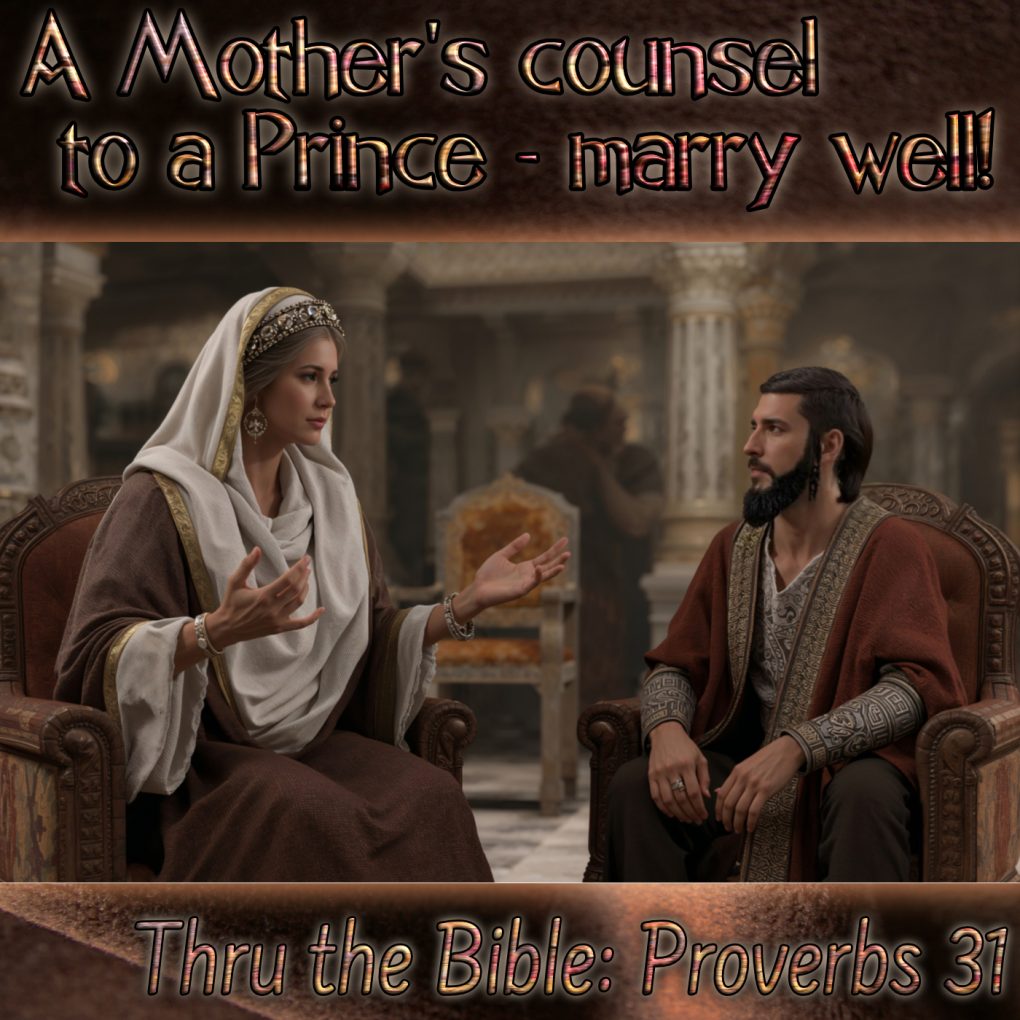
Marry well – a mother’s advice to a king!
Proverbs 31:,
This is the final chapter of the book of Proverbs as well as its fourth and final division.
As I have told you from our initial overview of this book of wisdom, Chapter 31 was written by King Lemuel whose name is unknown to us, but means “for God”.
Some believe this to be a king of Massah, a region possibly located in Northwest Arabia.
Many however, believe Lemuel to be a lovingly familial name for Solomon, perhaps given by Bathsheba his mother. This is agreed to by early Jewish tradition as well and is the assumption we will make of all that follows.
The thematic focus on royal wisdom, the value of a virtuous wife, and the poetic structure align with the themes found throughout the book of Proverbs, which is largely credited to Solomon.
This chapter is divided into two parts with greater emphasis given to the most important topic:
- Advice for kings and rulers to follow
- A description of a godly, virtuous woman who fears God and honors her husband.
These, too, seem to speak to Solomon’s authorship since he was a king who received godly advice regarding ruling. Additionally, he unwisely allowed his heart to be carried off by pagan women and so he knew something about the value and need of a godly wife.
This final chapter begins by attributing the, “The words of King Lemuel” to his mother as an oracle she had taught him. Given Solomon’s clear respect for his mother which is seen in other proverbs, this seems to be an additional proof of his authorship.
Proverbs 31:1-31,
“(1) The words of King Lemuel, the utterance which his mother taught him:
(2) What, my son? And what, son of my womb? And what, son of my vows?
Strictly speaking the NKJV has it right here, in interpreting these three statements as interrogatives, but the intended purpose hits us differently in English so that interpreting them as exclamations would more accurately convey the meaning, though it be less literal of a translation.
Others have, “O, my son. O, my own son (or son of my womb). O son of my vows.”
The three phrases used together in the introduction reveals a certain seriousness to the warnings that follow. The 2nd and 3rd are exclamations of endearment, revealing something about the heart of the mother in saying these things. It reveals how great of an investment she has made into his education and encouragements towards reverence for God as well as impressing upon him his place and obligation to God – to be about God’s business as both a covenant Israelite and a king.
“(3) Do not give your strength to women, Nor your ways to that which destroys kings.”
This is no peripheral issue – especially to Solomon in his life and speaks to the function, purpose and calling of women in the lives of men.
Men were not made for women, women were made as companions and helpmates for men.
Contrary to popular belief, studies indicate that men often feel a stronger, more urgent need for marriage than women, with recent data showing 74% of 12th-grade boys wanting to marry compared to 61% of girls. Most of this is believed to be linked to women’s modern desire for independence and to live a self focused life which is far less accommodated by marriage.
Men are also more likely to report wanting to marry sooner, and studies suggest they rely more on partners for emotional support.
It is no wonder therefore, that many modern women in 1st world countries do not sense an urge for marriage. Also, unlike men, women who have lost a husband often do not seek remarriage unless they were very young when they were widowed.
Studies show that within the first six months, 30% of men are ready to remarry, compared to only 16% of women. Further down the road, at 25 months after losing a spouse, 61% of men have already remarried, compared to just 19% of women.
This is not a weakness in men any more than it is a strength in women – it simply speaks to their purpose in creation.
Men often struggle more with the loss of daily companionship and are more likely to seek a new partner to manage their life, whereas women often adapt better to living alone.
Part of this is because women tend to live longer than men, therefore making the supply of available, age-appropriate men less available to widows, a phenomenon sometimes called a “marriage squeeze“.
In addition to this, widows frequently report a sense of freedom, or “liberation,” from their labors as a helpmate, making them more hesitant to give up their independence to become a helpmate for another person again.
Finally, women generally have stronger, more diverse, and more supportive social networks among other women, which reduces the immediate sense of need for a new partner to fill a loneliness void.
There are additional factors which affect these numbers including being over 65 when one loses a spouse, but I only supply these to further press the point Solomon’s mother was making.
A man’s drive to marry is also driven by sexual need which above nearly any other thing in creation can lead to some of the worst and long lasting decisions anyone could make. To make matters worse, if one is a king, the impact of their poor decisions are shared with their kingdom.
Knowing the outcome of Solomon’s life, Bathsheba’s advice here (assuming these were the persons in this chapter) was both intuitive and insightful!
The rest of this chapter is dedicated to her sage advice to her son as a king and as a man who will marry. The lion’s share being given to the proper qualities for a woman that her son should look for, which tells you how important a role women play in the overall story God is telling! A total of 5 verses are given to kingly issues, while 21 are focused on the attributes of a woman worth marrying!
“(4) It is not for kings, O Lemuel, It is not for kings to drink wine, nor for princes intoxicating drink; (5) Lest they drink and forget the Law, and pervert the justice of all the afflicted.”
“(6) Give strong drink to him who is perishing, and wine to those who are bitter of heart. (7) Let him drink and forget his poverty, and remember his misery no more.”
“(8) Open your mouth for the speechless, in the cause of all who are appointed to die.
(9) Open your mouth, judge righteously, and plead the cause of the poor and needy.”
I can’t help but think of Solomon’s answer to God’s offer to give him what he desired.
The account is found in 1 Kings 3:1-15. Let’s read verses 5-14 as I believe it directly touches on Bathsheba’s advice to Solomon in his youth.
“(5) One night in Gibeon the LORD appeared to Solomon in a dream. God said,
“Tell me what I should give you.”
(6) Solomon replied,
“You demonstrated great loyalty to Your servant, my father David, as he served You faithfully, properly, and sincerely. You have maintained this great loyalty to this day by allowing his son to sit on his throne.
(7) Now, O LORD my God, You have made Your servant king in my father David’s place, even though I am only a young man and am inexperienced.
(8) Your servant stands among Your chosen people; they are a great nation that is too numerous to count or number. (9) So give Your servant a discerning mind so he can make judicial decisions for Your people and distinguish right from wrong. Otherwise no one is able to make judicial decisions for this great nation of Yours.”
(10) The Lord was pleased that Solomon made this request. (11) God said to him, “Because you asked for the ability to make wise judicial decisions, and not for long life, or riches, or vengeance on your enemies, (12) I grant your request, and give you a wise and discerning mind superior to that of anyone who has preceded or will succeed you.
(13) Furthermore, I am giving you what you did not request – riches and honor so that you will be the greatest king of your generation.
(14) If you follow My instructions by obeying My rules and regulations, just as your father David did, then I will grant you long life.”
What is often missed through translation is what Solomon actually asked for. The words in Hebrew are “Alev Shomea”. ‘Lev’ means heart and ‘shomea’ means to listen. So Solomon asked God for a listening heart! So God gives Solomon a wise and discerning heart which in itself is insightful, for here we have God telling Solomon, and by extension us all, that a wise and discerning heart is one which listens!
No wonder much is made of listening as opposed to speaking in Proverbs, No wonder James instructs us to be “quick to hear and slow to speak and slow to anger” – because these do not produce righteousness!
But I want you to see where the initial wisdom to view himself in humility (young and inexperienced) and to recognize the need for a heart that listens came from – the advice of his mother! This does not discount the fact that David certainly emulated this before Solomon and no doubt taught it to him as well, but we know from this chapter in Proverbs he took it to heart from the instruction of his mother.
Again the words of Solomon were, “Give Your servant a listening heart so he can make judicial decisions for Your people and distinguish right from wrong. Otherwise no one is able to make judicial decisions for this great nation of Yours.”
Now I typically look this sort of thing up anyway and did so to confirm the meaning, but I owe this insight to a man named Tim Kay who offers Greek & Hebrew Bible Insights on facebook and is the Senior Pastor at Thornleigh Community Baptist Church in Australia. I ran across him for the first time a month or so and his post on Solomon was about the second of his I ever came across. I immediately saw its connection with this chapter which I knew we would be covering soon so I saved it and referred back to it here.
Now we begin the main division of this chapter and it serves as a dive into the deep end of the pool.
Bathsheba begins her introduction to the attributes of a godly woman who fears God and does her husband good by asking a rhetorical question designed to emphasize that such a woman is rare, precious, and of immense value. This does not make such a woman impossible to find, but it does show that any man who finds one, is blessed beyond reason!
“(10) Who can find a virtuous wife? For her worth is far above rubies.”
Few words ever spoken were as true as these. Not only regarding how rare a find this is, but also the attribution to such a woman’s value!
Her devotion to her husband is addressed first as being preeminent among her qualities.
“(11) The heart of her husband safely trusts her; so he will have no lack of gain.
(12) She does him good and not evil all the days of her life.”
“(13) She seeks wool and flax, and WILLINGLY works with her hands.
(14) She is like the merchant ships, She brings her food from afar.
(15) She also rises while it is yet night, and provides food for her household, and a portion for her maidservants.
(16) She considers a field and buys it; From her profits she plants a vineyard.
(17) She girds herself with strength, and strengthens her arms.
(18) She perceives that her merchandise is good, and her lamp does not go out by night.
(19) She stretches out her hands to the distaff, and her hand holds the spindle.
(20) She extends her hand to the poor, yes, she reaches out her hands to the needy.
(21) She is not afraid of snow for her household, for all her household is clothed with scarlet.
(22) She makes tapestry for herself; Her clothing is fine linen and purple.
(23) Her husband is known in the gates, when he sits among the elders of the land.
(24) She makes linen garments and sells them, and supplies sashes for the merchants.
(25) Strength and honor are her clothing; She shall rejoice in time to come.
(26) She opens her mouth with wisdom, and on her tongue is the law of kindness.”
I will take this opportunity to brag about my wife. When we first were married, I was pretty full of myself. I thought I had it all figured out and Teri looked to me as if I was as wise as a sage. Through frustrations and difficulties over time I came to realize how my neat and tidy little boxes I had life broken down into, didn’t really represent reality. This created disillusionment and frustrated anger in me. In the middle of all of this was this embodiment of calm I married. She always had a word of wisdom offered calmly and in kindness which I was rarely wise enough to see the wisdom in – at least in our first several years. Later I began to see her calm and admire it. I told some who looked to me as wise and worthy of following that it was Teri who I looked to as the kind of person I wanted to be when I grew up. This was received as humility and with a chuckle but I meant it more and more as the years waxed on.
Though God used all of you and others to bring me to where I currently am as a work in progress, and none are without significance, it is Teri that I know God used as the calm in my storm. My soul was SO vexed in so many ways. Looking back I am astounded, honestly and without irony, that I did not have severe bleeding ulcers. But modeled in front of me as a standard that looked far more like Jesus than what I was seeing in the mirror was Teri.
Now of course she had her faults like anyone, but it was the beauty of her inner peace in the midst of all the turmoil she married into that served in very real ways like a lighthouse leading to safe harbor.
If she never made any additional contribution to my life, that one was significant enough to make her this virtuous woman to me in every tangible way that truly matters – and I could not be more honest and sincere in what I am saying.
“(27) She watches over the ways of her household, and does not eat the bread of idleness.
(28) Her children rise up and call her blessed; Her husband also, and he praises her:
(29) “Many daughters have done well, but you excel them all.”
(30) Charm is deceitful and beauty is passing, but a woman who fears the LORD, she shall be praised.”
It is hard to ignore that Bathsheba did not list beauty as a primary attribute – especially in today’s world of obnoxious vanity and this phrase explains why. Charm and beauty are deceitful and passing. The work passing actually carries the primary meaning of vain, but includes the additional idea of being brief and temporary! People believe that such is not as true now as it used to be, but I believe it is just as true as it ever was. Additionally I believe that all our attempts at retaining cosmetic youth, have only served to make women appear more superficial and desperate than ever. Women who are 40+ who attempt to look like they are in their twenties are a sad and repulsive sight, even those who don’t pursue it through surgical means. There is a dignity to women who age gracefully.
It is often said, by women, that men age well. That they just get more and more distinguished and refined, but I have seen the same among women. It is just such a sad thing that they often do not have eyes to see the beauty inherent with their age.
“(31) Give her of the fruit of her hands, and let her own works praise her in the gates.”
This closing statement has a dual meaning. It means her works will speak on her behalf and what they speak will praise her. But it also reaffirms the former verse regarding her husband’s praise of her and also offers an insight into a godly man and husband.
As we read earlier in verse 23 he is known in the gates, which was the place where the wise elders of Israel presided over justice. Here in this exalted place, when he speaks of his wife, it is not through complaints or regarding things he wished she did better. A thousand times NO! This man praised his wife, in her absence, among his companions and friends.
Let me say this to any man who listens to this! I grew up among men in my family who typically treated and spoke of their wives as emotional, irrational creatures who were led more by feelings than common sense. This always seemed treasonous to me and made me angry. I am not saying that they didn’t love them, but they gave into the social norm and did not allow their value of their wives to muscle past peer pressure to praise their wives openly. To me this was cowardice and caused me to lose much respect for them. Now in return, many of the women complained against their husbands in their circles as well, which I also did not like, but to me, the men were the ones setting the pace.
Might I suggest that if your wife does not match these attributes in every category, it does not negate your responsibility for acknowledging the ones she does possess. You will almost without exception find that over time, her diligence in aspiring to the entire list will increase in an environment of praise rather than criticism!
Jael
Now I am going to close out tonight with an example of how lost this generation is in terms of sound doctrine.
Over the course of the last 2 years I have personally witnessed posts on social media which have set forth Jael as a primary example of a Proverbs 31 woman.
Now I am not for a minute trying to defame Jael – that would be hard to do since we know virtually nothing about her. All I am wanting to point out is two things:
- What makes a woman a proverb 31 woman is her devotion to God, her husband, her family and to possessing Godly character.
- The other reason I’m mentioning this is to illustrate the lengths people will go to to create examples of what they want to believe or what they advocate. The integrity of scripture and its proper exegesis do not serve as an obstacle to that goal!
Now in case you do not remember this woman, she is mentioned in the passage about Deborah the prophetess and judge. Now we also know virtually nothing about Deborah, but we can at least assume certain things about her since she was called by God and the Spirit of God was upon her. But these things HAVE to be assumed for they are NOT clearly stated. However in these posts, Deborah was set forth as a warrior leading the armies of Israel and whom the men of Israel both followed and obeyed. This is NOT true!
Of course we know from having read through Judges 5 & 6 and spending SOME time with what the passages do and do not say, that Deborah did not lead anyone into battle, but only accompanied Barak. She did this because the Law forbade women from going to war, which is consequently why we know God did not commission Jael to do what she did.
Deborah did indeed judge Israel, but she was only one of many. She was NOT among the elders who sat at the city gates. She appears to have dealt with basic civil issues and regarding messages God gave her in prophecy – which is the one and only example we have in scripture. She did her judging outside of the city under a tree named in her honor and she was in fact honored by all of Israel.
But in these posts, it was Jael who was prominently featured! The reason for this seems to be because these posts were composed by egalitarians and so Jael is depicted as a godly warrior who along with Deborah delivered Israel from their enemies. The reason why Jael is featured in these posts even more prominently is because it was she that killed a man.
Now while part of this is true, however, virtually none of its implications are true.
To be fair, what she did accomplished the will of God, but GOD did not commission her to do it and He certainly did not advocate the way she accomplished it.
To be thorough I read everything the Bible has to say about Jael, her husband, their homeland including their affiliation with Israel.
Jael was a Kenite as was the man she killed whose name was Sisera.
You see Sisera was the commander of the Canaanite army under King Jabin of Hazor and King Jabin had a peace treaty with the Kenites. This woman, Jael, being a Kenite, was in a peace treaty with the man she killed. This is why Sisera supposed he would be safe in her company and he should have been if Jael had honored her country’s treaty with Jabin.
Now the Kenites did have some affiliation with Israel since their Exodus from Egypt and so some of them were worshippers of the God of Israel. However, we know nothing of Jael or her husband Heber’s devotion to God whatsoever. I’m not saying they didn’t have devotion to Him, what I am saying is that NOTHING in the text suggests it.
Literally all we know about this woman is that she was married to Heber, was a nomadic, tent dwelling Kenite and that she lied to and murdered a man.
- Was Sisera (the man she killed) a bad man? Yes.
- Was it a good thing that he died? In the end, Yes.
- Did she do this because God told her to or out of some obedience to or worship of God? This is highly unlikely but in the end there is absolutely no information regarding this at all. So one cannot be rightly dogmatic in claiming God did.
What we DO see is that it was God’s plan to deliver Sisera into the hands of Barak, which Deborah clearly stated in Judges 4:6&7. Due to Barak’s cowardice however, God told Barak through Deborah that He was selling Sisera into the hands of a woman.
The context makes it very clear this was NOT God’s will but His judgment against Barak who would not go into war without Deborah reminding him prophetically of his duty and without Deborah going with him.
The word “sell” as in “sell into the hands of a woman”, is a basic verb of exchange such as the selling of the right of the firstborn by Esau to his brother (Gen. 25:31). It has the nuanced sense of handing over, or surrendering something from the one to whom it rightfully belongs to someone else.
So God took the honor of this deliverance away from Barak, an Israelite man of war into the hand of a Kenite woman.
Now to claim that this made her actions godly or even inspired is to say that because God handed Israel over into the hands of Nebuchadnezzar due to their disobedience that it was God’s plan all the while and that Nebuchadnezzar’s actions were blessed by God. We know from biblical history that such was NOT the case. In fact, God punished Nebuchadnezzar for his actions during Israel’s exile in Babylon.
In our example, Sisera came to Heber’s tent and found Jael. She welcomed him in as one to whom she was loyal thus deceiving him into a sense of false security. Then upon falling asleep, she murdered him by driving a tent stake into his temple.
Later in a song the Hebrews told Deborah to sing, Jael is said to be worthy of reward for the death of Sisera, but nothing is said regarding her motives or character which is what Proverbs 31 is all about.
What makes the woman described in Proverbs 31 of noble character (the first words describing her in Proverbs 31:10) is that she reveres the God of Israel and is of outstanding moral character.
Nothing about disloyalty to one’s nation, lying and murder makes anyone of outstanding character! But there you have it, Jael is being trumpeted by people in churches today as a potent example of a Proverbs 31 woman!
That is the day in which we live. There is little scriptural study. Less still of scriptural knowledge and integrity, and less even of people who are diligent to search a matter out that they read, simply because it is what they want to hear.
So to close out this chapter and book of Proverbs, I will repeat what I said in our introduction to Proverbs. That it isn’t hard to identify many commonalities between the teachings of Proverbs and those of Jesus and the apostles in the New Testament. God’s word is timeless and His wisdom is pertinent for all ages, locations, people groups and cultures.
Blessings!
Blessings!