|
This is a text reader for the article below:
Getting your Trinity Audio player ready...
|
Wednesday 2/25/26
Thru the Bible: Song of Solomon
Message Video Player
Message Audio Player:
Podcast: Download (Duration: 1:09:00 — 126.4MB)
Intro to… Solomon’s Love Song
Most people who are at least passingly familiar with their Bible know that the book of Song of Solomon is some sort of love story between Solomon and some lady. That is about where most people’s familiarity drops off and as a guy, I can understand that!
Unless you are the type of person who enjoys reading about the passion and lovingly descriptive dialogue between two lovers, it kinda reads like a “hard pass” type of book. But there is much more to this little love novel than immediately meets the eye.
The Song of Solomon is characterized by intense, emotive dialogue between lovers and a type of theatrical chorus that follows them around. The composition has often been compared to ancient Egyptian love songs.
The Title
The title was not added, but is part of the oldest surviving copies, showing that the title was given by its author. Thus we have great certainty that Solomon was the author and he also identifies the writing style by the words “Song of”.
Based upon its construction, Solomon was either calling this a book of several songs OR he could have meant it as a superlative meaning that this was the Song to end all songs or the best or most excellent song.
As you traverse the book, I believe you will see that either interpretation is quite possible.
Before I go further into the construction and layout of the book, I will introduce you to its characters.
The Characters
The Song of Solomon is unique in all of scripture in that it features dialogue between the two main protagonists and 3 other distinct groups who serve much like a “chorus” in a theatrical play.
However, the spotlight never truly leaves the two main characters—King Solomon and the Shulamite maiden.
King Solomon
King Solomon is the assumed de facto man, groom and husband of the story. There are some good objections to this – primary among them is that Solomon never seemed like much of a “one woman” kind of guy, being married as he was to 700 wives, not to mention his concubines. As such, this may be more of a fictional story than a real life story. Nevertheless, the commonly held belief is that the Song of Solomon depicts King Solomon as the main protagonist – whether fictional or not.
So for sake of argument and since we have no solid secondary possibility, we are going to run with King Solomon as the man, shepherd, king, lover, groom & husband in the story. Nothing about this calls into question the contents or the authorship, only the characters depicted, and being a poem of wisdom, there is no rule that requires the story to be non-fictional. Remember even the parables of Jesus were true, though metaphorical and fictional.
Of course, we know who Solomon is – he is the first son from the union of King David & Bathsheba who lived.
You may recall that following King David’s betrayal of Uriah by committing adultery with his wife and then setting him on the front lines of the battle to die – he was paid a visit by Nathan the prophet. He told King David that because he had shown contempt for the Lord by his sins it resulted in Israel’s enemies to blaspheming God. As judgment for this the Lord decreed the death of the child born of his adultery union with Bathsheba.
So when Solomon was born from these two, he held very special significance.
It was he who took the throne and it is he who is the main character in this book.
In the narrative he is presented as a lowly shepherd, a king and as he is often referred to by the Shulamite maiden as “beloved”.
Each of these roles will become clear as we work through the book.
As to his name, every single instance of the word “beloved” in Song of Solomon, clearly refers to Solomon. Additionally, the term “my beloved” is used a total of forty-two times in all of scripture with over half of these spoken by the Shulamite regarding Solomon, with the possible exception of chapter 7:9.
I will address this later, but much of the book is actually written from the Shulamite’s perspective. This includes the thoughts and words of Solomon as well. Most of Solomon’s words are actually written from the 1st person perspective of the Shulamite as she recounts his thoughts and words to and/or about her.
The Shulamite
As for the woman of Solomon’s desire, she is only known as the Shulamite woman. This presents a difficulty, but not one that speaks to the story or its meaning.
You see, there are three predominant views:
- The Greek Septuagint refers to her as the “Sunamite“. This is likely a connection to Abishag the “Shunammite” who was a young woman from Shunem who served King David (1 Kings 1:3-4, 15). The spelling is different though very similar in the Hebrew from which the Septuagint was translated. It is speculated that the elders rendering might have interpreted the term geographically (Shunem), which is in the territory of Issachar. It is believed they did this to make sense of the word, but that doesn’t necessarily reflect the original author’s intent.
- Some see it as a poetic name: The Hebrew root for “Shulamite” is likely related to Shalmon (Solomon) or Shalom (peace), suggesting a titular or poetic name rather than a geographical origin.
- Some see it as a title: “Shulamite” may have represented the feminine form of “Solomon” (Shelomoh), meaning “peaceful one,” “queen,” or “Solomoness“.
- Others see the Shulamite being the “Jerusalemite” (derived from Salem), making it a reference to her origin in Jerusalem, rather than a village named Shunem.
Suffice it to say – we have no idea where she came from or even if she is an Israelite.
There is one theory that Song of Solomon is a fictionalized depiction of Solomon’s wife Naamah, who is believed to be his favorite wife. She was an Ammonite. What gives her distinction was her being the mother of Rehoboam (See 1 Kings 14:21–31 and 2 Chronicles 12:13). How this might impact the story or what it spiritually symbolizes would require a fair amount of speculation.
Nevertheless, most people believe that she was an Israelite and most of the speculations I have outlined here are strong indicators of her being an Israelite. This belief is primarily based on the geographic and etymological connection of her name.
She is referred to as “the shulamite” only twice in the book. All other names are terms of endearment such as “My Love“, “My darling“, “Wife & spouse” those these may differ by translation.
The Chorus:
In addition to this and used as support cast are the chorus who are:
- the daughters of Jerusalem (the bride’s maids)
- Solomon’s friends (or attendants), and
- the Shulamite’s brothers.
The narrative centers on the dialogue between the two lovers and the commentary from these 3 groups.
The daughters of Jerusalem:
The “daughters of Jerusalem” or the bride’s maids, are a chorus of young, unmarried city women who act as friends, confidants, and a supporting audience to the love story. They are also referred to as ‘the maidens’.
They represent the community witnessing the unfolding romance and often interact with the bride, asking questions or responding to her pleas.
The Shulamite bride addresses them directly in chapters 2:7, 3:5, 8:4, inviting them into her experience.
They highlight the public, social aspect of the romantic relationship and uphold social norms.
Solomon’s friends (or attendants):
These are mentioned primarily in the context of Solomon’s wedding procession found in chapter 3:7-8 and as one of the choruses throughout the book.
Though they are addressed separately as if they were different groups, Solomon’s friends or attendants include his actual family and friends as well as a group of sixty valiant men who are described as “mighty men of Israel“.
Like in a traditional Jewish wedding, the groom would come to retrieve his bride who would enter a palanquin (a type of carriage).
These “valiant men”, who roughly compare to modern groomsmen, would typically just accompany the groom with singing, dancing and trumpet blasts from a ram’s horn.
With Solomon, being a king, these act more like an elite group of bodyguards, armed with swords. They were literally experts in war, and were tasked with protecting the bride from dangers in the journey from her father’s house, through the wilderness to the groom’s father’s house.
The “Friends” who, as I said, are included in this group, were those close to Solomon such as family and actual friends. They are the ones to whom Solomon says in chapter 5:1, “Eat, O friends; drink, yea, drink abundantly.” As such they suggest a wedding party or close community partaking in the celebration.
Finally the Shulamite’s brothers:
They represent the protective, authoritative, and traditional, familial, influence that oversaw the virtue and courtship of their sister – the bride-to-be.
They highlight the importance of communal consent in marriage and function as guardians of her purity and reputation, often placing restrictions on her activities.
In the Song of Solomon they are described as having some authority regarding their sister the Shulamite. Her first account of them was to call them “my mother’s sons”. This may be because they had different fathers OR because she was at odds with them.
The latter is at least possible, because in this same statement she said that they had made her “keeper of the vineyards” (chapter 1:6), BECAUSE they were angry at her.
There is a suggestion in the text that this was directly connected with her having a dark tan.
Different cultures and times periods have different standards for beauty. In this time of Israel’s history, fair skin was preferred. So forcing a tan on their sister made her less desirable on some level.
Chapter 1:5 has the Shulamite alluding to this when she asks ‘the maidens’ not to look at her because “I am dark BUT lovely” – indicating the two are typically separate qualities.
So it seems possible that her brothers may not have been pleased with her infatuation with this shepherd, and so sought to ward off the attraction by darkening her skin. But we will address this when we read through the first chapter.
We will cover the spiritual meanings of all of these characters in this poem of love, as we close out tonight.
The Song of Solomon as literature
If it were not for the lack of a clear plot, other than the love which exists between Solomon and the Shulamite, this book would be almost indistinguishable from a Greek play.
In fact, as a theatrical play is how I have taught the Song of Solomon in the past. Not as though it were actually a play, but I have used the format of a play to set the mental imagery for the development and flow of the book’s contents.
It is a mistake to try to read this book as a typical straight-forward tale which starts from the beginning and works progressively to a decisive ending. If you approach the book like this – you will not only completely misunderstand it, you will very likely walk away scratching your head with several questions regarding what the scriptures teach about courtship and marriage.
So how SHOULD we read and understand the Song of Solomon?
Well first off, we know that the Song of Solomon is included in that division of scripture known as poetic/wisdom literature.
So the starting point I believe is to see the Song of Solomon as primarily a lyrical love poem or collection of lyric love poetry which was either recited or sung to the accompaniment of music.
As such, it was designed to be enjoyed as a flowing, musical dialogue, rather than a linear narrative, often characterized by alternating voices.
Secondly, it is intended to convey wisdom. It is anyone’s guess as to whether Solomon had more spiritual aspirations in mind or not.
Regardless of Solomon’s intent, we know the scriptures to be inspired by God and so we know with 100% certainty that the Holy Spirit intended this to be illustrative of our relationship with God, and Jesus our Messiah in particular!
So the wisdom of the intimacy of that relationship is what we are to get from this book.
Again, PLEASE understand that I am not overstating this nor embellishing the truth.
Jesus (and by extension the Father Whom He represents) is central to ALL scripture – it is always ultimately a revelation of Jesus!
Being inspired, all scripture, to one degree or another is prophetic and we know “the spirit of prophecy is the testimony of Jesus”! [See Revelation 19:10]
Thirdly this is a theatrical poetic song written in a chiastic [kigh-ast-ic] structure (or chiasm). Now I’m sorry but there is just no way to dodge this bullet and do justice to the book. So while I’ve gone through some trouble to simplify this, you will still benefit from knowing something about the layout of this book. So let’s dive in!
Chiastic structure (or chiasm) also known as “ring theory“, is an ancient literary technique that presents ideas in a balanced, reverse-parallel, or “mirror” sequence, highlighting a central, pivotal message.
In this structure, themes and imagery are arranged symmetrically and fold in on themselves around a central point.
How it Works:
It uses a “ring” or mirrored design, where the first half of a passage or narrative corresponds to the second half but in reverse order.
The Pivot or Midpoint is often the climax. This makes it the main, but unrepeated message and serves as the central focus of the entire composition.
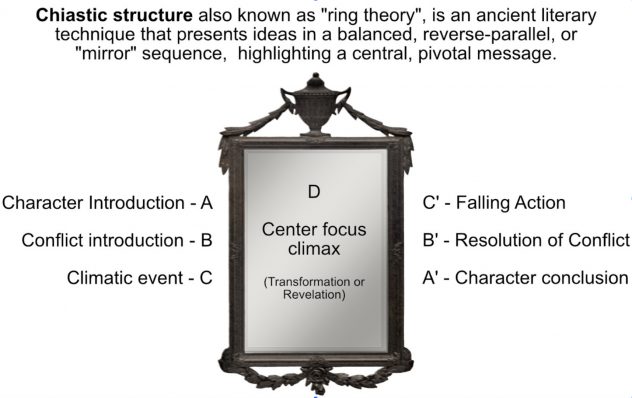
Now this can be done across an entire composition or even series of compositions, but can also be witnessed on a sentence by sentence level, by reversing typical grammatical structures.
A very well known example of this is found in John F. Kennedy’s inaugural address when he said, “Ask not what your country can do for you—ask what you can do for your country“ [January 20, 1961].
This chiastic [kigh-ast-ic] structure is a very ancient method, revealing that human minds were far more intricate in their thinking than in the modern age.
Modern movies have doubled back and begun to use this structure in the development of individual movies or series of movies.
Examples of this are:
- The Matrix (1999): Frequently cited for a perfect, scene-by-scene chiastic structure, where the first half mirrors the second.
- The Lion King (1994): This made use of a mirror structure where Simba’s journey away from Pride Rock is reversed by his journey back, with individual scenes echoing each other.
- Glass Onion: A Knives Out Mystery (2022) – Starts with the invitation and setup of the mystery, but quickly flashes back to show the characters receiving the puzzle box, setting up the context for the suspenseful gathering.
- Terminator 2: Judgment Day (1991): Featured a structured, thematic reversal.
- Back to the Future Trilogy (1985-1990): Does this to create symmetry in the plot across the several movies in a series.
- The Dark Knight Trilogy (2005-2012): Noted for doing the same.
Other examples can be cited but most reference movies I have either never seen or would not want to see.
Now this structure should NOT be confused with movies that start near the end, flash back to the beginning, and connect the scenes in chronological order to create suspense.
These are called “in medias res” [in MEE-dee-uhs RAYS] techniques, and are not true chiastic structures. These films merely build anticipation by beginning the movie with a future, often dramatic, outcome followed by words on the screen to the effect of “x number of years earlier”.
Chiastic structure (or ring composition) mirrors events in an A-B-C-B’-A’ pattern.
Key Examples of This Technique or films which contain an primary example of it:
- Citizen Kane (1941): Begins with the protagonist’s death and the word “Rosebud,” then explores his life to reveal the word’s meaning.
- Memento (2000): Uses reverse chronological order, with the end shown first and each scene showing what happened just before it.
- Forrest Gump (1994) – The entire film is framed by a flashback. It begins with Forrest sitting on a bench (near the end of his journey), and he tells his life story chronologically, with the tension coming from wondering how he ended up in certain situations (e.g., Vietnam, meeting Presidents).
- Titanic (1997) – Begins with the discovery of the wreck in the present day, then flashes back to the beginning of the journey, with the suspense built on the unavoidable, impending disaster.
- Saving Private Ryan (1998) – Starts with an old man in the present visiting a cemetery, then flashes back to the beginning of the D-Day invasion, with the suspense derived from the mission’s high stakes.
To drive home the point of this education in literature I will offer one more grand example of the Chiastic Structure.
I am profoundly NOT a Star Wars fan and this may in fact be one of the reasons, but for the great majority of people out there that liked those movies they do have the single redemptive quality of serving as an example to this structure which you may understand.
Example #1: Star Wars
Chiastic structure is used in the Star Wars saga, particularly to connect the original and prequel trilogies in a symmetric pattern.
Developed by George Lucas, this structure means Episodes I–III mirror Episodes VI–IV in plot, visual, and thematic elements, with Revenge of the Sith and A New Hope acting as the center.
This structure operates as a chiasmus (or “inverted parallelism”), meaning the story moves toward a midpoint (the end of Episode III/start of Episode IV) and then reverses the order:
- Episode I (The Phantom Menace) mirrors Episode VI (Return of the Jedi).
- Episode II (Attack of the Clones) mirrors Episode V (The Empire Strikes Back).
- Episode III (Revenge of the Sith) mirrors Episode IV (A New Hope).
This mirroring includes story beats, thematic elements, character arcs (Anakin vs. Luke), dialogue, and visual cinematography.
The ring pattern for this confusing series of movies is 1 & 6; 2 & 5; 3 & 4. This was done to maintain a certain level of overall confusion – at least that was the result for me!
~ OR ~
Example #2: The Lord of the Rings
The Lord of the Rings is widely considered to follow a chiastic structure, or “ring composition,” where the narrative journey outward from Rivendell is mirrored by the return, emphasizing themes of loss, recovery, and symmetry.
The story often mirrors the first half in the second (e.g., Hobbits in peril), creating a “cross-shaped” relationship (A-B-C-D-C’-B’-A’) throughout the saga.
Key chiastic elements in LOTR include:
- Mirroring Journeys: The journey to Mordor is largely balanced by the return journey, reflecting on the cost of the quest.
- Balanced Narrative Threads: Scholars highlight that the six “books” (into which the three volumes are divided) follow a structure of interlacing, where characters often encounter similar themes or dangers in parallel.
- Thematic Reflection: The story begins and ends with key scenes involving the Shire, showcasing a return to a changed home.
While ‘The Lord of the Rings’ is often described as a complex, interlaced, or cathedral-like structure, its deliberate, symmetrical parallelisms—especially regarding character arcs and structural beats—demonstrate a strong chiastic design.
The Lord of the Rings trilogy is the movie version of the 6 book series condensed into three films.
It follows a chiastic (ring) structure, where the narrative’s first half is mirrored in reverse during the second half to emphasize themes of corruption, redemption, and restoration.
The journey begins in the secure Shire (A), faces peril in the Mines of Moria [moore – e -a] (B), and climaxes at the center (C) before returning through similar perils and finally home to the Shire (A’).
Detailed Breakdown of the Chiastic Structure:
- The Shire & Departure (Beginning/End): The story starts with a birthday party and peaceful life in the Shire, and ends with the scouring and restoration of the Shire, bringing the characters back to where they started.
- Bilbo/Frodo & The Ring’s Power: The ring is initially passed from Bilbo to Frodo, revealing its corrupting influence, which is mirrored at the end when Frodo gives up his quest and Sam becomes a Ringbearer.
- The Fellowship & The Ring’s Burden: The formation of the Fellowship and the decision to take the ring to Mordor in ‘The Fellowship of the Ring’ is mirrored by the breaking of the Fellowship and the final journey to Mount Doom in ‘The Two Towers’ and ‘The Return of the King’.
- Peril in Moria/Shelob’s Lair: The Fellowship’s peril in the Mines of Moria (encountering the Balrog) mirrors the perilous journey through Shelob’s lair.
- Galadriel’s [Gah-lahd-rree-ayl] Mirror/The Ring’s Destruction: Frodo’s vision in Galadriel’s mirror, showing the potential future, is mirrored by the actual destruction of the Ring and the downfall of Sauron.
All of this echo out from the center and climax of the story.
The Center (Climax): The climax is the destruction of the One Ring in Mount Doom, which resolves the main conflict and initiates the journey back.
Key Mirroring Points:
- Characters: The innocent, naive Hobbits at the start are mirrored by the war-hardened heroes who return.
- Locations: The safe haven of Rivendell/Shire is mirrored by the desolate Mordor/returned Shire.
- Themes: The theme of temptation (Boromir) is mirrored by the temptation of Frodo at Mount Doom.
This structure ensures that the story is a complete, symmetrical circle, strengthening the narrative’s themes.
These represent a few of the films that have used this structure to create a more profound sense of thematic resonance, where the ending mirrors the beginning, often reinforcing the central message through symmetry.
Now let’s use our book of Song of Solomon as our example.
Outline and overview of the Song of Solomon
The chiastic structure connects the beginning, which in our case would be chapter 1:1–4 to the end which is chapter 8:14 through mirroring, often centering on the wedding scene found in chapter 4:16–5:1 which is of course the center point and climax of the story.
The Song of Solomon’s broader chiastic structure follows a (A-B-C-D-C’-B’-A’) format, where themes in the early chapters (such as looking for and finding the lover) are reversed or mirrored in the later chapters:
A: Initial meeting/courtship
B: Dreams/Seeking
C: Consummation (center)
C’: Reaffirmation of love
B’: Seeking/Finding
A’: Final commitment/Marriage
This technique is a hallmark of Hebrew poetry, used to emphasize important themes. In our book of Song of Solomon it emphasizes the mutual, reciprocal love of Solomon and the Shulamite.
Yes this is all terribly confusing but is evidently seen as very theatrical, and even eloquent to those who get this sort of thing.
How this is used and examples of where it shows up in the Song of Solomon are:
- Chapter 2:16 & 6:3: “I am my beloved’s, and my beloved is mine.” This statement, repeated with slight variation, highlights mutual ownership and perfect reciprocation in their relationship.
- Chapter 4:12: “A garden locked is my sister, my bride, a spring locked, a fountain sealed.” (ESV) The imagery moves from an open space (garden) to a sealed source (fountain), creating a structured, poetic, and intimate description of “the beloved”.
- Chapter 6:13 (implied): “Return, return, O Shulamite; Return, return, that we may look upon thee.” The repetition creates a rhythmic, mirrored structure that emphasizes the plea of the lovers.
- Finally chapter 7:10 (& 8:10): “I am my beloved’s, and his desire is for me.” This mirrors the structure of chapter 2:16, focusing on the mutual nature of their desire.
Applying all of this to the Song of Solomon:
The poem moves back and forth between three mirroring themes, using parallel passages like Springtime in chapter 2:10-13 with chapters 7:12-13 and 3:1-5 (searching) with chapter 5:2-8.
The center of the chiasm is generally identified as the consummation of the marriage found in chapter 4:16—5:1, marking the transition from courtship to union.
The composition of this “ring structure” often follows an A-B-C-B-A pattern, where the prologue in chapter 1:1-4 mirrors the epilogue in chapter 8:14.
A commonly recognized and simplified outline of this is:
A: Longing for the beloved (1:1-4)
B: Seeking/Finding the beloved (3:1-5)
C: The Marriage/Consummation (4:16–5:1)
B’: Further seeking and description (5:2–6:1)
A’: Final reunion and desire (8:14)
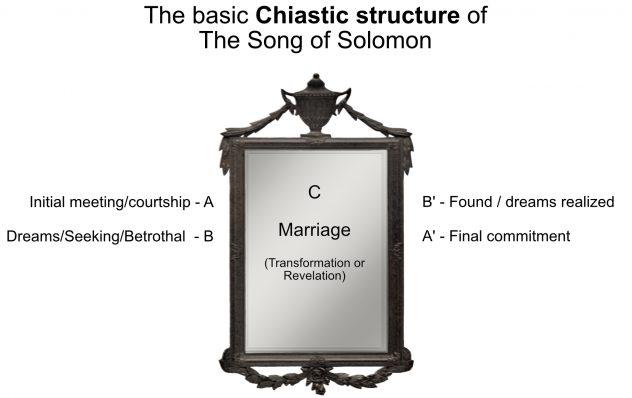
This structure emphasizes the intimacy, mutual desire, and ultimate union of the lovers, rather than a strictly chronological story.
What is the story behind the story?
As I said, the Song of Solomon was clearly inspired by the Holy Spirit to illustrate and give insight into our intimate union with Jesus!
The story tells of our betrothal to Christ, His purchase of us, His going to prepare a place for us and His sudden return which is all captured in the particulars of Jewish weddings.
Now I believe the Song of Solomon presents a series of scenes, perhaps even from the real life of King Solomon, but as I have clearly stated it does NOT unfold in chronological order.
The setting is the Kings palace in Jerusalem and many of the scenes are nothing more than flashbacks to a previous time in their courtship and developing relationship.
It kinda works like this – a chorus talks back and forth to the main characters of the play while support actresses known as “The daughters of Jerusalem” carry along the tempo of the story.
It tells the story of a poor family of Ephraim.
Ephraim means doubly fruitful and was the second or last son of Joseph who was made first when Jacob placed his hands on his grand sons to bless them.
In this family there is a girl who in some ways plays a role akin to that of Cinderella.
The poverty of her family forces her into the vineyards where she is happened upon by King Solomon posing as a young shepherd.
What appears here as a deliberate deception, occurs in Christ as He comes in flesh and as a suffering servant, rather than a conquering king or as God Himself.
In the Song of Solomon, a brief telling of “the story of their love” is offered as an overview.
Then the young shepherd leaves her with the promise that he will return.
Sound familiar?
The story has him absent for quite a long time, so much so that she begins to despair that he may not return.
One day, the electrifying word is shouted along the way that King Solomon is coming. She shows little interest since her heart belongs to the young shepherd boy, not knowing they are one and the same person.
Later she is puzzled as she learns that the king desires to see her.
When she is brought into his presence she recognizes him for who he is – her shepherd lover.
He takes her to his palace in Jerusalem where most of the song takes place.
You see there are reasons why these sort of stories resonate with us – they are a bringing of our souls before a mirror – they tell us of something our hearts know by way of instinct, but that our experiences tell our mind not to trust in.
It is a fairytale for starry-eyed children, but nothing “practical” you could build your life upon…when in fact, nothing could be further from the truth!
Snapping back for a moment into real life.
With Jesus’ return becoming more eminent at the passing of every day, is it any wonder at the world’s wisdom telling young girls that “needing and desiring a prince charming” is to live from a place of weakness and weakness is for fools.
That young boys are being told that a girl “does not want to be rescued”, that their services are no longer needed or desired and that they should quit acting as if there is truly a difference between men and women.
As I’ve told you in the past, that the encouragement of looking forward to Jesus’ return – to finally see Him for Who He is, was like a Jewish wedding and it is!
Hitting the major high points of a Jewish betrothal and wedding…
- A young man desiring to marry would come and offer a betrothal covenant and the price his father would pay for his bride to be – which was typically a LARGE sum.
- Included in this covenant would be a promise to provide for her.
- If accepted, the man would pay the price up front, the covenant would be signed and a cup of wine shared to seal their commitment to one another.
- Then the young man would go away to prepare a place for her, but before he left she would undergo a water baptism symbolizing her purity and commitment to him alone. This represented separation from her old life to a new one with her husband-to-be and a placing of herself under his authority. She was now “Kallah” – meaning an enclosed one (much like we are ‘sealed by the Holy Spirit’ for Christ’s return)
- Upon leaving he was to stand under a canopy similar to the one under which they would be married and say words like this, “I have to go, I’m going to prepare the Chuppah (bridal’s chamber), a place for you at my father’s house.”
- The young man would leave for approximately a year at the end of which he would come to get her, only the “set day” was not known.
- The bride’s friends would often come to stay with her during this time to help her be ready for his return which created a fair amount of excitement and anticipation for his arrival. They would also help dissuade doubts and fears – “Why hadn’t he come yet? Did he not desire her as much as she desires him? Maybe he has found his desire in someone else. Can he be trusted?” All of these “feeling based” doubts were encouraged away by the friends of the bride. [Like we are told in Hebrews to do – Encourage one another and all the more as you see the day of His coming approaching.]
- It was said that a Jewish bride had dove eyes. Like much of the words used to describe one another throughout this book is NOT physically comparative, but metaphorical. Dove eyes are used to describe the Shulamite woman. While doves are beautiful creatures, and their eyes being pure black, appear striking and innocent, this was not a physical comparison. It was actually a picture of purity more than anything else. Doves have no peripheral vision and they mate for life. So this was saying that she had eyes for no one else and her devotion was unable to be challenged. [This is true holiness without which none will see the Lord]
- He would return for her, often by night with loud shouts and blasts from a ram’s horn.
- Upon arriving at his father’s estate they would enter the prepared room (huppah) to consummate their union.
- This was followed by a celebratory feast, lasting up to seven days, hosted by the groom’s father (another attestation to the church being caught away at the beginning of the tribulation).
- Of course the notion was that they would live “happily ever after”.
So in keeping with the beginning of a Jewish betrothal, Song of Solomon 2:8-10 shows this part of the betrothal,
“(8) Listen! My love is approaching. Look! Here he comes, leaping over the mountains, bounding over the hills. (9) My love is like a gazelle or a young stag. Look, he is standing behind our wall, gazing through the windows, peering through the lattice. (10) My love calls to me: Arise, my darling. Come away, my beautiful one.”
Though this sounds like the groom coming to get the bride, this is actually a courtship scene leading to the betrothal.
Can you see the connections between Jewish weddings, the Song of Solomon and the promises of Jesus to the church?
I want to submit to you that the thing which “keeps” a Jewish bride are essentially three things.
- Her love for Him
- Her anticipation – she only knows him in part and longs to know him thoroughly
- The encouragement of her friends
The friends of the bride who helped make her ready find their ultimate fulfillment in the Holy Spirit left with us to prepare us to be ready for Him.
In fact the Spirit is said to be preparing us for Him “as a bride for her bridegroom”.
This also takes the form of the body of Christ. We are to encourage one another – but even that is by the Spirit. Thus the oil in the lamps of the bride’s maidens in Jesus’ parable of the 10 virgins.
These “maidens” are represented in the Song of Solomon by our siblings in Christ, possessing words seasoned with the Spirit’s influence.
Can you see why the book of Revelation says, “The Spirit and the bride say come” and “even so, Lord Jesus come quickly”.
It is NOT out of a hatred for the world, or a desire to be rid of this life but a longing cry of the heart to see Him for Who He really is, be finally and completely united with Him to forever live in union with Him in our Father’s house.
Metaphorically, what these “brothers” likely represent are the spiritual oversight and protective constraints of spiritual leaders over a believer’s faith to watch over their purity and devotion to Christ until our union is finalized at their death or at His return.
Blessings!
Blessings!