|
This is a text reader for the article below:
Getting your Trinity Audio player ready...
|

Wednesday 3/04/26
Thru the Bible: Song of Solomon
Message Video Player
Message Audio Player:
Podcast: Download (Duration: 1:05:30 — 119.9MB)
Let the Love Songs begin!
Now before we get started tonight, I want you to remember a few of the things we covered in our overview of this book.
First off, there are 5 players on the field:
- The Beloved who we believe to be Solomon
- The Shulamite who is his lover/bride
- The maidens/bride’s maids
- The family, friends and valiant men of Solomon and
- The brothers of the Shulamite bride.
When there is a shift in the dialogue from one speaker to another, you will be prompted by a statement which says so. These lead-ins are NOT original to the text in any of the ancient copies and are therefore not inspired NOR authoritative. They are however agreed upon by the majority of those who have expressed opinions – both scholarly and otherwise. Only about 10% of these identifying intros are debated and those are of small significance. Most of the reason for both the overwhelming agreement and small fraction of disagreement is the textual information present into text which more often than not clearly identifies the speaker.
This book is NOT for the faint of heart. It uses very blatant and clear sexual references in which both lovers express their longings and desires without shame. As we read it is important – imperative really that we do not lose sight of what this love story is illustrative of. This is inspired by God to reveal through human marital love, what Jesus desires with His bride.
The narrative in this book is characterized by a conversational style that alternates between dialogues and poetic reflections.
Also remember that this book is NOT in chronological order which will become immediately apparent in the first 7 verses alone.
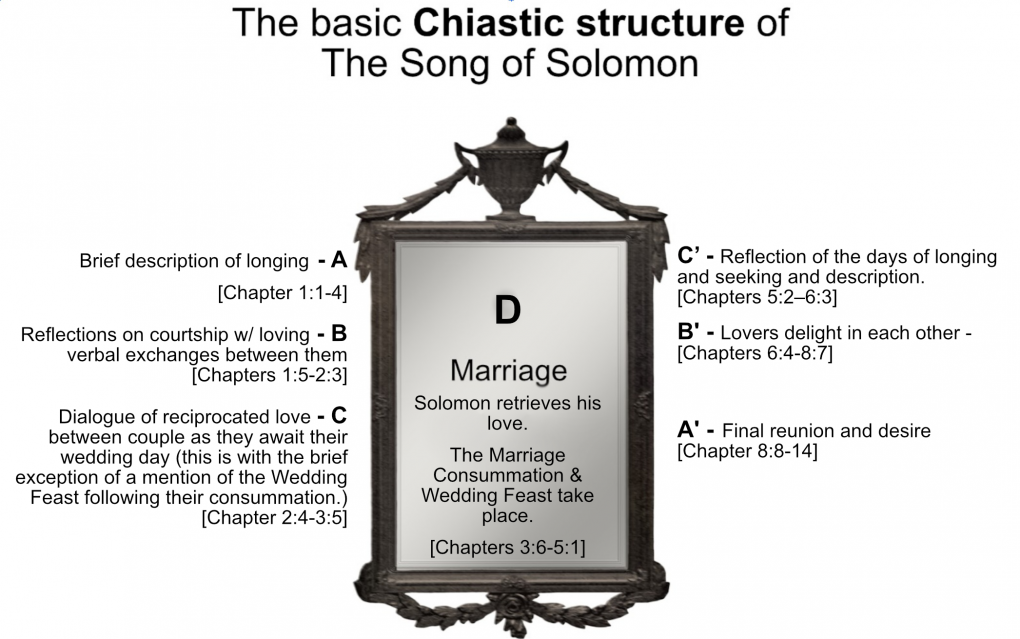
Finally, the development of the Song of Solomon follows the Chiastic structure I explained last week. An overview of which I have supplied as a pdf file which appears at the top of this post and HERE.
It follows an A – B – C – D – C’ – B’ – A’ structure the particulars of which are:
A: The Shulamite’s longing for intimate connection with Solomon. (1:1-4) (married)
B: Reflections on courtship / early frustrations / seeking for her beloved / loving verbal exchanges between them both. (1:5-2:3)
- With the exception of a brief mention of the celebration in the banquet hall following the consummation of their wedding – the rest of this division is all language of a love which has been confirmed through betrothal and in the stage of waiting (2:4-3:5)
D: Solomon retrieves his love/ The Marriage Consummation and celebration take place (3:6-5:1)
C’: Reflection on the days of longing and seeking and the lover’s descriptions of each other (5:2–6:3)
B’: Lovers delight in each other – (6:4-8:7)
A’: Final reunion and desire (8:8-14)
As the curtain opens on this book, we begin with the couple already married and therefore the setting is Solomon’s palace – as it is throughout the entire book.
By the time we reach verse 5, the Shulamite woman is remembering a particularly frustrating portion of her courtship to Solomon when she still did not know his
true identity as king. She was overly tanned due to working the family vineyard and is talking about this to her maidens.
Song of Solomon 1:1-17,
“(1) Solomon’s Most Excellent Love Song.”
“(2) The Beloved to Her Lover: Oh, how I wish you would kiss me passionately! For your lovemaking is more delightful than wine.”
Now here translations vary quite a bit and for pretty good reasons.
Though more poetic in English perhaps, the words “let him kiss me with the kisses of his mouth” the phrase doesn’t read like that in the Hebrew and is a grammatical construction which is intended to make the statement emphatic. So while the King James Version (KJV), Young’s Literal Translation (YLT), , Young’s Literal Translation (YLT), Douay-Rheims Bible (DRB), Literal Standard Version (LSV), and Smith’s Literal Translation of “let him kiss me with the kisses of his mouth” clearly denote passion and desire, I believe a more literal translation still is seen in the NET where the driven and urgent request is for him to kiss her passionately.
Either of these do NOT lend themselves to a scene of metaphoric meaning. So the next phrase should be translated in kind, but a straightforward literal translation is unlikely in the extreme. The Hebrew word is dodeyca and means breasts or loves – both appearing in the plural. Since this is the bride to the groom, “loves” is preferred for countless reasons. While this “could” perhaps be a reference to her lover’s broad and strong chest, which is a seat of affection for many women, such is a stretch on a literary level.
The Septuagint goes one direction with this word and the Masoretic another.
The scene is clearly an intimate one and is nearly certain to be referring to romantic love. The word translated here as “lovemaking” in the New English Translation is fitting, though other options are “your love/loves” or “caresses.” Again, since the scene is one where she is longing to be kissed passionately by her lover, even the idea of caresses could hardly be a PG affair.
“(3) The fragrance of your colognes is delightful; your name is like the finest perfume. No wonder the young women adore you!
(4) Draw me after you; let us hurry!
May the king bring me into his bedroom chambers!”
The words here are both a little steamy and blush worthy.
The Shulamite is shifting from marital language and refers to her lover as “the king”.
To the Shulamite, Solomon is first and foremost her husband and lover, and that is the scene before us. We are not looking at a dialogue which would have taken place in the throne room nor in the public courtyard of the palace. The language of this whole scene is that of a private and intimate setting. So her employing the term “king” here is intentional and plays into her what she desires from him.
She wants her groom to take hold of her, in an act of ardent and dominant passion. To with decisive strength take her to be ravished by his desire for her. There really is no other way to understand these words and while these are in fact common enough expressions of human desire especially in the early throws of marital love, I think for most of us it seems uncomfortably out of place in scripture. And therein lies a problem.
We’ve made our relationship with God so sterile and externally proper that ardent displays of passionate and even aggressive love can offend the mind, but here it is – plain as day and without apology.
Bearing in mind what I said in our introduction to this chapter tonight, the greater picture of this is an expression of the kind of desire Jesus wants to see from His bride towards Himself and that He unashamedly expresses towards her.
I know the wording here is of the Shulamite towards Solomon, but the fact that they were recorded by Solomon himself rather than the Shulamite, tells us much!
Regarding this desired virile action the Shulamite desires from her lover, the same wording in another setting is used of leading a donkey in gentle strength with leather straps to a desired location or of a king leading his captives away into captivity. There is no way in the Hebrew to miss that she clearly wants to be pursued, overwhelmed and drawn in by his strength and taken in sexual union.
The use of “king” and “his” as opposed to “our bedchamber” reveal a desire to be owned by his authority and strength. She wants to be his!
As I told you, this is NOT for the faint of heart!
Now we shift from this very intimate palace setting where these two lovers are basking in bliss of new marital love to the more muted and distant joy her maidens have for their friend in her marriage to her lover and king.
“The Maidens to the Lover: We will rejoice and delight in you; we will praise your love more than wine.
The Beloved to Her Lover: How rightly the young women adore you!
(5) The Beloved to the Maidens: I am dark but lovely, O maidens of Jerusalem, dark like the tents of Qedar, lovely like the tent curtains of Salmah. (6) Do not stare at me because I am dark, for the sun has burned my skin.”
Your translation may say Solomon rather than Salmah.
If you look up this word it will tell you it is the Hebrew word שֹׁלֹמה šelōmōh which is traditionally translated as Solomon. However, in the earliest copies, being unvocalized text, they used only consonants, rather than the spelling out of the entire word. So that quite honestly leaves the translation up to interpretation.
Overwhelmingly the supporters of the Masoretic text have sided with Solomon.
However, that only makes sense under two conditions.
- If the color of his curtains were a muted leather brown color. Something wholly unlikely for a King.
- If the color of Solomon’s curtains were well known in the kingdom and therefore common knowledge to all who would read the text. Afterall, this was a poetic love song intended to be shared, read and sung publicly and was intended to convey wisdom.
I think you can see that utilizing an example for comparison which no one can confirm or understand, and which makes his palace appear less than regal makes little sense.
The option is Salmah which makes so much more sense that it is astounding that the name Solomon has held so much traction.
The reason it makes sense is because those of that day knew what the curtains of Salmah looked like. Furthermore, like the tribe of Qedar mentioned first, Salmah was an Arabian nomadic tribe which inhabited a region in northern Arabia and the region of Petra.
So placing the two together in a comparative statement makes perfect sense for multiple reasons while the name Solomon, makes almost no sense at all!
Furthermore, though we do not know for certain, both Biblical and extra-biblical indicators would point more towards Solomon’s curtains being linens from Hiram of Tyre, a Phoenician who was skilled in creating purple, blue, and crimson fabrics. No doubt, the Shulimate was not describing herself as purple, blue and red. Her brothers were angry, not abusive!
Regardless of which of the above is true, the idea being conveyed is that this Shulamite woman’s skin was darkly tanned, but not so much as to appear black. So if Solomon’s curtains were like this, his curtains were a dull, dusky brown OR they were actual leather and may have served as blackout curtains.
“My brothers were angry with me; they made me the keeper of the vineyards. Alas, my own vineyard I could not keep!”
This is the reference to the observation I made last week.
The brothers of the Shulamite were angry with her and so forced her to work out in the family vineyard. Perhaps with the express purpose of making her skin tanned.
We have no solid indicators as to what was upsetting the brothers, but my theory remains the same from last week, but it relies upon the next verse so let’s read it and then speculate.
“(7) The Beloved to Her Lover: Tell me, O you whom my heart loves, where do you pasture your sheep? Where do you rest your sheep during the midday heat? Tell me lest I wander around beside the flocks of your companions!”
The difficulty in tacking anything down is the timing and as I have told you and will continue to remind you – the Chiastic format of this song does not lend itself to any chronology that is not at least loosely assumed.
So far in these first 7 verses, we see her in marital bliss, then hearing the shared joy of her bridesmaids at their marriage, but then the scene flashes back to their time of courtship and her frustration at being so darkly tanned when she would like to be as attractive for her nomadic shepherd lover as possible.
So in the same breath as her talking about her frustration over her tan, and mentioning that it was the direct result of her brother’s anger at her, she brings up her search for her nomadic shepherd.
So I think it is a fair assumption to think that her brothers thought it unseemly for her to be galivanting along the countryside looking for her shepherd lover – especially when it took her dangerously close to other shepherds who may not have been safe to be around when alone. So whether their anger was at her recklessness, her forwardness, her attraction to a nomadic shepherd or some other thing, their answer was to keep her busy. Her getting darker skin in the process may or may not have been intentional since fair skin was definitely preferred at this time in Israel’s history.
Her statement that she could not look after her own vineyard is clearly metaphorical. Since she was still an unmarried woman in Israel, the only vineyard which could be said to be hers was that of her family and she was already tending that one. Most scholars believe this was a poetic way of saying that she could not look after her appearance since she was being forced to work out in the field.
Now Solomon answers her query…
“(8) The Lover to His Beloved: If you do not know, O most beautiful of women, simply follow the tracks of my flock, and pasture your little lambs beside the tents of the shepherds.”
Since the relationship between Solomon and the Shulamite are illustrative and therefore to be understood as instructional regarding our relationship with Jesus, then these words are important.
The Shulamite, though in love with the Shepherd, cannot find Him on her own. She has sought, but to no avail!
The advice of her Shepherd lover is to follow the trodden path of those who follow Him and to take up camp with her young goats near the other shepherds.
This seems to point to our need for community in our life of devotion to God. The advantage of following those who follow Christ and staying close to those called as Spiritual leaders in our life – such as Christ’s undershepherds.
We have already established that this Shulamite was young and under her brother’s protection and authority. While she had been given the additional task of tending the vineyard, she evidently also did what most young girls did in Israel.
One of the common responsibilities for young girls in ancient Israel, was to tend to the family herd. This was often done in her teen to early womanhood years.
Their responsibilities included leading the family herd out to nearby pastures in the morning and bringing them back in at evening. Additionally they would water the flocks, often meeting at wells, as seen with Rachel in Genesis 29:9 and the daughters of Jethro/Midian in Exodus 2:16–21.
While in the fields, they often spun yarn with a drop spindle.
Because sheep and goats cannot wander as far as camels, they were often kept closer to home in areas where women and girls tended them, especially in sedentary or semi-nomadic settings which is where we find our Shulamite.
“(9) The Lover to His Beloved: O my beloved, you are like a mare among Pharaoh’s stallions.”
This is not intended to be illustrative of any particular physical attribute of the Shulamite but rather an overall assessment of the power of her beauty to attract male attention.
Pharaohs were known for having their chariots pulled by two stallions rather than a team of horses with mixed genders. These stallions were highly trained, elite horses paired with a light and highly maneuverable, rear-axled carriage, which differed significantly from the heavier, slower vehicles used by many neighboring nations.
The Egyptians had to begin training their stallions to ignore mares since neighboring nations began to use mares to their advantage when engaging the Egyptians. They would send mares into the battle to distract the stallions and turn the battle to their advantage.
So this wording is pointing out the distracting nature of her overpowering beauty.
“(10) Your cheeks are beautiful with ornaments; your neck is lovely with strings of jewels. (11) We will make for you gold ornaments studded with silver.”
If you are like me, you might wonder at the reference to her cheeks “with ornaments”.
Were these piercings or decorative dots affixed to the skin by means of some adhesive? The answer is no. These were earrings!
Earrings in the ancient middle east were nearly always of the large, dangling sort. These would draw attention to the upper checks where they would rest against the skin, rather than to the earlobes on which they were attached.
“(12) The Beloved about Her Lover: While the king was at his banqueting table, my nard gave forth its fragrance.”
“Table” – This was more of a couch to recline on while eating. Sometimes it was a setting for a group of people gathered in a circle, though other times it was a more private affair such as an enclosure. In this case, the scene appears to be at the wedding feast, and so it would most likely represent a circle of lounging chairs or couches for eating and talking.
“Nard”- This was a perfume which possessed a “musky,” “earthy” scent. Specifically it was an aromatic oil extracted from a variety of the Valerian plant which grew in the Himalayan region of India. It differs somewhat from the variety we are familiar with in the West. It is also referred to in some translations as “spikenard”.
The mention of this perfume gives us an almost undeniable tell, that this verse was referring to a time following their consummation – perhaps at the celebratory wedding feast. That is because the cost of the oil was immense, often imported from the Himalayas in sealed, precious alabaster jars, making it a gift for royalty or high-status guests. It was the kind of gift that symbolized great devotion. It is most likely therefore that this perfume would have been a gift from Solomon.
Beyond this, its availability to the common man would be limited in the extreme.
It was a luxury, aromatic, and sacred substance associated with romantic and intimate contexts. Later in Song of Solomon 4:13-14 it is referred to as a “garden” of exotic spices. It was often worn by women at banquets because of its seductive charms. Thus its use here at this banquet.
However it was also highly regarded as a luxurious, fragrant perfume and ointment. It is in fact the very perfume which Mary of Bethany used to anoint Jesus‘ feet and head in Mark 14:3 & John 12:3. This was an act of profound adoration, worship, and preparation for burial. You remember the protestation of its use on Jesus’ feet – that it could have been sold for a great price and the money used for the poor.
“(13) My beloved is like a fragrant pouch of myrrh spending the night between my breasts.”
Myrrh was also an expensive luxury item, which had to be imported into Israel from Arabia, Abyssinia, and India .
In liquid form it could be carried in small bottles like the nard mentioned earlier. However, it was also used in solid form in which it was carried in a small cloth pouch or sachet worn next to the body as is mentioned here.
The myrrh was mixed with fat and shaped into cones. As the fat melted from body heat, the myrrh’s aroma mixed with the anointing oil would perfume a woman’s body.
It possessed a very strong & beautiful fragrance, which was associated with romance and would last for long periods of time. As such women often wore it to bed to perfume themselves for the next day, which is how it is being used in connection with Solomon here.
“(14) My beloved is like a cluster of henna blossoms in the vineyards of En Gedi.”
The “henna blossom” was a sweet smelling whitish flower that grew in thick clusters. Like myrrh, the henna plant was used to make sweet smelling perfume.
Here this metaphor is being used to describe Solomon as a respite from a life which would otherwise have seemed harsh and unbearable. This is because of the mention of its location being the En Gedi. You see, En Gedi is a lush oasis in the midst of the desert wilderness on the southwestern shore of the Dead Sea. This region is hot, arid, windswept and desolate. Its dry sands extend monotonously for miles. The region is covered with a dusty haze and characterized by almost unbearable heat during most of the year.
In the midst of this inhospitable desert is the En Gedi. It is the only sign of greenery or life for miles around. It stands out as a lush oasis in which indescribable beauty is found including a waterfall. It provides not only life saving relief, but delight and refreshment to anyone who happens upon it.
“(15) The Lover to His Beloved: Oh, how beautiful you are, my beloved! Oh, how beautiful you are! Your eyes are like doves!”
I told you last week the meaning of this metaphor and I believe it makes all the more sense in this given context.
It was said that a Jewish bride had “dove eyes” which was, more than anything else, a statement regarding the purity of her love and devotion to him. Doves have no peripheral vision and they mate for life. So this was saying that she had eyes for no one else and her devotion was unable to be challenged.
She had just expressed such admiration and grandiose picture of Solomon that his response is a loving, but somewhat self-effacing acknowledging statement of her loving adoration of him.
“(16) The Beloved to Her Lover: Oh, how handsome you are, my lover! Oh, how delightful you are! The lush foliage is our canopied bed; (17) the cedars are the beams of our bedroom chamber; the pines are the rafters of our bedroom.”
Her acknowledgement of Solomon’s handsomeness and delightfulness were an echoed response to his spoken admiration of her beauty in verse 15.
The word “delightful” can be an expression of outward attraction OR of inward character. In this place, given the grammar of the statement, lends itself to synonymous rather than synthetic parallelism. So this was a continued statement of his attractiveness to her.
This is a wonderful expression, not because of what it is being said, but through what is transpiring between these two lovers.
The words of love are both heard AND reciprocated.
So often in relationships, people receive compliments, but are not diligent to offer an honest comment in reply. This dialogue reveals that they see one another. They hear one another. That the words of their lover, has meaning that cannot go un-replied to!
She then gives a statement which would have been heard almost like a preview of the night of passion they would likely share.
You see in Jewish weddings, on the night the groom retrieved his bride and brought her to his Father’s house – they would enter the bridal chamber he had prepared for her. This was done with all the guests already present.
They would right then consummate their wedding in the bridal chamber so that they were truly one, before the celebratory feast began. This takes the sense of community to a whole new, albeit uncomfortable level!
So this statement by the bride was seemingly a flirtatious admission of enjoying their lovemaking and an expression of anticipation to return there soon.
Suggested by those who know the language is that embedded in her statement, by use of the greenery as well as the stateliness and strength of the Cedar beams and the Pine canopy – the Shulamite was symbolizing the strength, security, and permanence of their union.
Now in closing, as I will likely do throughout this book, I want to acknowledge the realities of Christ Jesus with us His bride which these words are intended to represent by the Holy Spirit Who inspired them.
Application in Christ: Passion, devotion & Joy
As I told you back when we were looking at the offerings of Israel, the whole burnt offering which was to open and close every day in Israel was a depiction of complete and total devotion to God. The entire sacrifice was consumed – there was nothing left after the flames had run their course. The two words “burnt” and “offering” (or “sacrifice”) are actually one word olah which means “to ascend”. Most likely this is because the entire essence of the animal is converted by fire to smoke and so – in an altered state of smoke the sacrifice is literally offered up to God or ascends towards Him. This is also why the offering is called a pleasing odor to the Lord. [See – Offerings of Freewill]
The burnt offering was a VOLUNTARY offering often given during times of celebration, feasts & at festivals.
The one offering the Burnt Sacrifice, as in all the offerings – presented the animal at the door of the tabernacle for approval, they then pressed their hands upon the creature’s head. In this case – it was in order to transfer the sins of the individual to the animal, but to indicate a transference of person. This animal was being offered to God symbolically representing the Israelite offering it which is why ALL of it was consumed. It was an offering of complete dedication and consecration to God of the whole person – the entire being and life!
This is why the offering took all night – the entire animal had to be completely consumed in the flames.
This is seen in a negative way in places like Jeremiah and Amos when God would not accept their Burnt Offerings because they were offered in pretense and not sincerity.
I only bring this back up to show that God has always desired ALL of us and that includes our passion and affection. They belong to Him!
There is much made of fragrances, outward beauty and shared love – not only in the actions, but in the open expressions they speak to one another.
As humans we understand the desire to not just know, but hear the affection of our mates. There is a LOT of that which goes on in this Song of Songs and therefore stands as a lesson communicated. God wants us to not be silent about our love for Him.
Furthermore, this communication of love is NOT just towards God, but about Him to others. The Shulamite speaks of her love for her beloved to the “daughters of Jerusalem” and they take delight in and share in her joy.
Theirs is also a communal celebratory life. They not only take pleasure in one another in the intimacy found in private times, but they celebrate their union and love among family and friends – inviting them into their joy. This sort of thing is realized in many middle eastern nations including Jewish. Additionally Greek, Italian, India, Nigeria, Cambodia, Jamaica and Mexico all have large communal expressions of shared joy at the union of a newly married couple. And it should be known that this is the scene we see depicted in scripture as occurring in heaven at the new birth of anyone who comes to Christ as well as the wedding feast we will have with Christ at the end of this age.
Blessings!
Blessings!