Intro Solomon Song

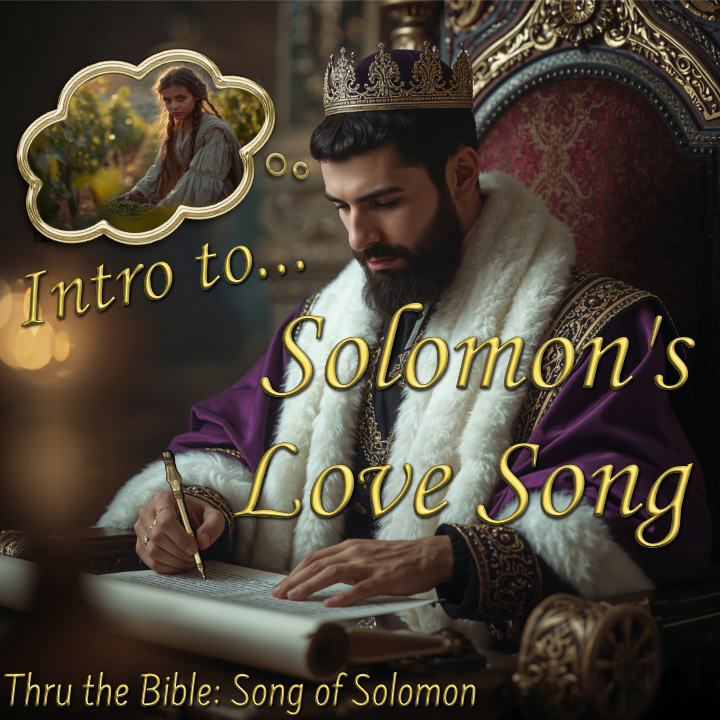
Intro to… Solomon’s Love Song

Tonight we are taking a somewhat “deep dive”introduction into the Song of Solomon.

The Song of Solomon is among those books of scripture classified as wisdom – poetic literature. Its structure is complex and unique in all of scripture. The development of the story is NOT linear and unless you understand the literary structure you are likely to miss a great deal of what is going on in this book.

There are only 8 chapters and 5 characters. There is of course the shepherd/king who we assume to be Solomon himself. There is the object of his affections known formally only as “the shulammite”. Then there are three theatrical “choruses” who interact with the main characters throughout the narrative. These are the “daughters of Jerusalem” (the bride’s maids), Solomon’s friends (or attendants), and the Shulammite’s brothers.

Nearly the entire story actually takes place in Solomon’s Palace where “flashbacks” to their time of courtship leading to marriage takes place.

Interestingly, the overwhelming majority of the story is written from the 1st person perspective of “the Shulammite” woman, rather than from the main protagonist whom we assume is King Solomon.

All together this is a very interesting book in terms of layout, story telling, story development and spiritual imagery.

Of course, being an inspired book, the main person being revealed is actually Jesus and the Shulammite represents the church – His bride. The choruses represent the church, the angels and the ministers of the New Covenant whose job is to present the church as a chaste bride to her Bridegroom.

Other than the book of Job, this is the most detailed book introduction in our entire trek ‘Thru the Bible’ so far, but I believe it was both necessary and beneficial.

Continue reading
Bathsheba Solomon Proverbs 31

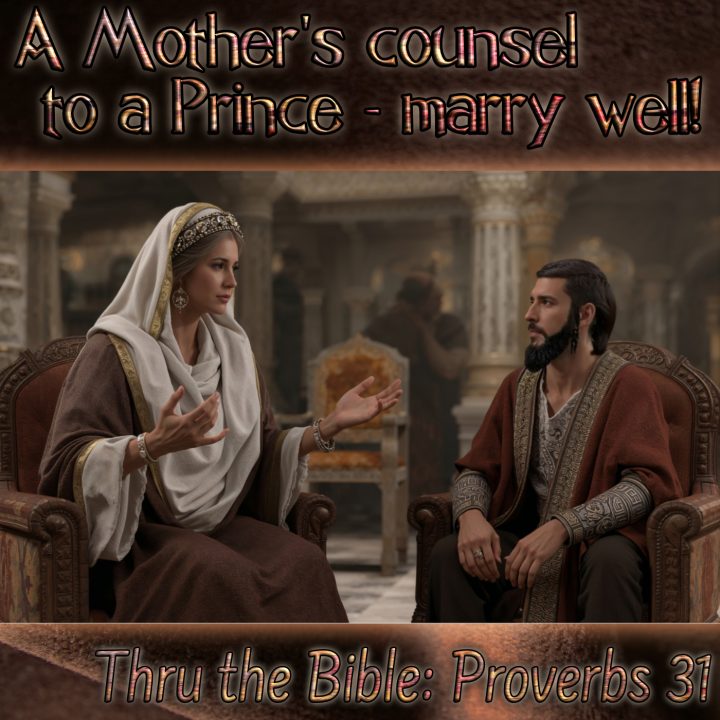
A Mother’s counsel to a Prince… marry well!

This is the final chapter of the book of Proverbs as well as its fourth and final division.

Chapter 31 was written by King Lemuel which most likely was a lovingly familial name for Solomon, perhaps given by Bathsheba his mother.

This chapter is divided into two parts with greater emphasis given to the most important topic:

• Advice for kings and rulers to follow
• A description of a godly, virtuous woman who fears God and honors her husband.

These, too, seem to speak to Solomon’s authorship since he was a king who received godly advice regarding ruling. Additionally, he unwisely allowed his heart to be carried off by pagan women and so he knew something about the value and need of a godly wife.

The importance of a God fearing wife who possesses godly character cannot be overstated for ANY man, but all the more for a King!

Continue reading
Proverbs 30 Agur Paul job

Where Agur’s wisdom, Job’s correction & Paul’s letter to Rome intersect

This chapter is itself the 3rd major division within the greater book of Proverbs. It is written by Agur, a man unknown in scripture who like Balaam of Beor may very well have been a non-Israelite prophet of God.

Agur begins by a self-effacing statement regarding his own wisdom apart from God.

He then offers a list of five statements which are presented in a way which brings God’s correction and confrontation with Job irresistibly to mind.

This list includes the most clear and pointed reference to the incarnate Messiah in the entire book of Proverbs, calling Him the Holy One, speaking of Him as the son of God and asking who would ascend to bring Him down, or descent to bring Him back up. These words are also quoted by Paul in Romans 10 and his reference material may have been both Agur’s proverb and Moses’ statement in Deuteronomy 30:12–14.

The rest of this proverb uses God’s wisdom and ways seen in His creation to highlight things which are insatiable, mysterious, possess social order, wisdom and majesty.

All of this too is very similar to the confrontation of God with Job in Job 38-41.

Continue reading
Proverb 29 Dreams

Good thing Paul didn’t pursue his dreams!

This is the final chapter in the second division of the greater book of Proverbs, which is comprised of a collection of Solomon’s wise saying collected and compiled by the order of King Hezekiah many years after Solomon’s death.

Perhaps the most noteworthy verse in chapter 29 is verse 18 and we spend a fair amount of time with it.

Ironically, what makes this verse noteworthy is not due to any particularly outstanding truth it reveals, but because of how often it is misunderstood and mistaught in the church today as a justification for selfish pursuits and materialist lives.

To accomplish this amazing feat of diabolical twisting of the passage, Proverbs 29:18 is typically never quoted in its entirety. Additionally, it is artificially connected with partial and misquotes of Habakkuk 1:5 and 2:2.

If Paul had been raised under and followed the modern misteachings of this verse, prior to his Apostolic ministry, he would have gone to the Jews and the New Testament as we know it would not even exist.

Continue reading
Proverb Parable Prodigal

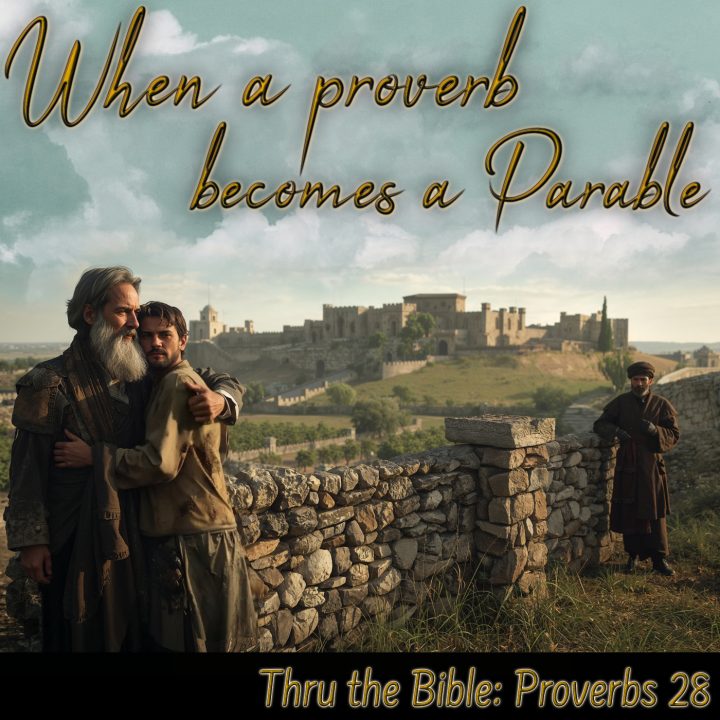
When a Proverb becomes a Parable

So much is lost to many in this generation, due to their desire to protect themselves from what they misunderstand or perceive as a threat to their freedom. I speak in regard to their primitive understanding of the Law and its role in the life of the New Covenant believer. This is only exacerbated through poor teaching. So many things Paul said are read & only understood on a surface level without any thought to the duplicity it creates throughout the rest of the New Testament, not to mention scripture as a whole.

If every favorable reference to the teachings & life guiding principles of the Old Testament were removed from the New, along with all lead in & out material written solely for those references, what would remain of the New Testament would be an exceedingly brief number of pages filled with loose & disconnected thoughts.

The body of the New Testament contains about 5,000 verses, and many estimates place the quotes, references & allusions to the Old Testament to be between 2,000-4,000. That is a serious amount of material to remove!

I say this because I believe many do not even read the Old Testament & those that do, often miss where these exact words, thoughts, teachings or illustrations are mentioned in the New Testament & I believe that is precisely what happened with Proverbs 28:7.

If Jesus was not referencing this passage in His parable of the prodigal, it would be quite surprising indeed!

Continue reading