|
This is a text reader for the article below:
Getting your Trinity Audio player ready...
|
Wednesday 1/07/26
Thru the Bible: Proverbs 26
Message Video Player
Message Audio Player:
Podcast: Download (Duration: 46:54 — 52.3MB)
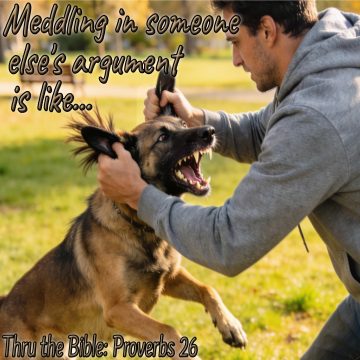
Meddling in someone else’s argument is like…
Proverbs 26:1-28,
“(1) Like snow in summer or rain in harvest, so honor is not fitting for a fool.
(2) Like a sparrow in its flitting, like a swallow in its flying, a curse that is causeless does not alight.”
There are two possible meanings here, both of which are seen in different translations.
Either this means that a curse without a cause will not enter with the implication that it will not achieve its goal OR it means it will come back and bite its source.
The Masoretic Text has the negative with the verb “to enter; to come” so as to make it mean “will not come” (לֹא תָבֹא, loʾ tavoʾ). This is interpreted to mean “will not come to rest” or “will not come home.”
Some commentators have taken another reading of the text so as to read in the positive so that the curse “will come home to him.”
This is also a little difficult, but it gives the idea that an undeserved curse will come [back] to him [who gave it]. Just as a bird will fly around and eventually come home, so will the undeserved curse return on the one who gave it.
This is plausible, but there is no referent for the suffix, making it syntactically difficult.
In either translation the unwarranted curse will ultimately fail in its objective.
“(3) A whip for the horse, a bridle for the donkey, and a rod for the back of fools.”
It is no surprise that what passes for “science” in the modern age, is at variance with this verse. Animal science today is driven more by sentimentality and an evolutionary and environmentalist devotion to the idea of humans being the disease of the planet and other such drivel so that clear behavior issues are explained away as problems introduced by human involvement. But this is no more accurate than saying that the only reason humans rebel is because of the involvement of God. If it were not for God being Who He is in relation to humans, there would be nothing to rebel against and so it is regarding the relationship between the creatures of the earth and their master’s mankind.
I say all of that to point out that according to Solomon, a horse needs a whip and a donkey a bridle for the same reason a fool needs a rod and he is NOT wrong!
According to Charles Bridges,
“This proverb inverts our ideas. We should have given the bridle for the horse, and the whip for the donkey. The Eastern donkey are a very superior race, both in beauty and spirit, a valuable property to their owners. The bridle is necessary to curb and to guide them; while the horse, perhaps badly broken in, may need a whip; if dull, to accelerate his speed; if fiery, to correct his temper.
Every creature subdued for the service of man needs his appropriate discipline.
The Lord “guides his children with His eye.”
But let them cultivate a pliable spirit; “not as the horse and the mule, whose mouth must be held in with bit and bridle.” (Psalm 32:8-9 .)
The fool neither hears the voice, nor sees the directing eye. He will be ruled neither by reason nor persuasion.
A rod therefore is for the fool’s back.”
“(4) Answer not a fool according to his folly, lest you be like him yourself. (5) Answer a fool according to his folly, lest he be wise in his own eyes.”
Obviously Solomon knew these two statements began the same, but ended with what appears to be contradictory advice. I believe that in this form of poetry, the parallelism demands that one interpret the beginning of both verses differently though they were deliberately written in a way as to make them appear the same. This is clearly Paradoxical parallelism which is expressed through both Antithetical & Synthetic parallelism.
Meaning that at first glance the wisdom offered is a paradox. But knowing this is wisdom literature, one should expect certain plays on words which are intended to draw the mind in for closer consideration to solve the Paradox. I believe this is done by acknowledging that the beginning statements of both are actually Antithetical meaning they contrast rather than agree. This therefore, forces the second part of each statement to actually be Synthetic, meaning completing the overall thought, rather than contradicting it.
It really is quite clever!
As such I believe it to be a literary ploy intended to make one think through a cleverly concealed yet, obvious truth.
One should not answer a fool in line with the fool’s mode of reasoning, or you will be no better than they. But when you answer a fool, answer him in a way which demonstrates the folly of their own reasoning.
This to me is the most obvious and straightforward understanding of the otherwise apparently contradictory statements.
After coming to these conclusions I thought I’d allow AI to offer a stab at it and surprisingly found that our agreement was nearly identical.
Proverbs 26:4 and 26:5 are an excellent example of parallelism found in Hebrew poetry. The two verses, which appear contradictory on the surface, are placed together to present a composite truth that requires the reader to use wisdom and discernment in application.
Types of Parallelism…
Antithetical Parallelism (Contrast): This is the most common interpretation, where the second line is set in contrast to the first, using an opposing idea to make a point.
The verses highlight opposite scenarios and consequences:
Verse 4: Do not answer a fool according to his folly, lest you also be like him. This applies when engaging would drag you down to their level and make you appear foolish.
Verse 5: Answer a fool according to his folly, lest he be wise in his own eyes. This applies when a lack of response would allow the fool to think their foolish ideas are wise or correct, which could influence others.
Synthetic Parallelism (Completing the Thought): Some scholars view it as a synthetic parallelism, where the second line builds upon or completes the thought of the first by providing an additional, necessary perspective. Both statements are true and offer complementary guidance for different situations.
Paradoxical Truth: The juxtaposition creates a paradox that forces the reader to think deeply and apply the right instruction to the right situation, rather than following a single, rigid rule.
The brilliance of this poetic device is that it challenges the reader to seek divine guidance (James 1:5) to know when to speak and when to remain silent, rather than offering a simple, one-size-fits-all instruction.
“(6) Whoever sends a message by the hand of a fool cuts off his own feet and drinks violence. (7) Like a lame man’s legs, which hang useless, is a proverb in the mouth of fools.”
I had my own ideas regarding these two verses but after reading the notes associated with them in the New English Translation, I decided I would be hard pressed to improve upon it or even say it more concisely or clearly. So here it is…
“Sending a messenger on a mission is like having another pair of feet. But if the messenger is a fool, this proverb says, not only does the sender not have an extra pair of feet – he cuts off the pair he has. It would not be simply that the message did not get through; it would get through incorrectly and be a setback! The other simile uses “violence,” a term for violent social wrongs and injustice. The metaphorical idea of “drinking” violence means suffering violence – it is one’s portion. So sending a fool on a mission will have injurious consequences.”
“(8) Like one who binds the stone in the sling is one who gives honor to a fool.”
Okay well this one made me laugh. In part because it is so silly. In part because the mental imagery it conjures is cartoonish and finally because I’ve done things which were equally ridiculous and self defeating having not grasped its stupidity when I did it, but quickly realized it afterward.
The key to understanding the verse is not reading past the word “bind”. One lays a stone in the pouch of a sling so that it will release in projection towards its intended target. But if you bind it in its cradle, then upon snapping it back so as to release the stone and hurl it towards its goal it will instead circle back around and hit you with similar force.
The point is that only someone who does not know how to work a sling would be so foolish and in similar fashion, to honor a fool would not only be stupid and counterproductive, it would also come back on you.
“(9) Like a thorn that goes up into the hand of a drunkard is a proverb in the mouth of fools.”
Meaning it hurts them, speaks to their lack of wisdom and against their folly, but they are too dull to realize it.
“(10) Like an archer who wounds everyone is one who hires a passing fool or drunkard.”
This verse has its difficulties in translation, but when one considers all the options, this one is the only one which I believe makes sense without reading more in the text than can be rightly justified.
The KLV, NKJV has, “The great God Who formed everything Gives the fool his hire and the transgressor his wages.”
While no one could disagree with this statement, it reads too much into the text and takes too many liberties in my view.
The NET notes do a good job explaining the differences and their reasons.
“An archer is one who wounds anyone; And the employer of a fool is (particularly) the employer of those just passing by.”
This translation understands the participles substantivally rather than verbally.
In a battle, archers are not initially taking aim to hit an individual bull’s eye. They shoot as a group high in the air at the approaching enemy forces, who then find themselves in a hail of dangerous arrows. The individual archer is indiscriminate.
When someone hires whoever is passing by, indiscriminately, that employer is more likely to end up with an incompetent or foolish employee.
The words in the line have several possible meanings, making it difficult and often considered textually defective.
The first line has רַב מְחוֹלֵל־כֹּל (rav mekholel kol).
The first word, רַב (rav), can mean “archer,” “ master,” or “much.”
The verb מְחוֹלֵל (mekholel) can mean “to wound” or “to bring forth.”
The possibilities are:
“a master performs [or, produces] all,”
“a master injures all,”
“an archer wounds all,” or
“much produces all.”
The line probably should be stating something negative, so the idea of an archer injuring or wounding people [at random] is preferable.
An undisciplined hireling will have the same effect as an archer shooting at anything and everything (cf. NLT “an archer who shoots recklessly”).
Additionally I thought the Jewish Publication Society on the Old Testament offered an interesting take on the verse. It represents the verse this way,
“A master performeth all things; but he that stoppeth a fool is as one that stoppeth a flood.”
“(11) Like a dog that returns to his vomit is a fool who repeats his folly.”
This verse has its own interpretation clarified for us in Peter’s second letter regarding the apostate Christian.
He says,
“(14) They have eyes full of adultery, insatiable for sin. They entice unsteady souls. They have hearts trained in greed. Accursed children!
(15) Forsaking the right way, they have gone astray.
They have followed the way of Balaam, the son of Beor, who loved gain from wrongdoing, (16) but was rebuked for his own transgression; a speechless donkey spoke with human voice and restrained the prophet’s madness.
(17) These are waterless springs and mists driven by a storm. For them the gloom of utter darkness has been reserved.
(18) For, speaking loud boasts of folly, they entice by sensual passions of the flesh those who are barely escaping from those who live in error. (19) They promise them freedom, but they themselves are slaves of corruption. For whatever overcomes a person, to that he is enslaved.
(20) For if, after they have escaped the defilements of the world through the knowledge of our Lord and Savior Jesus Christ, they are again entangled in them and overcome, the last state has become worse for them than the first.
(21) For it would have been better for them never to have known the way of righteousness than after knowing it to turn back from the holy commandment delivered to them.
(22) What the true proverb says has happened to them:
“The dog returns to its own vomit, and the sow, after washing herself, returns to wallow in the mire.” – 2 Peter 2:14-22
“(12) Do you see a man who is wise in his own eyes? There is more hope for a fool than for him.”
Such a person is proud, possessing no ears to hear anything but agreement with his own beliefs and thoughts. This person is cut off from grace making a fool in a better position for a favorable outcome than he.
Now we have 4 verses focused upon the sluggard…
“(13) The sluggard says, “There is a lion in the road! There is a lion in the streets!”
(14) As a door turns on its hinges, so does a sluggard on his bed.
(15) The sluggard buries his hand in the dish; it wears him out to bring it back to his mouth.
(16) The sluggard is wiser in his own eyes than seven men who can answer sensibly.”
This last verse makes the “sluggard” have much in common with the one who is wise in his own eyes from verse 12. Therefore, the fool has greater reason for hope than the sluggard as well.
“(17) Whoever meddles in a quarrel not his own is like one who takes a passing dog by the ears.”
“(18) Like a madman who throws firebrands, arrows, and death (19) is the man who deceives his neighbor and says, “I am only joking!”
“(20) For lack of wood the fire goes out, and where there is no whisperer, quarreling ceases. (21) As charcoal to hot embers and wood to fire, so is a quarrelsome man for kindling strife.”
“(22) The words of a whisperer are like delicious morsels; they go down into the inner parts of the body. (23) Like the glaze covering an earthen vessel are fervent lips with an evil heart.”
This one is a little interesting. The Masoretic Text clearly has “silver dross” where we have “glaze covering”. While these are very different words in the Hebrew and in other instances could throw off the flow and overall meaning of the text, it is my view that either translation conveys the intended point very nicely. Nevertheless I believe the alteration from “silver dross” to “glaze covering” is both forced and unnecessary.
The argument is that earthen vessels of the ancient middle east did not typically have silver dross applied to them. Such would have been a silly investment since they were notoriously fragile and prone to cracking and breaking due to their inherent fragility, porous nature, and the sometimes harsh firing conditions. They would often break soon after being crafted and need immediate repairs or simply be discarded. As such, silver, which was a precious and rare commodity in other kingdoms, would not be wasted on inferior or fragile vessels. Furthermore there were sumptuary laws in these nations which dictated what people could wear, eat, and own, based on their social rank, wealth, or moral/religious beliefs in order to curb extravagance and reinforce social hierarchies.
So you can see there are plenty of reasons to question this wordage.
However, in Israel, during the time of Solomon’s reign – silver was a common metal even among the poor. As such it “may” have been used with earthen pottery, but archeological evidence does not support this as a common thing.
There is however archaeological evidence and textual analysis indicate that the substance referred to as “silver dross” in the Bible (Hebrew sigim) was actually a form of lead oxide (litharge) slag produced during silver refining, and this material was indeed used as a glaze for pottery in the ancient Near East, including in the general region of ancient Israel.
What it produced was a brilliant, glassy finish and colors leaning towards both yellow and green. What is more important to the meaning of this proverb is the intent in doing this to earthen vessels. It was partly to enhance the visual appeal and, in some contexts, to make the vessel appear of greater value and THAT is how it serves as a good illustration for “fervent lips with an evil heart”.
The words “fervent lips” means “burning or glowing”; the LXX translates these words as “flattering lips”.
What do flattering lips do? They dress up words to convey messages which are not necessarily true or are at least situationally embellished in order to gain advantage. Such words are employed by those with an evil heart.
So the entire idea seems to be that those who dress up words in order to flatter and gain advantage have an evil heart, in the same way that silver dross glaze dresses up an ordinary clay vessel to appear as something of far greater value than it really is.
A person of this moral caliber is further described in the next 3 verses…
“(24) Whoever hates disguises himself with his lips and harbors deceit in his heart; (25) when he speaks graciously, believe him not, for there are seven abominations in his heart; (26) though his hatred be covered with deception, his wickedness will be exposed in the assembly.”
“(27) Whoever digs a pit will fall into it, and a stone will come back on him who starts it rolling.”
“(28) A lying tongue hates its victims, and a flattering mouth works ruin.”
Tri
Blessings!