|
This is a text reader for the article below:
Getting your Trinity Audio player ready...
|
Wednesday 5/20/26
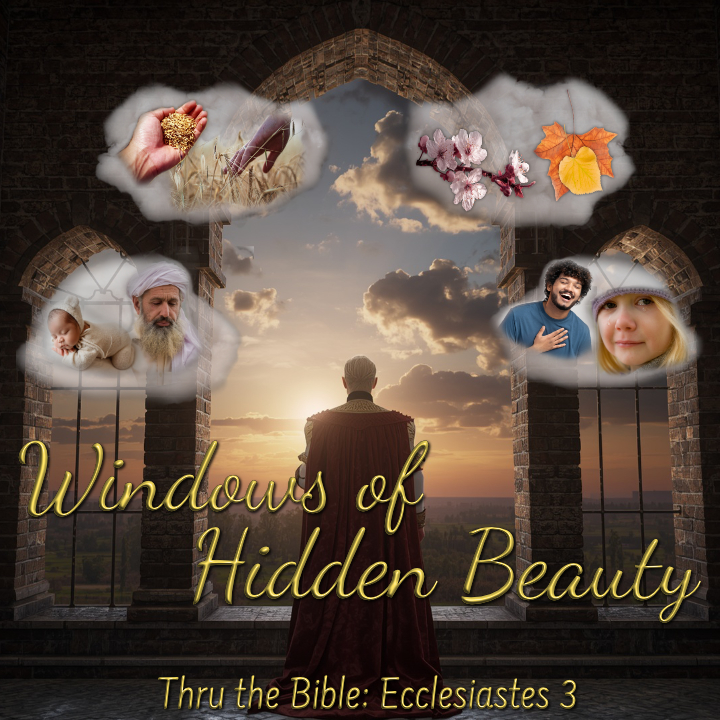
Thru the Bible: Windows of Hidden Beauty
Message Video Player
Message Audio Player:
Podcast: Download (Duration: 1:20:43 — 147.3MB)
Window of Hidden Beauty
Ecclesiastes 3:1-22, (ESV)
“(1) For everything there is a season, and a time for every matter under heaven:”
On the surface, this verse presents us with an intriguing question. The answer most people arrive at will be in keeping with their understanding of God’s sovereignty and character.
For most people, I believe their view of God’s sovereignty is that it is absolute. It is in clearly defining its expression that I believe most opinions cause people to divide along party lines.
God’s sovereignty is in fact absolute. This cannot be logically contested in that He is the Creator and Owner of all which makes His word, will and authority absolute. The problem I believe people have is superimposing upon God, human limitations and weaknesses.
For a human to have power and authority is always a tricky proposition since we are inwardly divided, fickle and easily influenced by emotions and circumstantial opinions.
God on the other hand is not. He is omniscient, unthreatened and all powerful and His actions are always in keeping with His ever unchanging character.
What confuses some people is that this actually places limitations on what God will and will not do – in fact, what He CAN and CANNOT do. God Himself said that it is impossible for Him to lie. That He hates injustice but loves justice and mercy. If one were to be able to clearly identify every aspect of God’s character and ways, His actions would be entirely predictable!
I say all of this because the body of Christ is and has been for some time divided on this topic of God’s sovereignty and its connection with whether mankind possesses freewill.
Now, we settled this issue years ago I wrote an article way back in 2009 called – Is God Sovereign and more recently I taught three lessons on it last year when we ran into the passage in 2 Timothy regarding ‘the elect’. Those messages were called – Free-willed vessels of Honor Pt. 1 • Pt. 2 • Pt. 3.
However, just because we have studied this before does not set aside our need to study this passage as well – it is ALL God’s word and stands to shed light on our understanding of truth. We MUST always handle God’s word with the utmost respect. It would be easy to just say, “well I know it sounds like freewill isn’t real here, but we know better so let’s just move on”, but that would not show the sort of diligence which we must always exert when studying God’s word!
So we do not set aside what we have learned, but we also let each passage speak for itself and then if we see an apparent conflict, we have to reexamine all we know in light of the new information. That will not happen tonight, but I’m just saying it to reinforce what we as Christians should do in our respect and diligence regarding God’s holy word!
So let’s examine this first verse which along with the 11th verse sets the theological framework for this whole chapter.
In the Hebrew, the terminology used in Ecclesiastes 3:1 overwhelmingly leans toward a predetermined, divinely appointed timeframe rather than a random, coincidental occurrence.
Now these are not the only options available to us. In addition to predetermination and random coincidence we also have the cause and effect of free-willed human decisions. Those are the three players on the field. What we have eliminated based upon the text is random coincidence – not freewill.
Solomon frames all human experiences inside God’s master timetable. The passage dictates that events do not happen by random chance or chaotic accident; they happen in their appropriate, God-ordained season.
Now this helps us as well. A season is a relative time period rather than a specific date in time.
Most people who have any knowledge realize that there really is no such thing as true randomness. Everything which comes into contact with a person or event influences its outcome to some degree. You have no doubt all heard of the butterfly effect (the law of nature – not the movie).
The flap of a butterfly wing on one side of the world could set in motion a cascading effect that leads to a tornado on the other side of the world. Of course this example is exaggerated, but it is still a point well made.
Usually, life circumstances are far too complex and multifaceted for our powers of observation to clearly decipher what things, people and events influenced the outcome and to what degree – but our ability to capture a series of influential events leading to a specific outcome does not mean they did not occur.
The grammar and vocabulary of this passage shape its meaning. The use of two distinct Hebrew words for time—zeman (זְמָן) and et (עֵת)—highlights the interplay between God’s absolute, predetermined calendar and the specific, opportune moments experienced in our lives as they unfold.
The differences between the two words reveal specific theological points:
- Zeman (זְמָן – “Season” or “Appointed Time“): This term refers to a fixed, predetermined, and divinely ordained period or duration established by God. It carries the root meaning of a “plan” or “devised” time. In Eccl 3:1, it emphasizes God’s ultimate sovereignty over history—signifying that the overarching rhythms of life (like birth and death) are not random, but part of a divine timetable.
- Et (עֵת – “Time” or “Proper Moment“): This term is broader but is more closely associated with a specific “point in time” or an “appropriate/opportune” moment. While zeman is the overarching structure, et denotes the “ripe” moment for a specific action or event (such as a time to weep or a time to laugh). It emphasizes the experiential and qualitative nature of the specific moment.
The way in which Solomon repeats his thought employing the use of these two terms creates a poetic parallel emphasizing that every event has a structurally assigned window.
This is a VERY important distinction because if understood strictly, it all but eliminates the possibility of freewill, but in reality, the fact that all of these events are either seasonal or are reaping in nature. This places the statement back within the context of what we read in scripture and what we perceive as occurring in nature.
An excellent example of the truth of these two words as they play out in real life can be found in the way God deals with nations and it is an example which is familiar to you.
In the Acts 17:26 Paul tells us that,
“From one man God made every nation of the human race to inhabit the entire earth, determining their set times and the fixed limits of the places where they would live, (27) so that they would search for God and perhaps grope around for him and find him, though he is not far from each one of us.”
This tells us the scope, expression and purpose of God’s power over nations. He determines what, where, when, how and why. But does that mean that these decisions are free from human choices? Absolutely not!
The counterpoint to this is found in Genesis 15:13–16 where we see God telling Abraham that his descendants would remain in Egypt for 400 years before being given the promised land because the judgement of the Amorites was not yet ripe.
So taken together we see that God gave the land to the Amorites with the purpose of them finding Him through seeking. That a “season” was afforded them in which to accomplish this. If they failed to seek and therefore find God, “an appointed time” of judgement was in place so that this same land would be allocated to another nation for the same purpose. In the case of the Amorites, we do not know the entire time allotted by God, but we know they had 400 more years, once Jacob died and Israel became captives in Egypt.
So, if in fact, all of these things were predetermined by God, that would also imply that either we have no freewill OR that our choices present us with no real life consequences since God has already predetermined the outcome independent of our choices.
But is that what we see in scripture? Of course not!
Consider the prophetic word given to Israel through Moses, Joshua and Isaiah all at different times, but towards the same end.
Deut. 30:15-20,“Look! I have set before you today life and prosperity on the one hand, and death and disaster on the other. (16) What I am commanding you today is to love the LORD your God, to walk in his ways, and to obey his commandments, his statutes, and his ordinances. Then you will live and become numerous and the LORD your God will bless you in the land which you are about to possess. (17) However, if you turn aside and do not obey, but are lured away to worship and serve other gods, (18) I declare to you this very day that you will certainly perish! You will not extend your time in the land you are crossing the Jordan to possess. (19) Today I invoke heaven and earth as a witness against you that I have set life and death, blessing and curse, before you. Therefore choose life so that you and your descendants may live! (20) I also call on you to love the LORD your God, to obey him and be loyal to him, for he gives you life and enables you to live continually in the land the LORD promised to give to your ancestors Abraham, Isaac, and Jacob.”
Joshua 24:14-15, “(14) Now obey the LORD and worship him with integrity and loyalty. Put aside the gods your ancestors worshiped beyond the Euphrates and in Egypt and worship the LORD. (15) If you have no desire to worship the LORD, choose today whom you will worship, whether it be the gods whom your ancestors worshiped beyond the Euphrates, or the gods of the Amorites in whose land you are living. But I and my family will worship the LORD.”
Isaiah 55:6, “Seek the LORD while He may be found; call upon Him while He is near.”
The fact that statements like these appear in various forms throughout the Bible, force our decision towards most of these events in Solomon’s list as being either “set seasons” and “windows of opportunity” and that the given outcome of many are conditioned upon our responses.
Solomon now launches into his somewhat famous 14 merisms. Merisms are phrases or figures of speech where the totality of a thing is expressed by combining contrasting, complementary parts.
“There is a time to be born and a time to die”
In this case, instead of Solomon generating a comprehensive listing of every possible event in a human life, he simply cites the extremes or opposing elements of major high points which are common to most people, in order to imply everything else which could fit between them.
It is like a phrase I once heard,
“Our lives are not marked by birthdays, but by the events that fall between them.”
So it is that Solomon is capturing the highs and lows most common to all human experience in order to make a point.
“a time to be born, and a time to die;”
Here I will offer but one more example which will aid you in your understanding of scripture on this point. We all are familiar with the passage in Hebrews 9:27 that says, “And as it is appointed for men to die once, but after this the judgment,” it does not mean that it is appointed unto man a specific time to die – at least not in every case. For we see in the case of Hezekiah that God passed judgement upon him that he would die from his illness in 2 Kings 20:1 and Isaiah 38:1. But upon hearing this Hezekiah repented in tears and postponed this judgment for 15 years so that Hezekiah recovered from his terminal illness. So it is in this light we are to understand these statements.
“a time to plant, and a time to pluck up what is planted;
(3) a time to kill, and a time to heal;
a time to break down, and a time to build up;
(4) a time to weep, and a time to laugh;
a time to mourn, and a time to dance;
(5) a time to cast away stones, and a time to gather stones together;
a time to embrace, and a time to refrain from embracing;
(6) a time to seek, and a time to lose;
a time to keep, and a time to cast away;
(7) a time to tear, and a time to sew;
a time to keep silence, and a time to speak;
(8) a time to love, and a time to hate;
a time for war, and a time for peace.”
“(9) What gain has the worker from his toil?
(10) I have seen the business that God has given to the children of man to be busy with. (11) He has made everything beautiful in its time.
Also, he has put eternity into man’s heart, yet so that he cannot find out what God has done from the beginning to the end.”
The idea here is at once very complex and exceedingly simple and obvious.
There are two theological choices for translating Solomon’s statement at the beginning of verse 11 and that greatly impacts the meaning. Unfortunately, one’s personal point of view can further illuminate or obscure either of these choices.
A proper “word-for-word” translation here would be as it appears in most modern translations “God has made everything beautiful in its time”.
This translation however, is problematic on many levels. For example, the first things mentioned in Solomon’s list is birth and death. Death is set forth in the scriptures as the enemy of God and the result of rebellion against Him. So how can death ever come to a time in which it is beautiful?
Well, the fact that all things are to some degree of another subjective, we could “find a way” to see beauty even in death.
Examples might include:
- When someone dies simply from old age.
- When Jesus died to redeem mankind from sin and death.
- When death itself finally dies.
But these are all subjective and therefore not likely to be what Solomon was truly aiming at and therefore serves only a possible secondary meaning at best.
The NET Bible made a rather bold choice to render this verse in a unique fashion, but one in which it more easily conforms to what Solomon’s clear point was within the larger context of the chapter.
They translate verse 11 as “God has made everything fit beautifully in its appropriate time” and such is strongly justified by the Hebrew text.
Traditional translations differ not only with this translation but among each other largely because of differing theological views and the fact Hebrew poetry is notoriously ambiguous which allows for some flexibility in one’s understanding of what it is saying. However, as I am fond of pointing out, no verse, chapter or even book of scripture exists in a vacuum. It is always to be limited in its scope by what is revealed throughout all of scripture.
The verb “made” used here in Hebrew can also mean “set,” “ordained,” or “appointed.” When paired with the adjective for “beautiful”, we are honestly left with room for interpretation.
Should the emphasis be placed on the aesthetic beauty of God’s timing, or the functional fitness of His design?
The verse opens with a Hebrew phrase which literally translates to “beautiful, in its time“.
- Beautiful (yapheh): While this usually means aesthetic beauty, in this context, it takes on a more nuanced meaning regarding beauty of “appropriate,” “fitting,” or “well-ordered.”
- Appropriate time (eth): This points directly to the preceding verses in Ecclesiastes 3 where Solomon cites his 14 examples.
Therefore, “making everything fit beautifully in its time” perfectly aligns with Solomon’s thesis that God operates in such a way as to bring everything to its appropriate closure so that cause and effect, sowing and reaping, choices and consequences, mercy and judgement all culminate in depiction of perfect balance within the sphere of providential order.
The KJV says “made every thing beautiful in His time“, while the CSB opts for “appropriate in its time“. In some ways, both are true. This chapter is, in some ways, revealing where the intersection between God’s time and human experience.
This leads into the closing point of the statement in verse 11.
“Also, He has put eternity into man’s heart, yet so that he cannot find out what God has done from the beginning to the end.”
Let me just say that Hebrew is a highly contextual language, and Ecclesiastes is famous for its wordplay and deliberate ambiguities.
In the second half of the verse, the Hebrew contains the word ‘olam, which can mean “eternity,” “the world,” or a “hidden, obscure thing.”
- Translators of the ESV and NIV interpret ‘olam as “eternity,” resulting in the famous line: “He has also put eternity into man’s heart“. They interpret this as humanity possessing an innate longing for the infinite, which this world cannot satisfy.
- The NET Bible interprets the word as “obscurity” or “hidden things.” They translate the second clause as God placing a mysterious veil of ignorance over human hearts, preventing us from fully grasping His master plan.
While there are various interpretations, in the end, they all appropriately highlight the central theme: God’s timing is perfect, yet humans lack the capacity to fully comprehend it.
So while Solomon suggests that the full scope of God’s plan is beyond human comprehension, there is still an acknowledgement that we can discover, grasp, and appreciate certain aspects of it within the scope of our daily lives.
The verse beautifully balances two distinct realities regarding divine purpose:
- The incomprehensible “big picture: The text concludes with the idea that “no one can find out the work that God does from the beginning to the end.” This signifies that complete “end goal” comprehension of everything is unattainable for human minds; the ultimate, overarching tapestry of the universe is too vast for us to fully map out.
- Grasping the specific and the present: Despite our inability to know the beginning and see the end, the verse affirms that God “has made everything beautiful in its time.” This indicates that we can recognize, experience, and find meaning in specific moments and seasons as they unfold. We can understand the present aspects of God’s work (like enjoying the fruits of our labor, experiencing joy, and appreciating relationships) without needing to know the ultimate destination of God’s overall plan.
Historically, this verse is often interpreted as an invitation to embrace life’s present blessings and mysteries. Instead of being paralyzed by the inability to see the full, grand finale of one’s life, the text encourages finding purpose, contentment, and gratitude in the specific, localized expressions of good that God both allows and affords us to witness and experience.
So it is that Solomon concludes with this…
“(12) I perceived that there is nothing better for them than to be joyful and to do good as long as they live; (13) also that everyone should eat and drink and take pleasure in all his toil—this is God’s gift to man.
(14) I perceived that whatever God does endures forever; nothing can be added to it, nor anything taken from it. God has done it, so that people fear before Him.
(15) That which is, already has been;
that which is to be, already has been; and God seeks what has been driven away.
(16) Moreover, I saw under the sun that in the place of justice, even there was wickedness, and in the place of righteousness, even there was wickedness.
(17) I said in my heart, God will judge the righteous and the wicked, for there is a time for every matter and for every work.”
Now an ongoing theme of Solomon in this book is to focus upon the similarities between the wicked and the righteous – especially that they both wind up dying regardless of the way they conducted their lives. But the scriptures tell us plainly that God will not judge the righteous with the wicked and that God does show mercy to the merciful. So that while they will both certainly die physically, their eternal judgment will indeed reflect and reward their individual life choices.
Next Solomon wisely offers a clarification which is often missing in scripture and that is that the testing God does, is not to reveal something to Himself which He did not know, but rather to reveal it to us.
Of course there is the additional, yet unstated reason of justice. God will often test someone in order to prove the justness of His actions either for or against them. We have an advisory who accuses us and challenges God’s justice in His blessing of His children and while God owes nothing in terms of accountability to satan, God does owe it to His Own character to prove the justice of one judgement or another. [Consider these passages in support of this truth – Romans 3:26 & Psalm 51:3.)
While Solomon typically makes this comparison between the righteous and the wicked, as I previously pointed out, here he strengthens the force of his argument by revealing that what happens to animals also happens to humans in regard to physical death. There is no advantage of one over the other. THEN he drives home his overarching point in this chapter by pointing out something which is “hidden” from man.
“(18) I said in my heart with regard to the children of man that God is testing them that they may see that they themselves are but beasts. (19) For what happens to the children of man and what happens to the beasts is the same; as one dies, so dies the other. They all have the same breath, and man has no advantage over the beasts, for all is vanity.”
“(20) All go to one place. (in that…)
All are from the dust, and to dust all return.
“(21) Who knows whether the spirit of man goes upward and the spirit of the beast goes down into the earth?”
While both share the same physical fate, we do not know if the spirit of man goes up and the spirit of animals goes down. The word spirit is רוַּח (rûaḥ) roo-ahk, and means spirit, wind, breath. It is used to refer to the Spirit of God. The same spirit that inspired prophets to speak God’s words and is modified adjectives to speak of evil spirits. It can also simply refer to the breath as a result of breathing. The point here is not to say for certain that animals are definitely eternal spirits like humans, but to reveal that we do not know. All we know is what we can see and that is that we both will eventually stop breathing and physically die. Do we know if in dying an animal simply returns to the dust from which they came and nothing more? No, we do not – and things such as this which are hidden from us is part of Solomon’s overall point as he said in the later part of verse 11,
“Also, He has put eternity into man’s heart, yet so that he cannot find out what God has done from the beginning to the end.”
So what is the conclusion Solomon makes from these observations?
“(22) So I saw that there is nothing better than that a man should rejoice in his work, for that is his lot.
Who can bring him to see what will be after him?”
This last phrase captures the overall thrust of this chapter which is that eternal matters are undiscoverable and therefore unpredictable.
The conclusion: Live for today – rejoice in what you do while “under the sun” or “under the heavens” because who knows what will become of you or where you will go when your earthly time is over.
POSSIBLE QUOTES:
- P. Moreland, “God maintains a delicate balance between keeping his existence sufficiently evident so people will know he’s there and yet hiding his presence enough so that people who want to choose to ignore him can do it. This way, their choice of destiny is really free.”
“What can be seen on earth indicates neither the total absence, nor the manifest presence of divinity, but the presence of a hidden God. Everything bears this stamp.”
– Blaise Pascal, Pensées (449) / 142
“Instead of complaining that God had hidden himself, you will give Him thanks for having revealed so much of Himself.”
Blessings!
Blessings!