|
This is a text reader for the article below:
Getting your Trinity Audio player ready...
|
Wednesday 5/13/26
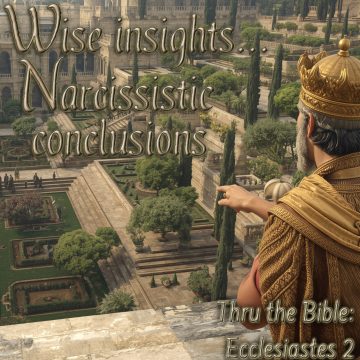
Thru the Bible: Wise insights… Narcissistic conclusions
Message Video Player
Message Audio Player:
Podcast: Download (Duration: 59:58 — 111.9MB)
Wise insights… Narcissistic conclusions
Ecclesiastes 2:1-26, (ESV)
Now remember the setting is an elderly Solomon who is reflecting back on the actions of his life. We do not know for certain the progression of Solomon’s moral decline. It may have begun very early in life or cropped up later, but most declines into sin are not immediate. Nevertheless, by his old age his heart had been turned as we see in 1 Kings 11.
1 Kings 11:1-6, “(1) King Solomon loved many foreign women in addition to Pharaoh’s daughter: Moabite, Ammonite, Edomite, Sidonian, and Hittite women (2) from the nations that the LORD had told the Israelites about,
“Do not intermarry with them, and they must not intermarry with you, because they will turn you away from Me to their gods.”
Solomon was deeply attached to these women and loved them. (3) He had 700 wives who were princesses and 300 concubines, and they turned his heart away from the LORD.
(4) When Solomon was old, his wives seduced him to follow other gods. His heart was not completely with the LORD his God, as his father David’s heart had been.
(5) Solomon followed Ashtoreth, the goddess of the Sidonians, and Milcom, the detestable idol of the Ammonites. (6) Solomon did what was evil in the LORD’s sight, and unlike his father David, he did not completely follow the LORD.”
Solomon allowed these wives to turn his heart from God to the pagan idols of Ashtoreth, Molech & Chemosh.
- At that time, the primary focus of Ashtoreth (also known as Astarte or the “goddess of the Sidonians“) was as a fertility and sensuality deity. Her worship was often paired with Molech (Baal) and centered on ensuring agricultural prosperity, love, and sexual vitality, frequently involving indulgent rituals and sacred prostitution.
- Molech was the Ammonite god associated with child sacrifice. This idol worship was centered around fertility rites aimed at securing prosperity. It was deeply intertwined with Canaanite and Phoenician religious traditions.
- Chemosh was the national, protective deity of the Moabites and a warrior god who was worshipped to secure military victory, prosperity, and protection. [See Lev. 18:21; Jdg. 2:13; 1 Kings 11:5, 7, 33.]
Though these seem to exercise little impact on the pursuits of Solomon since he was already prosperous and had many wives, I still thought it wise to read in order to offer you what little backdrop we have available to us on Solomon and the condition of his life before we begin the actual contents of the book which, in my opinion, begins with chapter 2 since chapter 1 functions somewhat like an intro/overview to the book.
“(1) I said in my heart,
“Come now, I will test you with pleasure; enjoy yourself.” But behold, this also was vanity.”
It is interesting that the phrase here in the Hebrew almost presents this as an intellectual puzzle to be solved by observation and contemplation rather than personal indulgence. The following verses however, quickly lays that possibility to one side.
Verse 2 could be understood as saying two different things, but evidently in Hebrew it is clear which is intended.
“(2) I said of laughter, “It is mad,” and of pleasure, “What use is it?”
Solomon is not presenting this as a question to himself to explore and search out, as in verse 1, but is offering the results of something already looked into.
“(3) I searched with my heart how to cheer my body with wine—my heart still guiding me with wisdom—and how to lay hold on folly, till I might see what was good for the children of man to do under heaven during the few days of their life.”
Let’s take a closer look at this statement because it supplies us with Solomon’s own statement regarding his intentions in all of this.
- “I searched with my heart” (לִבִּ֖י תָּ֣ר בַּחָכְמָ֑ה): “Heart” refers to the entire soul – mind, will emotions and not just the “feelings”. Solomon is attempting to express his deliberate, intellectual investigation and controlled testing of something rather than an impulsive binge or action.
- “My heart still guiding me with wisdom” (וְלִבִּ֥י נֹהֵ֖ג בַּחָכְמָ֑ה): The verb “guiding” or “driving” is a deliberate construction by which Solomon is suggesting a delicate balance—using wisdom to direct his indulgence. There are real technical and spiritual problems with this, because true wisdom would not guide such a process, but rather steer one away from it. So we are presented with a dilemma – do we take Solomon’s words at face value knowing that due to his sin, he might only “believe” his wisdom was still intact OR do we assume this is God’s testimony about Solomon’s condition? Well that is a real question which underscores all that follows. The only things that lead me to believing his testimony is that his wisdom was a gift AND that it would seem that this account would provide no sure guide towards truth and godliness unless his wisdom had in fact remained with him.
- “To lay hold on folly” (וְלֶאֱחֹ֣ז בְּסִכְל֑וּת) embedded in this declaration is a clear intent to engage in and with frivolous and lascivious behavior in order to test its value. While this could easily be seen as an intellectual front for vice, scripture seems to be setting these facts before us as truth, so we will proceed under that assumption.
- “Till I might see what was good” (עַד־אֲשֶׁ֣ר אֶרְאֶ֔ה אֵי-זֶ֣ה טוֹב): Solomon, possessing wisdom already knew what was truly good, so I think this may saying what activities in life one might engage in which will lead to the greatest sense of fulfillment. The word “good” not meaning “perfect” in an experiential or moral way, nor meaning merely “okay” but rather something which in itself is truly valuable and worthwhile. Something that holds true profit and provides lasting satisfaction, rather than temporary or fleeting enjoyment. Something that in the doing would produce an outcome that actually improves the “few days of their life,” even offering a meaningful answer to the purpose of human toil.
In this very chapter (verses 24-26) we already catch a glimpse of his conclusions which again reveal an “end of life” time of composition. The “lasting and worthwhile” benefit Solomon is seeking in these earthly pursuits leads him to the awareness that such cannot be found in things or the pursuits of this life but rather in the appreciation of these things as a gift from God,
Now I know it seems a ridiculous thing to search out “folly” or “foolishness” by means of wisdom. I mean, could there be a clearer example of oil and water not mixing.
However, since Solomon was gifted wisdom from God and there is no indication that his wisdom ever left him and we have self-assertions within this book that his wisdom remained with him, this makes this pursuit of “foolishness” and “folly” seem all the more unbelievable.
So I looked up the word “folly” again and it presented an insight that may have even been hidden from Solomon at the time, but which was later brought before him in full view.
The word translated as “foolishness” or “folly” means a way of life devoid of wisdom, God, self-understanding, or an understanding of others.
Perhaps Solomon was being purposeful here – attempting to use wisdom to seek out those things one can do and pursue in life that could result in lasting satisfaction apart from God.
All the while wisdom itself was steering Solomon towards the very truth he sought, through entering into the results of the foolishness of his actions. To use the deep inner sense of his heart as well as clear intellectual conclusions derived from the emptiness and death which comes from selfish pursuits to reveal what has always been true of created things. That lasting value, satisfaction, and life can only be found in the Creator, not in what He creates alone.
Solomon continues…
“(4) I made great works.
I built houses and planted vineyards for myself.
(5) I made myself gardens and parks, and planted in them all kinds of fruit trees.
(6) I made myself pools from which to water the forest of growing trees.
(7) I bought male and female slaves, and had slaves who were born in my house. I had also great possessions of herds and flocks, more than any who had been before me in Jerusalem.
(8) I also gathered for myself silver and gold and the treasure of kings and provinces.
I got singers, both men and women, and many concubines, the delight of the sons of man.”
While not immediately important to our purposes in studying Ecclesiastes, I will simply mention in passing that the scriptures express a clear distinction in the way Israelite slaves and foreign slaves were treated.
There is no indication that Solomon was either overly kind and generous or harsh and neglectful of any slave – foreign or Israelite, but it would seem unlikely that he would have been cruel.
Owning slaves in that day was radically different from today, in that in foreign nations they were treated less than human. In Israel however, there were laws against such treatment and they were called upon by God to remember that they themselves had come out of slavery.
That being said, these “foreign slaves” were purchased which would indicate they had not been “resident strangers” but rather literal foreigners purchased from other nations OR slaves purchased from “resident strangers” living in Israel. In both cases, it would seem these did not include the “resident strangers” themselves. Leviticus 25:44-46, allowed Israelites to purchase slaves from the foreign nations around them and from foreign residents living in Israel. These were owned outright as property and were assigned various tasks of service either for the temple such as cutting wood or carrying water, or for Solomon’s personal projects.
Israelites were NOT purchased by Solomon, but rather conscripted and this caused a fair amount of backlash and resentment among the Israelites later in Solomon’s reign. What made these men and women different in treatment from the actual slaves was that they were forced into temporary labor for short time periods, then allowed to return home for a while before returning to forced labor again. This was like a national “draft” only it was not for war, it was for work. There is no proof that they were paid, but rather they were coerced into forced labor on top of mandatory taxation. This all accords with God’s warning to Israel against seeking kings to rule over them in 1 Samuel 8:10-18 that a king would take their sons and daughters to work his fields and build his weapons.
This is a great example of the wisdom of Proverbs 19:3 which says,
“A man’s own foolishness leads him astray, yet his heart rages against the LORD.”
Ecclesiastes 2…
“(9) So I became great and surpassed all who were before me in Jerusalem. Also my wisdom remained with me.
(10) And whatever my eyes desired I did not keep from them.
I kept my heart from no pleasure, for my heart found pleasure in all my toil, and this was my reward for all my toil.”
“(11) Then I considered all that my hands had done and the toil I had expended in doing it, and behold, all was vanity and a striving after wind, and there was nothing to be gained under the sun.”
The word “gained” is ִיְתרוֹן yiṯrôn (yith-rone) and has two meanings – what come as the result of something and the profit or advantage of something – the both of which are in their own ways implied here. Solomon indulged himself in many projects, but once completed found they conveyed no lasting benefit for all the labor invested.
“(12) So I turned to consider wisdom and madness and folly. For what can the man do who comes after the king? Only what has already been done.
(13) Then I saw that there is more gain in wisdom than in folly, as there is more gain in light than in darkness.
(14) The wise person has his eyes in his head, but the fool walks in darkness. And yet I perceived that the same event happens to all of them.”
This is another great example of what was going on in Solomon. Wisdom revealed that to be wise carries more benefit than being foolish even as light conveys more benefit than darkness. But this insight was run through his “under the sun” mentality or filter so that it contaminated his conclusions. Since in the end, everyone is going to physically die and be forgotten, what little good my wisdom and light (insight) gave me, is of no lasting value. It is fleeting, temporary and therefore without value.
“(15) Then I said in my heart,
“What happens to the fool will happen to me also. Why then have I been so very wise?” And I said in my heart that this also is vanity.
(16) For of the wise as of the fool there is no enduring remembrance, seeing that in the days to come all will have been long forgotten. How the wise dies just like the fool!
(17) So I hated life, because what is done under the sun was grievous to me, for all is vanity and a striving after wind.”
So we see what was truly valuable to Solomon was his natural life, his image before mankind and his lasting legacy on the earth. This was so much true, that if his efforts could not guarantee him these outcomes, then those efforts were meaningless and futile.
“(18) I hated all my toil in which I toil under the sun, seeing that I must leave it to the man who will come after me, (19) and who knows whether he will be wise or a fool? Yet he will be master of all for which I toiled and used my wisdom under the sun. This also is vanity.”
(20) So I turned about and gave my heart up to despair over all the toil of my labors under the sun, (21) because sometimes a person who has toiled with wisdom and knowledge and skill must leave everything to be enjoyed by someone who did not toil for it. This also is vanity and a great evil.”
Most people leave their valuables for their children and grandchildren and this gives them a sense of completion and a job well done – a life well lived. But Solomon was so consumed with his own person, his own selfish benefit as well as how he was viewed and would be remembered by others – that this enraged him!
These are more than simple points of irritation to Solomon, but represent a profound existential crisis.
The word “hated” שָׂנֵא śānē’(saw-nay’) in verse 18 in this context carries the nuance of disgust, rejection and total disillusionment with the effort expended. It implies a profound weariness and a sense that the work was ultimately futile or “empty”.
Solomon is not simply angry at this, he was repulsed by the reality that his hard work will be left to someone else who did not earn it. So much so that he came to hate what he had created.
The word “despair” אַשׁ yā’aš (yaw-ash’) ment these truths lead him to surrendering all hope, abandoning himself to despair and give up on the possibility of anything yielding a positive outcome.
The use of this word in this context indicates that there was nothing superficial about these feelings and conclusions but they represented a crisis of soul that affected his entire person and life.
Because death severs the laborer from his reward, and that the fruit of his labor is left for others to gain the benefit of, brought him to a state of near mad inner despair. This was a life crisis for which he could see no remedy!
“(22) What has a man from all the toil and striving of heart with which he toils beneath the sun? (23) For all his days are full of sorrow, and his work is a vexation. Even in the night his heart does not rest. This also is vanity.”
This is not so much a statement of all people, but rather Solomon’s which he assumed anyone who truly grasped the truth of his conclusions would forever be robbed from enjoying his toil AND his rest.
Nevertheless, is it all we have, so it is best to attempt to enjoy it to the best of your abilities…
“(24) There is nothing better for a person than that he should eat and drink and find enjoyment in his toil. This also, I saw, is from the hand of God, (25) for apart from Him who can eat or who can have enjoyment?”
(26) For to the one who pleases Him God has given wisdom and knowledge and joy, but to the sinner He has given the business of gathering and collecting, only to give to one who pleases God.
This also is vanity and a striving after wind.”
It is hard to see where Solomon saw himself in these ending statements. Since he knew and readily acknowledged that he was wise, yet he seems to feel he has more in common with the sinner. Perhaps in his charity of thought he realized that he was in some ways both. He was a man who had been initially blessed with wisdom in the piety of his youth, but who was now cursed with the same so that as a sinner he was unable to enjoy his selfish pursuits.
Blessings!
Blessings!