|
This is a text reader for the article below:
Getting your Trinity Audio player ready...
|
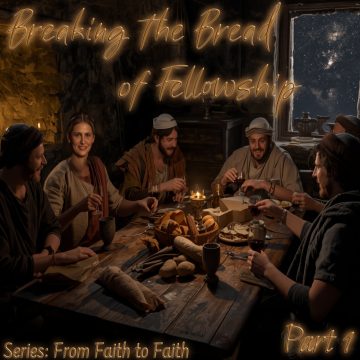
Sunday 6/07/26
Title: Breaking the Bread of Fellowship Pt. 1
Click for Message Video
Message Audio Player:
Podcast: Download (Duration: 1:16:29 — 59.7MB)
Breaking the Bread of Fellowship Pt. 1
We are continuing this week looking at the third devotion of the early church which were communal meals, also known as koinonia meals. They included both the Lord’s Supper which we focused upon in closing on Pentecost and will continue this morning, as well as normal meals of fellowship later called love (agape) feasts.
Turn with me now to John 6…
John 6:24-68 (ESV),
“(24) So when the crowd saw that Jesus was not there, nor His disciples, they themselves got into the boats and went to Capernaum, seeking Jesus. (25) When they found Him on the other side of the sea, they said to Him,
“Rabbi, when did You come here?”
(26) Jesus answered them,
“Truly, truly, I say to you, you are seeking Me, not because you saw signs, but because you ate your fill of the loaves.
(27) Do not work for the food that perishes, but for the food that endures to eternal life, which the Son of Man will give to you. For on Him God the Father has set His seal.”
Now this real life occurrence is a living out or unrehearsed and living parable of the words of God through Isaiah to Israel nearly 700 years prior referenced in Isaiah 55:1-13. Let’s turn there and then return here to witness the agreement in the lesson both are teaching us. This will set the pace for the greater teaching of sharing in communion at the Lord’s table before we close today.
Isaiah 55:1-13,
“(1) Come, everyone who thirsts, come to the waters; and he who has no money, come, buy and eat! Come, buy wine and milk without money and without price.
(2) Why do you spend your money for that which is not bread, and your labor for that which does not satisfy?”
This is essentially the same question Jesus just asked the crowd which had sought for Him.
“Do not work for the food that perishes, but for the food that endures to eternal life” – John 6:27
“Listen diligently to Me, and eat what is good, and delight yourselves in rich food.”
The Ephesian Church we are studying, had fallen into a trap just like this one. It’s a trap the enemy sets for every child of God that he can’t distract or draw away through blatant sin, and that is the trap of self-governance or and forgetting one’s place.
I would call it the trap of over-diligence but that paints the wrong picture, because for most people it’s hard to imagine being too diligent. But imagine, if you will, an employee whose job is to run the register and make sure things tally out at the end of the shift. However, this employee comes back later in the evening at the end of the next shift and takes it upon themselves to try and tally out the figures at the end of that shift… and this employee just never stops.
They grow increasingly more involved in the input and output of the store so that they are there when deliveries are made and items are stocked and inventory is confirmed.
This goes beyond diligence and into an area of control that doesn’t allow for trust.
When a person acts like the Ephesian church and becomes so over diligent regarding their study and understanding of sound doctrine, it doesn’t take too long before that path leads away from intimacy with and love for Christ and towards a disconnected preoccupation with facts about Him. This latter approach is always, to some degree or another, whether cognizant or not, is to protect yourself. Either from being deceived, or from the vulnerableness of intimacy or just to make sure you can never be caught off guard – always knowing what to say.
This is a fine line which the mind cannot figure out, and it is a line that is different for each person.
In the end, there is a need to study and in need to investigate – to show due diligence by putting effort into something that has real transcendent meaning like your relationship with Christ. But in order for it to be a relationship there has to be room for trust that the Holy Spirit will lead and guide you into the truth and that you can trust Him to protect your heart from false doctrine and from things which are offensive to the nature of Christ.
If God had to make a choice between diligence and love He would choose love. Of course this does not represent a real choice because if one does love, they will pursue, but you can pursue and not love and that’s the real issue here.
We cannot afford for even one moment to think of our walk in Christ as anything but a living breathing relationship with God. One of coming to know and being known in vulnerability, intimacy and trust.
Faith or Trust does not come from learning about God so much as it does by interacting with him.
Romans 10 tells us the “faith comes by hearing and hearing by the word of God”.
Of course you all know this means God’s revealed word – meaning that which the Holy Spirit knows we need to understand and which He reveals to us.
It is as we will learn in a moment – the lesson of the manna – where we cannot live by externals and flesh born provisions alone, “but by every word” that never fails to fall off the lips of God to us every moment of every day.
I want to suggest something here in passing which has real value to us, and that is the fact that God said “EVERY word” not, “some of God’s words” or “those words I personally like”, but EVERY WORD – that PROCEEDS (and ongoing communication of His soul to ours).
And so picking up in verse 3 the prophet encourages Israel by saying,
“(3) Incline your ear, and come to Me; hear, that your soul may live; and I will make with you an everlasting covenant, My steadfast, sure love for David.
(4) Behold, I made him a witness to the peoples, a leader and commander for the peoples.”
The reason God was able to make him a true and steadfast witness is because for David it truly was a witness -meaning something he had experienced and lived himself and so therefore was on good grounds to serve as a testimony.
“(5) Behold, you shall call a nation that you do not know, and a nation that did not know you shall run to you, because of the LORD your God, and of the Holy One of Israel, for He has glorified you.”
No I don’t pretend to understand all this means when it says that God has glorified you, at least under the old covenant, but that word glorify means to beautify. May I suggest to you that there’s nothing beautiful about filthy rags. Our efforts to perfect ourselves, our actions regardless of how much natural good they do and how far reaching their effects are if they’re not done in God through his power through his might and short through reliance and trust upon his guidance and power then they are in fact both sin as Romans 14:23 tells us and filthy rags.
So at least one meaning for this that “the Lord has glorified you” would run very similar to what it means in the New Testament. That you, through your knowing and trusting of God, have come to be united with Him, allowing His power and will to be expressed in and through you.
That is the most beautiful condition which could be said of any of God’s creations.
There’s nothing beautiful about a defiant and a rogue angel, but the beauty of God’s angels is at once, that they have ever lived before Him, having never disobeyed Him and ever live to respect and honor Him. And in that way they serve as our examples even as we are designed to serve as theirs.
Isaiah guys on to say,
(6) “Seek the LORD while He may be found; call upon Him while He is near; (7) let the wicked forsake his way, and the unrighteous man his thoughts; let him return to the LORD, that He may have compassion on him, and to our God, for He will abundantly pardon.
(8) For My thoughts are not your thoughts, neither are your ways My ways, declares the LORD.
(9) For as the heavens are higher than the earth, so are My ways higher than your ways and My thoughts than your thoughts.”
And now we read a poetically descriptive analogy of the glorification process I mentioned just a moment ago.
(10) “For as the rain and the snow come down from heaven and do not return there but water the earth, making it bring forth and sprout, giving seed to the sower and bread to the eater, (11) so shall My word be that goes out from My mouth; it shall not return to Me empty, but it shall accomplish that which I purpose, and shall succeed in the thing for which I sent it.
(12) “For you shall go out in joy and be led forth in peace; the mountains and the hills before you shall break forth into singing, and all the trees of the field shall clap their hands.
(13) Instead of the thorn shall come up the cypress; instead of the brier shall come up the myrtle; and it shall make a name for the LORD, an everlasting sign that shall not be cut off.”
This passage is easily connected to John 14 with the “Vine and the branches” and His word abiding in us and with Hebrews which warns of producing nothing but “briars and thistles” in response to the rain of God’s word often falling upon the soil of our souls.
Let’s return to our passage in John 6…
“(28) Then they said to Him,
“What must we do, to BE doing the works of God?”
(29) Jesus answered them,
“This is the work of God, that you believe in Him Whom He has sent.”
The fact that God has never required, of any person or people group, initial blind faith, should solidly place this statement of Jesus in a context which says, “come to know Me”. Or as Jesus often said it, “possess eyes to see in ears to hear”.
“(30) So they said to Him,
“Then what sign do You do, that we may see and believe You? What work do You perform? (31) Our fathers ate the manna in the wilderness; as it is written, ‘He gave them bread from heaven to eat.’”
(32) Jesus then said to them,
“Truly, truly, I say to you, it was not Moses who gave you the bread from heaven, but My Father GIVES you the true bread from heaven. (33) For the bread of God is He Who comes down from heaven and gives life to the world.”
You can see here that Jesus is trying to get them to know Him and therefore believe Him.
“(34) They said to Him,
“Sir, give us this bread always.”
(35) Jesus said to them,
“I am the bread of life; whoever comes to Me shall not hunger, and whoever believes in Me shall never thirst.”
This is a great example of what I pointed out to you earlier. These statements were all focused upon an ongoing action and life.
The grammatical structure and the immediate narrative context of John 6:35 strongly imply an ongoing commitment to fellowship and dependence, rather than a one-time transaction.
The Greek present tense primarily communicates a continuous, ongoing, or habitual action.
While the substantive participle has Jesus describing a lifestyle or identity.
A literal translation would look like this – “the one who is continually coming” and “the one who is continually believing“.
The context supports this as well since the object lesson is centered around a daily need of nourishment – namely bread.
So the “work of God” they are to busy themselves with is a continual coming to the Father through Jesus in a long-term relationship of knowing and trusting (faith).
It is a commitment to ‘The Fellowship’s – ongoing fellowship or koinonia.
Remember 1st John tells us that the fellowship is not just horizontal among the brethren but it is first vertical between us and God. He also says that you cannot have one without having the other.
This backs our primary lesson which is that faith is NOT a once and done prospect but an ongoing relationship of continual growth in actively trusting Christ.
If Jesus had meant to communicate that a singular, isolated event of coming and trusting was all that was necessary, John in recording it, would likely have used an aorist participle (denoting a single, completed action).
The choice to use the present tense portrays a continuous and relational drawing near to God the Father through Christ Jesus.
And if the teaching is that we come to know the Father through the Son and as a result trust them both, then it stands to reason that the invitation is a continual one as well.
We are forever welcomed before the throne of God.
We just read in Isaiah 55 “everyone who is thirsty come and have your thirst quenched without cost”.
- Jesus said at the great feast, “whoever is weary and heavy latent come and learn of Me and you will find rest for your souls.”
- When God says to the church of Thessalonica to “pray without ceasing”.
- When the psalmist says, “pour out your heart before Him God is a refuge for us” and when he warms us to not “be like a horse or like the mule who have no understanding and will not come near unless they’re harnessed with bit and bridal”.
- When we are told by the writer of Hebrews to “…come boldly unto the throne of grace, that we may obtain mercy, and find grace to help in time of need.“
- And by Paul to the Philippians that we are to “be anxious for nothing but in everything come before our God in prayer with a heart and attitude of worship and thanksgiving”.
Are we not being told by all of this, not only that God wants to be known and discovered but that He invites us to seek Him and find Him – that He is indeed not very far from every one of us for in Him we live and move and have a very being.
We can do that without being hungry and pursuing.
Get out of your tent and look, gather and eat!
Blessings!
Blessings!