|
This is a text reader for the article below:
Getting your Trinity Audio player ready...
|
Wednesday 7/01/26
Thru the Bible: Cast your bread upon the Water
Message Video Player
Message Audio Player:
Podcast: Download (Duration: 47:11 — 26.2MB)
Cast your bread upon the Water
Ecclesiastes 11:1-10,
Now this first verse in the New English Translation is radically different than I have ever heard it, but it is also the first time it made any sense.
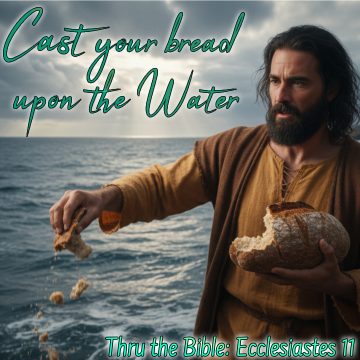
“(1) Send your grain overseas, for after many days you will get a return.”
The word “cast” is often used in many translations but “send” is equally an accurate term. “Bread” is often used in place of “grain” but both translations of this word are well represented in scripture.
In the end, I think common sense wins out. If you cast your bread upon the water, it will not return to you in many days, it will be water logs, break apart and be eaten by both fish and fowl. Even if it did return to you, you would not want it. No, it makes many times more sense to believe this is talking about exporting grain for profit. And profit seems to be the theme of these first few verses as well, making this translation even more likely/
“(2) Divide your merchandise among seven or even eight investments, for you do not know what calamity may happen on earth.”
This is very much akin to mutual funds which pool money from many investors to buy a wide diversity of stocks, bonds, or other securities. This diversifies your financial portfolio and thereby decreases your overall risk from having all your eggs in one basket so to speak.
“(3) If the clouds are full of rain, they will empty themselves on the earth, and whether a tree falls to the south or to the north, the tree will lie wherever it falls.”
Solomon is saying, you can’t control everything. Whatever happens, happens. It is what it is – worrying or using the possibility of adversity to avoid taking action is not wise – which is what the next verse affirms.
“(4) He who watches the wind will not sow, and he who observes the clouds will not reap.”
Now Solomon encourages us to not allow ignorance to lead to un-chased thoughts of despair and woe. It IS true, you do not know what tomorrow will bring, but if you do nothing, then your cowardice and over caution will be certain to generate a scenario very similar to the one you were concerned about avoiding. So he encourages us to go ahead, and commit to something. Do it with all your might. If you plant seed, then plant several varieties because you do not know what will prosper and what will not. But not planting anything will certainly end in poverty and hunger.
“(5) Just as you do not know the path of the wind, or how the bones form in the womb of a pregnant woman, so you do not know the work of God Who makes everything.
(6) Sow your seed in the morning, and do not stop working until the evening; for you do not know which activity will succeed – whether this one or that one, or whether both will prosper equally.”
These are all very practical statements regarding life and provision which address motive and motivation, incentive and apathy, encouraging action with caution.
“(7) Light is sweet, and it is pleasant for a person to see the sun. (8) So, if a man lives many years, let him rejoice in them all, but let him remember that the days of darkness will be many – all that is about to come is obscure.”
Light and dark, the sun and dark clouds are mostly metaphors. The light and sun represent this present life and darkness represents the grave. The obscure nature of the future is also first referring to death and second to our immediate future as the text supplied.
NOW, Solomon begins to shift his tone and attention. Chapter 11:9 is quite literally THE pivot point of the entire book!
Up until now Solomon has presented to us a book filled with subjective views of what benefits mankind and what doesn’t. What externally seems fair while we live out our physical lives and what does not. What collectively is foolish, fleeting and without value as compared with what possesses real and lasting value.
What Solomon now encourages is a glance behind the curtain if you will. A consideration of what is to come, where we will have to own, in one final and eternal reality, the consequences of choices we made while living “under the sun”.
This is where God’s intentions in inspiring this book and Solomon’s personal reasons for writing it begin to meet up!
These closing verses will also serve as our beginning verses next week as we work through the final chapter. There are distinct advantages to placing this verse at the end of this chapter, but there are other advantages to reading it as the segue into the final chapter of Ecclesiastes.
“(9) Rejoice, young man, while you are young, and let your heart cheer you in the days of your youth. Follow the impulses of your heart and the desires of your eyes, but know that God will judge your motives and actions.”
This is the first statement of balanced enjoyment with caution in the entire book!
Solomon has often concluded that the best there is for mankind while “under the sun”, is to busy ourselves with work which is both best suited to our skills and which brings satisfaction and delight. Then to take the proceeds of our labors and eat and drink, so as to enjoy the short times of joy afforded us in this life. He presents this as God’s gift to us.
Here Solomon continues with this encouragement, especially when we are young and have the strength and vigor to make the most of it. BUT, he cautions us to do whatever we do, with a view to the fact that our actions are before the eyes of God before Whom we will have to offer an account.
Interestingly here, Solomon draws the heist attention not to our actions alone, but rather to the motive behind them. God sees all and will try all.
This is the introduction to the book’s conclusion which drives our attention towards motives and actions which will best hold up under the scrutinizing gaze of our Creator. If we limit our enjoyment to things which God allows, sanctions and smiles upon and we do them in joyful respect to the Giver of these gifts – there is a reward. But if we esteem them higher than the Creator, and replace the Giver with the gifts He gives, then we make ourselves idolaters and the substitution is both serious and deadly.
If you will permit me, I will quote from one of my favorite books, The Pursuit of God by A.W. Tozer. It is from the beginning of the second chapter which is entitled, “The Blessedness of Possessing Nothing”
“Before the Lord God made man upon the earth He first prepared for him a world of useful and pleasant things for his sustenance and delight.
In the Genesis account of the creation these are called simply “things.” They were made for man’s use, but they were meant always to be external to the man and subservient to him. In the deep heart of the man was a shrine where none but God was worthy to come. Within him was God; without, a thousand gifts which God had showered upon him.
But sin has introduced complications and has made those very gifts of God a potential source of ruin to the soul.
Our woes began when God was forced out of His central shrine and things were allowed to enter. Within the human heart things have taken over. Men have now by nature no peace within their hearts, for God is crowned there no longer, but there in the moral dusk stubborn and aggressive usurpers fight among themselves for first place on the throne.
This is not a mere metaphor, but an accurate analysis of our real spiritual trouble.…
The tyranny of things
Our Lord referred to this tyranny of things when He said to His disciples, “If any man will come after Me, let him deny himself, and take up his cross, and follow Me. For whosoever will save his life shall lose it: and whosoever shall lose his life for My sake shall find it” (Matt. 16:24 – 25).
Breaking this truth into fragments for our better understanding, it would seem that there is within each of us an enemy which we tolerate at our peril.
Jesus called it “life” and “self,” or as we would say, the self-life.
Its chief characteristic is its possessiveness: the words gain and profit suggest this.
To allow this enemy to live is, in the end, to lose everything.
To repudiate it and give up all for Christ’s sake is to lose nothing at last, but to preserve everything unto life eternal.
And possibly also a hint is given here as to the only effective way to destroy this foe: it is by the cross. “Let him take up his cross and follow me.” …
So Solomon calls upon us to banish all but God from the inner shrine of our hearts!
“(10) Banish emotional stress from your mind. and put away pain from your body; for youth and the prime of life are fleeting.”
On the surface, this reading is troublesome – for what young person would deliberately inflict pain upon their body?
The word translated as “pain” here almost certainty does not mean don’t “harm your body” in a literal self-injurious sense.
The opening of the verse helps to provide the context for understanding the entire verse and it encourages young people to remove emotions which tend towards stress. These include, but are not limited to things such as anger, jealousy, bitterness, anxiety, despair, loneliness, self consciousness & shame to simply name a few.
These emotional extremes are pervasive in teens and young adults since their entire world is in flux at such an age.
Their bodies are continuing to change, their hormones fluctuate widely, life has not yet taken its long term shape. They are often stressed between knowing what they want to pursue in life against what they feel they are good at. Added to this is the pressing concern of failure and what they believe others think.
It is, all in all, a very stressful time of life!
Solomon encourages them to not indulge in these emotions and thought patterns through engaging with them. So the context is one which regards the destructive effects in one’s heart from over thinking or over evaluating everything.
So when he shifts the attention to their bodies, it seems more consistent with the flow of thought that this call to remove harmful tendencies from their life since the word “flesh” here can also mean one’s whole person or your whole physical life.
As such this could include the type of wayward living that the young are particularly prone to. Staying up late, indulgent consumption of food, or alcohol, smoking and the use of drugs. Over exertion along with other forms of excessive behavior including too much study or over working and not getting enough rest.
All of these have a destructive and harmful effect on the body and if continued in, can become the adopted “norm” for their long term adult life.
As such a possible paraphrase for this verse could be, “Take anger out of your heart and keep harmful ways away from your whole life, because youth passes quickly.” In many ways this seems to capture the moral and practical force of the verse better than a literal idea of bodily injury.
It’s no stretch of the imagination to consider that most young adults live as if they believe they are superhuman.
- When their heart gets broken over puppy love, they rebound pretty strong.
- When they fall they don’t typically break.
- When they over-indulge they tend to snap back quickly.
And this tends towards a mindset of indestructibility which WILL NOT last!
I know all too well that in that environment of mental and emotional invulnerability it is easy to acquire habits which will bring great harm later in life.
Emotionally I was pretty resilient. I didn’t take too much to heart if someone picked on me or put me down. As such, I dealt it out with regular proficiency as well and wound up hurting some people I dearly loved, not realizing that not everyone’s emotions were as elastic as my own.
Physically – in my youth I fell off roofs, ladders, slammed car doors completely shut on my fingers, bounced my head off sidewalks and always walked away with little more than bumps and bruises.
So when I got married, I thought nothing of leaning a 30’ extension ladder against a 3 story house where the bottom of the ladder was precariously balanced on the top of a work horse at the bottom of an empty pool on an incline just so I could reach the fascia of the house to paint it. I did this because it was “safer” than leaning over the edge of the roof to paint it. lol
It worked, I didn’t get hurt and it only added to my superhuman view of life.
Another time, I balanced one leg at the near top end of an a-frame ladder while holding a sheet of plastic to the ceiling and wall with my other foot and both hands spread out like a three point star. I did this so my co-worker could spray acoustic popcorn texture on the ceiling. This time however, I lost my balance and fell. My legs got twisted between the legs of the a-frame ladder as I crashed down on a hard tile floor.
I got up and my knee hurt but I shook it off and kept walking. My honest thought was that the pain would go away in a little while. 4 hours later my knee had swollen to the size of a cantaloupe and I could no longer put any pressure on it without enormous pain. Even at that, I just chuckled about it when my wife came to pick me up, because I figured it was temporary and would be right as rain by morning.
I couldn’t have been more wrong!
The same happened to both my rotator cuffs from moving too quickly atop pallets stacked 15 feet high with 50lbs pound bags on my shoulders then falling 15’ between to stacks of pallets which whipped my arms above my head in the fall.
So, I can say that this is a wise word of caution from Solomon, not only in the more obvious and practical areas of life like I just mentioned, but in more subtle ones as well.
He rightly observes that youth is fleeting!
No one tells you when you have turned that magical corner, but like the flicking of a switch you can go from being made of indestructible rubber to being made of fragile porcelain and the transition is made none the easier due to a bloated superhuman mindset.
So, without over-naturalizing Solomon’s warning, the verse is part of Ecclesiastes’ greater advice to enjoy youth responsibly while remembering that your youth will not last forever.
So do not let youthful passion turn into anger, bitterness, reckless behavior, or the kind of trouble that poisons your whole mind and life. Because more often than not, once the pattern is set, addictive behavior becomes the norm and the harm is both cumulative and irreparable.
Blessings!