|
This is a text reader for the article below:
Getting your Trinity Audio player ready...
|
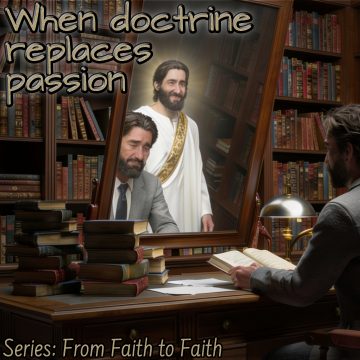
Sunday 7/12/26
Title: When Doctrine replaces Passion
Click for Message Video
Message Audio Player:
Podcast: Download (Duration: 1:26:35 — 52.2MB)
When Doctrine replaces Passion
After weeks and weeks we are now back in Revelation 2 where we first looked at the Ephesian church as a go-to example to learn from regarding possessing living faith. Or living from faith to faith.
As you remember Ephesus was filled with sincere believers who had really been through a lot – not only due to the oppressive pagan environment in which they lived but also due to false teachers coming in attempting to sway the flock.
They and their pastors had poured much time and effort into being established in sound doctrine, but somewhere along the way that push towards solidity in knowledge, supplanted the ardency of their first love for Christ.
On the surface this seemed to us to be an odd result of diligence in obedience to Christ’s command through Paul to get established in sound doctrine.
You would naturally think that any diligence, whose focus was obedience and fidelity to Christ, would naturally GROW your love, rather than allow it to diminish. But that is part of the human condition while we are still in the flesh. You can do one without the other and convince yourself that you’re actually fine or even better than you were before.
Perhaps even more astonishing than this was Jesus’ judgment to these diligent saints which was a call to change their minds in regard to His position not only as a Lord, but as the One they loved more than anything else.
If they failed to respond with appropriate vigor and earnestness, He would personally remove their church as a light in the darkness – the representation of the ‘city set upon a hill’ in Ephesus.
This was a serious penalty, but we know our Lord well enough to know it was a just decision, even if we have a hard time reconciling it with what appears to us to be a church that was more diligent than most in today’s world!
Let’s re-familiarize ourselves with the passage again…
It is Revelation 2:1-7 and I am reading from the ESV
“(1) To the angel of the church in Ephesus write: ‘The words of Him Who holds the seven stars in His right hand, Who walks among the seven golden lampstands.”
This is our first clue as to the terrible nature of the failing of this church.
Regarding doctrine, they needed only familiarize themselves with the teachings of the apostles. But Jesus Himself was walking among them and He was largely unperceived by them.
This is the first of many personal check points for us to examine ourselves in the light of their mistakes.
Now how do I know that Jesus was largely unperceived by them, though He was walking among them?
Because their love for Christ did not end, it just diminished in intensity and fervor. That can only happen if one’s faith becomes distant and mechanical.
You can still love the object of your faith, but you are no longer stirred to passion and unwavering devotion to their person, only their cause.
In order for their faith to be a living faith they lived by, Jesus had to be real to them in the most palpable sense of the word. There could be no sustained distance of heart in recognizing and responding to His person especially when aware that we are in their presence.
That in fact is the one major difference between being externally religious and being truly holy, which is to say devoted.
(2) “‘I know your works, your toil and your patient endurance, and how you cannot bear with those who are evil, but have tested those who call themselves apostles and are not, and found them to be false. (3) I know you are enduring patiently and bearing up for My name’s sake, and you have not grown weary.”
They were devoted to Jesus the Lord of the Kingdom, but some aspect of their relation to Him had been severely neglected in order to do all these things and yet, love Him less.
“(4) But I have this against you,…that you have abandoned the love you had at first.”
I told you weeks ago that a good word substitution here for “abandoned” is “neglected” and while that is true, I’m afraid I did not give it enough weight, relying as I was, upon their actions of obedience to establish themselves in sound doctrine.
A more proper evaluation of this idea is “to depart from” and can actually be used of divorce so this is a rather serious sin.
Metaphorically it carries the notion of leaving, deserting and quitting.
Jesus used the word towards the Pharisees when He told them they were “neglecting the weightier matters of the Law.” [Matt. 23:23] Theirs was not a simple oversight, but one which to some degree was a decision they had made.
In fact, that passage may offer us a more keen insight into this accusation of Christ to the saints in Ephesus.
Let’s read it. It’s found in Matthew 23 in which the entire chapter lists 7 woes Jesus evoked upon them.
Matt. 23:23-28,
“(23) Woe to you, scribes and Pharisees, hypocrites! For you tithe mint and dill and cumin, and have neglected the weightier matters of the law: justice and mercy and faithfulness. These you ought to have done, without neglecting the others. (24) You blind guides, straining out a gnat and swallowing a camel!
(25) “Woe to you, scribes and Pharisees, hypocrites! For you clean the outside of the cup and the plate, but inside they are full of greed and self-indulgence. (26) You blind Pharisee! First clean the inside of the cup and the plate, that the outside also may be clean.
(27) “Woe to you, scribes and Pharisees, hypocrites! For you are like whitewashed tombs, which outwardly appear beautiful, but within are full of dead people’s bones and all uncleanness. (28) So you also outwardly appear righteous to others, but within you are full of hypocrisy and lawlessness.”
Now I am not suggesting that the Ephesian believers fit this description, but it is hard to miss the fact that the scribes and Pharisees were both experts in doctrine and externally hated non-compliance with the tenants of the Law, but were simultaneously not close to God’s heart at all.
While I believe this church was better off in many ways, in other ways they were worse. At least the scribes and Pharisees were not born again, they did not have the law written upon hearts made soft by the miracle of the new birth and they did not have the Spirit of God within or upon them.
These Ephesian believers did!
To whom much is given much is required.
Based solely on the Greek text and its grammar, we can safely conclude that this condition in the saints of Ephesus was due to having intentionally departed from their primary, foundational devotion to Jesus.
They had shifted their hearts from relational love to mere mechanical duty and to some degree or another, the accusation of Jesus – as stated – clearly shows some level of willfulness in this decision.
There is no way to be honest with the text and conclude this was a simple misstep occasioned by unrecognized neglect.
In fact, an examination of the specific vocabulary and grammar used by Jesus reveals several concrete facts about their heart condition:
I will remind you that the verb translated here as “abandoned” means to “leave, forsake, or abandon.”
Grammatically, it is an active indicative verb which means that these Ephesian believers were the active agents who initiated this departure; it was a conscious fading or setting aside of their devotion rather than an accidental loss.
Now we have to be careful here, because when we hear the words “depart, abandon or forsake” in relation to Christ, we can make the mistake that it was Christ Himself they were departing from and that would be a great error. If that had been the case, this warning would have come too late.
No, what they had (on some level) for willfully set to one side was the love they had for Jesus at the beginning of their salvation.
The adjective translated as “first,” as I told you many weeks ago, was indicative of both priority and chronology.
This means the love they had at the beginning of their faith, as well as the love that holds the “first” place of importance in their lives.
We need to recall that Jesus Himself said that those who do not love Him more than earthly people or possessions cannot be His disciple and are not worthy of Him.
Luke 14:25-35,
“(25) Now great crowds accompanied Him, and He turned and said to them,
(26) “If anyone comes to Me and does not hate his own father and mother and wife and children and brothers and sisters, yes, and even his own life, he CANNOT BE be My disciple. (27) Whoever does not bear his own cross and come after Me CANNOT BE My disciple.“
The words “come after” speak of a complete allegiance to Christ.
When one carried a cross in Rome, it was a clear symbol of humiliation and execution.
So this word does not imply a simple stroll with Christ, but rather a lifetime of continual submission, walking the same path of suffering and obedience that He walked.
“(28) For which of you, desiring to build a tower, does not first sit down and count the cost, whether he has enough to complete it? (29) Otherwise, when he has laid a foundation and is not able to finish, all who see it begin to mock him, (30) saying, ‘This man began to build and was not able to finish.’
(31) Or what king, going out to encounter another king in war, will not sit down first and deliberate whether he is able with ten thousand to meet him who comes against him with twenty thousand? (32) And if not, while the other is yet a great way off, he sends a delegation and asks for terms of peace.
(33) So therefore, any one of you who does not renounce ALL THAT HE HAS CANNOT BE MY DISCIPLE.
(34) “Salt is good, but if salt has lost its taste, how shall its saltiness be restored? (35) It is of no use either for the soil or for the manure pile. It is thrown away.
He who has ears to hear, let him hear.”
Matthew 10:34-39 offers a less pointed and complete account but it is serious nonetheless. It says,
“(34) Do not think that I have come to bring peace to the earth. I have not come to bring peace, but a sword. (35) For I have come to set a man against his father, and a daughter against her mother, and a daughter-in-law against her mother-in-law. (36) And a person’s enemies will be those of his own household. (37) Whoever loves father or mother more than Me is not worthy of Me, and whoever loves son or daughter more than Me is not worthy of Me. (38) And whoever does not take his cross and follow Me is not worthy of Me. (39) Whoever finds his life will lose it, and whoever loses his life for My sake will find it.”
So there was a relational disconnect with Jesus.
The specific word for “love” here is agape, which signifies a self-sacrificial, willful devotion and care. A love called out of one’s heart due to their preciousness to you. A love that compels you to spend yourself sacrificially on another.
Blessings!