|
This is a text reader for the article below:
Getting your Trinity Audio player ready...
|
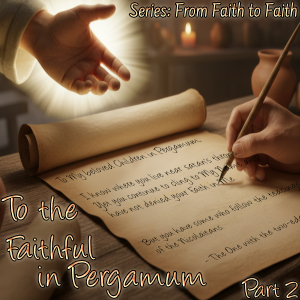
Sunday 8/23/26
Title: To the Faithful in Pergamum Pt. 2
Click for Message Video
Message Audio Player:
Podcast: Download (Duration: 1:23:16 — 47.5MB)
To the Faithful in Pergamum Pt. 2
This is our second week looking at the letter Jesus addressed to the saints in Pergamum.
As we have already tacked down, this was almost certainly during the reign of Domitian though it could be later. Extra biblical accounts have Domitian as the one who had Antipas killed, who Jesus mentioned in this letter.
Domitian’s treatment of both Jews and Christians is a tailored fit for the persecution addressed to the churches of Smyrna and Pergamum.
One source of this persecution was his aggressive promotion of emperor worship. While some provinces of Asia minor were less prominent and therefore less persecuted, Pergamum was of strategic importance and was fiercely loyal to Rome. It had an actual temple of the imperial cult and it was a city wide practice which was scrutinized for adherence to refer to the emperor as “our lord and god“. A title reserved by both Jew and Christians alike for God alone!
At this time, the imperial cult had become a marker of civic loyalty and patriotism. So refusing to participate in burning incense before the emperor’s image, attending festivities and acknowledging the emperor’s divine status — was to paint a red ‘X’ on yourself.
It was viewed as political disloyalty!
Additionally Pergamum was a very wealthy city as well as being among the most culturally significant cities in the Roman province of Asia containing many centers of worship to heathen gods.
Finally, Pergamum had active trade guilds and professional associations (collegia). Many guild meetings and feasts involved religious components — invoking patron deities, making offerings and honoring the emperor.
Christians refusing to participate were excluded from professional networks, markets, and economic protection. This wasn’t just religious; it was economically isolating.
The whole culture at Pergamum was saturated with pagan religious language and practice, so that remaining visibly Christian meant constant rejections and exclusions at least and at worst it could get you killed.
Revelation 2:12-17,
“(12) To the angel of the church in Pergamum write the following:
“This is the solemn pronouncement of the One Who has the sharp double-edged sword: .”
(13) “‘I know where you live – where satan’s throne is. Yet you continue to cling to My name and you have not denied your faith in Me, even in the days of Antipas, My faithful witness, who was killed in your city where satan lives. ”
“(14) But I have a few things against you: You have some people there who follow the teaching of Balaam, who instructed Balak to put a stumbling block before the people of Israel so they would eat food sacrificed to idols and commit sexual immorality.
(15) IN THE SAME WAY, there are also some among you who follow the teaching of the Nicolaitans.”
There is a LOT here, but we will work from the last statement towards the beginning. That is from verse 15 backwards to the opening of verse 14.
So a situation like this is really very serious!
What are Jesus’ next words?
“(16) Therefore repent.”
It is important to note here that the address is literally and deliberately NOT directed at those who were sinning.
Jesus praises the majority of the church for their faithfulness, even during a time when Antipas was martyred among them.
Then, still addressing the faithful, Jesus says,
“I have a few things against you: You have some people there who…”
Notice He did not say, I know the ones who are sinning and I am calling you out and addressing you.
Rather Jesus is directly addressing the whole church ABOUT the “some”.
This is important because there is a call to “repent” given to those sinning – not directly and this is made all the more clear in the grammar of the Greek.
So if Jesus is addressing those saints who are living righteously, then what is His call to “repent” regarding?
He is calling upon the faithful to deal with the sin in their midst.
What will happen if they fail to address the sin?
“If not, I will come to you soon and war against them with the sword of My mouth.
(17) He who has an ear, let him hear what the Spirit says to the churches.
To the one who conquers I will give some of the hidden manna, and I will give him a white stone, with a new name written on the stone that no one knows except the one who receives it.’
This last statement is more general and seems to apply to every Christian in Pergamum – the faithful and those who are wavering.
In Verses 14-16 the grammar is accusatory and employs an imperative structure:
- “You have people there…” (hymeis = the church community, 2nd person plural)
- “Repent therefore!” (imperative directed at the church)
- “Or I will fight against them” (autous = the false teachers, 3rd person)
Clear binary: church vs. false teachers; you must respond or they will be dealt with.
Verse 17 (promissory structure):
- “To the one who conquers…” (tō nikōnti — singular, articular participle with definite article)
- “I will give…“
Grammatically what is going on here is the “the one who conquers” (dative singular of the masculine participle with definite article) is not restrictive in the grammatical sense. It doesn’t say “to the one among you who was already faithful” or “to those of the faithful to take action and repent.” Rather it is a universalizing statement:
“To whoever conquers/overcomes [in this church]…“
So the promise is to all parties. What they are repenting of will differ, but the reward will be the same!
We have already addressed that these saints in Pergamum, were facing immense economic and social pressure to attend idol-worshiping festivals, rituals and celebrations as well as emperor worship.
By refusing to compromise, they lost their social status and access to real necessities in life and business as well as just general approval and social shame. Jesus steps in and promises that if they reject the world’s corrupt invitations, He will personally provide something vastly superior in each of these arenas.
Hidden Manna vs. Food Sacrificed to Idols
One of the sins of those unfaithful saints Pergamum and their teachers was consuming food sacrificed to idols (eidolothuton) at pagan celebrations.
Jesus contrasts this defiled, worldly food with “hidden manna”—the pure, heavenly bread of God.
In Hebrew history, a pot of manna was hidden inside the Ark of the Testimony as a testament to God’s supernatural provision in the wilderness as well as to Israel’s unfaithfulness to God in failing to trust in His provision.
So Jesus is reminding them of something as well as promising something.
He’s reminding them of his promise to meet their needs. “Do you not know that your father is aware that you have need of these things?”
And this promise was stated as a reason not to worry or be anxious.
But then Jesus goes one step further and reveals to them a future and spiritual provision as well which is directly linked to their faithfulness and overcoming the demonic pressures to conform to the world around them in order to secure natural provision and dissuade persecution.
Jesus is saying, “If you refuse to feed your temporal flesh at the tables of false gods, I will satisfy your eternal spirits with everlasting sustenance directly from and in the presence of God.”
Jesus, in the teachings of His ministry, identified Himself as the true manna from heaven so this invitation is very intimate.
The White Stone vs. The Pagan Invitation
Now this bit is a little more speculative in that, while we know these things were true in the ancient Greco–Roman world, it is only upon guess that we attempt to apply it to the kingdom promise Jesus is giving.
In the ancient Greco–Roman world, a small white stone (psephos) carried a few but highly specific cultural meanings and uses that more or less fit this perfectly within the given context of Pergamum:
In ancient courts, jurors voted with stones. A black stone meant condemnation; a white stone meant acquittal and innocence.
Pergamum was the seat of Roman judicial power (“where satan’s throne is“), where Christians were being marginalized, criticized, ostracized, economically restricted and in recent history even had a noteworthy man among them condemned to death for refusing to worship the emperor.
Jesus counters this by saying that though the world judges them guilty for faithfully clinging to Him and publicly embracing and confessing His lone Lordship, He, for the same reason, is promising them the white stone of divine and eternal acquittal where neither condemnation nor death may ever threaten them again!
Additionally, it was common in the Greco–Roman world that in order to attend private banquets, theatrical events, or elite civic festivals, citizens needed a token or stone that acted as an entrance ticket.
If a Christian refused to worship the local gods, they were blacklisted and denied a ticket.
Jesus essentially promises: “Deny their festivals, and you will feast both with and upon Me.” It may also be a subtle mention of the wedding feast.
The New Name vs. Cultural Identity
The white stone is promised with a “new name written on it“.
In pagan trade guilds, your identity, safety and “good name” were inexorably tethered to the name of the patron deity or the Roman Emperor you swore allegiance to.
By receiving a secret, intimate name from Christ, the believer is granted a secure, eternal identity and divine protection that the hostile culture could never strip away.
Finally, white stones also carried general connotations of good fortune and happiness.
For example, Romans had a proverbial custom of marking especially good or lucky days with a white stone and bad days with a black one.
Probably connecting daily happenings with matters of judgement.
The phrase “a day to be marked with a white stone” [dies albo notanda lapillo] appears in the writings of Catullus, Horace, Pliny the Elder, and Martial.
So this letter is literally more about dealing with false teachings and teachers, as well as those believers who follow them, than it is in addressing those teachers and followers themselves.
We are immediately reminded of the strong words of Paul to the Corinthians regarding sexual sin in their church and we will read it in closing since it introduces the type of contact we are to have with the world in contrast to that which is addressed here in the church of Pergamum.
1 Corinthians 5:1-13,
“(1) It is actually reported that sexual immorality exists among you, the kind of immorality that is not permitted even among the Gentiles, so that someone is cohabiting with his father’s wife.
(2) And you are proud! Shouldn’t you have been deeply sorrowful instead and removed the one who did this from among you?
(3) For even though I am absent physically, I am present in spirit. And I have already judged the one who did this, just as though I were present.
(4) When you gather together in the name of our Lord Jesus, and I am with you in spirit, along with the power of our Lord Jesus, (5) hand this man over to satan for the destruction of the flesh, so that his spirit may be saved in the day of the Lord.
(6) Your boasting is not good. Don’t you know that a little yeast affects the whole batch of dough?
(7) Clean out the old yeast so that you may be a new batch of dough – you are, in fact, without yeast. For Christ, our Passover lamb, has been sacrificed.”
Notice the contrast with the teaching of the Nicolaitans. It is BECAUSE Jesus had paid for our sins that we are OBLIGATED to live lives of holiness unto Him!
“(8) So then, let us celebrate the festival, not with the old yeast, the yeast of vice and evil, but with the bread without yeast, the bread of sincerity and truth.”
“ (9) I wrote you in my letter not to associate with sexually immoral people.
(10) In no way did I mean the immoral people of this world, or the greedy and swindlers and idolaters, since you would then have to go out of the world.
(11) But now I am writing to you not to associate with anyone who calls himself a Christian who is sexually immoral, or greedy, or an idolater, or verbally abusive, or a drunkard, or a swindler.
Do not even eat with such a person.
(12) For what do I have to do with judging those outside? Are you not to judge those inside?
(13) But God will judge those outside. Remove the evil person from among you.”