|
This is a text reader for the article below:
Getting your Trinity Audio player ready...
|
Sunday 8/16/26
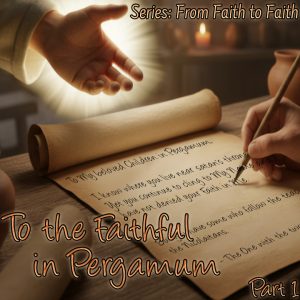
Title: To the Faithful in Pergamum
Click for Message Video
Message Audio Player:
Podcast: Download (Duration: 1:31:03 — 50.8MB)
To the Faithful in Pergamum
Well we finished up last week with the church of Ephesus as our first example of how to live out our lives From Faith to Faith.
This week we are looking at Jesus’ address to the saints in Pergamum.
As we have already tacked down, the only time period in which these issues make any real sense is between 80-95 A.D. and that for many reasons. Furthermore, it is where the great majority of scholarly opinions land. I do not mean to be dismissive of those who hold to preteristic views, but the evidence is simply too strong to ignore that the date for the book of Revelation as a whole and therefore these letters to the churches in Asia in particular are quite late in the first century.
Why that is important to our church in Pergamum is our ability to tack down who was ruling Rome since the impact of this is substantial!
Both scholarly opinion as well as dating offered by early church fathers identify Domitian as the one ruling Rome at this point and his historic treatment of Jews and Christians is a tailored fit for the persecution addressed to these churches.
One source of this persecution we mentioned last week is that he aggressively promoted the imperial cult and demanded dominus et deus noster (“our lord and god“) as a title.
At this time, the imperial cult had become a marker of civic loyalty and patriotism. Refusing to participate in burning incense before the emperor’s image, attending festivities and acknowledge the emperor’s divine status — was to paint a red ‘X’ on yourself. It was viewed as political disloyalty!
All of this was a direct challenge to Christians who were taught to distance themselves from pagan rituals, celebrations and worship as well as reserving the title of “Lord” and “God” for Jesus Christ alone!
Pergamum was also among the wealthiest and most culturally significant cities in the Roman province of Asia. It was:
- A major center of the previously mentioned imperial cult which as early as 29 BC actually had a temple built for Augustus.
- Additionally it had temples to Asklepios (the healing god), Athena, Dionysus, and Zeus
- Home to a famous library rivaling Alexandria’s
- Strategically important and loyal to Rome
Pergamum had active trade guilds and professional associations (collegia). Many guild meetings and feasts involved religious components — invoking patron deities, making offerings and honoring the emperor.
Christians refusing to participate were excluded from professional networks, markets, and economic protection. This wasn’t just religious; it was economically isolating.
How this impacted real life for a Christian in Pergamum:
- Inability to participate in guilds meant limited access to quality goods, contracts, and market credibility.
- Refusal to honor the emperor and gods was seen as impiety and unpatriotism.
- The ambient culture was saturated with pagan religious language and practice — remaining visibly Christian meant constant rejections and exclusions at least and at worst it could get you killed.
Domitian was known for punishing perceived disloyalty, including against Christians and Jews (both seen as refusing proper religious/political deference).
Domitian authorized and promoted hostility toward Christians and Jews, but it was likely experienced unevenly across the empire and may have involved a mix of legal sanctions, economic pressure, and executions rather than a single coordinated “policy.”
Domitian used legal and fiscal tools to enforce conformity to his religious authority. This is one of several internal clues for dating as well. A very heavy taxation was placed upon Jews and Domitian increased enforcement of the fiscus Iudaicus (Jewish tax imposed after 70 CE) and apparently expanded it or applied it aggressively to Christians as well. It wasn’t just taxation — it was a deliberate tool of identification and control.
Christians faced real jeopardy, including execution in some cases.
The consensus reading is that Revelation 2:12-17 reflects a Christian community under real social and economic pressure — though not necessarily martyrdom. Though Antipas is clearly mentioned, his being the sole example illustrates that that level of hostility was not common practice in Pergamum. But neither was it off the list of possibilities either.
This letter is urging resistance to assimilation at precisely the moment when assimilation would have been easiest and most profitable.
Revelation 2:12-17,
“(12) To the angel of the church in Pergamum write the following:
“This is the solemn pronouncement of the One Who has the sharp double-edged sword: .”
This is how Jesus introduces Himself to these saints and like He did with the church of Smyrna, He recounts a reference to chapter 1 where John describes Him as having a two-edged sword proceeding out of His mouth.
This would have likely been a reference to Hebrews which these saints would have been familiar.
In Hebrews 4, the writer is addressing the need to enter into the rest of Christ through the obedience of faith and thereby cease from works of self justification as well as sins of the flesh. Then beginning in verse 10 the connection is made between entering rest through obedience to the power and preeminence of God’s word.
Hebrews 4:10-16,
“(10) For the one who enters God’s rest has also rested from his works, just as God did from His Own works. (11) Thus we must make every effort to enter that rest, so that no one may fall by following the same pattern of disobedience. (12) For the word of God is living and active and sharper than any double-edged sword, piercing even to the point of dividing soul from spirit, and joints from marrow; it is able to judge the desires and thoughts of the heart. (13) And no creature is hidden from God, but everything is naked and exposed to the eyes of Him to Whom we must render an account.
(14) Therefore since we have a great high priest Who has passed through the heavens, Jesus the Son of God, let us hold fast to our confession.
(15) For we do not have a high priest incapable of sympathizing with our weaknesses, but One Who has been tempted in every way just as we are, yet without sin. (16) Therefore let us confidently approach the throne of grace to receive mercy and find grace whenever we need help.”
So this introduction would have been very suitable for these saints as we will see.
(13) “‘I know where you live – where satan’s throne is. Yet you continue to cling to My name and you have not denied your faith in Me, even in the days of Antipas, My faithful witness, who was killed in your city where satan lives. ”
Again we see a Jesus who knows! He is actively walking amid the 7 churches and He sees what they face, He is not detached, uncaring or unmoved by their plight.
This was the description of the majority, but Jesus sees another group in their midst who He must address and He does so with the sword of His mouth.
If Jesus were one of us, He might, upon seeing the difficulty of their circumstances, offer an empathetic encouragement to just do the best they can in the middle of such terrible surroundings. But Jesus is NOT us. His concern for them is greater than ours would be and it is rooted in what is right, just and true and therefore, what will put them in the best standing for eternal life than any other thing.
Satan’s throne here is a reference to his demonic authority in that city. His influence being highly evident and felt by all who possess even a modicum of spiritual sensitivity. This all paints a picture of an oppressive weight and environment in which to live. This isn’t just where his rule is expressed, it is where satan feels at home. This is where he dwells.
Jesus says,
“(14) But I have a few things against you: You have some people there who follow the teaching of Balaam, who instructed Balak to put a stumbling block before the people of Israel so they would eat food sacrificed to idols and commit sexual immorality.
(15) IN THE SAME WAY, there are also some among you who follow the teaching of the Nicolaitans.”
There is a LOT here, but we will work from the last statement towards the beginning. That is from verse 15 backwards to the opening of verse 14.
The Nicolaitans were a sect that apparently taught that Christians could engage in immoral behavior with impunity.
The early church father Irenaeus connected them to Nicolaus, one of the seven original deacons in the church in Jerusalem according to Acts 6:5. Irenaeus also further described them as an immoral Gnostic sect (Adv. Haer. 1.26.3; 3.11.1).
Last week when I offered a definition for the teachings of the Nicolaitans it occurred to me that they were probably connected in some way to the gnostics and this further suggests this may be true.
A very simplified description of the Gnostic belief is that the natural world was inherently evil and functioned like a realm in which our spirits were imprisoned in natural bodies. Since our bodies are also part of this natural realm they too are inherently evil and therefore cannot be redeemed. This is where the name of this group comes from – you see they believed the only way to be released from our imprisonment here to return to the divine realm was through the acquisition of special knowledge (gnosis). When this belief was mixed with the Christian teaching of salvation through knowing Christ, it naturally followed that we can eventually ascend into the divine through special knowledge without concern over moral aspects of human life. Meaning, what we do with our bodies was inconsequential since they could not be redeemed anyway.
This holds much in common with the Nicolaitans in their lack of concern over sin, only their teaching was from the belief that our sins have already been paid for anyway, so whether we sinned or not made no difference.
In short, Jesus has already paid for all sin making immoral behavior a type of “open bar”. The tab has been paid so you might as well indulge!
The way it was further distorted in Christian circles was by encouraging believers to mingle with the lost, enter into their pagan celebrations, eat foods sacrificed to idols and freely fornicate.
So Jesus offered an Old Testament in Balaam as a direct comparison to what the doctrine these false teachers were teaching of the Nicolaitans.
When the prophet Balaam realized he couldn’t curse the Israelites directly, he changed tactics. He advised King Balak to use Moabite women to seduce the Israelite men into pagan temple parties and sexual immorality. By getting them to compromise from the inside out, Israel brought judgment upon themselves.
In like manner, some within the church of Pergamum were both teaching and practicing the exact same thing. They were literally enticing Christians to lower their guards, attend pagan feasts, and engage in immorality under the guise of Christian liberty.
There exists an interesting linguistic connection between these two teachings as well which many biblical scholars have noted.
- Balaam in Hebrew roughly translates to “conqueror of the people” or “swallower of the people“.
- Nicolaitan in Greek (Nikolaos) literally means “one who conquers the people” (nikē = victory/conquer, laos = people).
Jesus wasn’t listing a grocery list of unrelated sins. He was exposing a recurring spiritual phenomenon: whenever a frontal assault against God’s people fails, false teachers will inevitably arrive to suggest that holiness is optional and that blending in with the world is perfectly harmless.
Jesus HATES this, as should we!
There are very strong parallels between what is happening here in Pergamum and what Peter addresses in his second letter.
Let’s read 2 Peter 2:1-22,
“(1) But false prophets arose among the people, just as there will be false teachers among you. These false teachers will infiltrate your midst with destructive heresies, even to the point of denying the Master who bought them.
As a result, they will bring swift destruction on themselves. (2) And many will follow their debauched lifestyles. Because of these false teachers, the way of truth will be slandered. (3) And in their greed they will exploit you with deceptive words. Their condemnation pronounced long ago is not sitting idly by; their destruction is not asleep.
(4) For if God did not spare the angels who sinned, but threw them into hell and locked them up in chains in utter darkness, to be kept until the judgment, (5) and if He did not spare the ancient world, but did protect Noah, a herald of righteousness, along with seven others, when God brought a flood on an ungodly world, (6) and if he turned to ashes the cities of Sodom and Gomorrah when He condemned them to destruction, having appointed them to serve as an example to future generations of the ungodly, (7) and if He rescued Lot, a righteous man in anguish over the debauched lifestyle of lawless men, (8) (for while he lived among them day after day, that righteous man was tormented in his righteous soul by the lawless deeds he saw and heard)
(9) – if so, then the Lord knows how to rescue the godly from their trials, and to reserve the unrighteous for punishment at the day of judgment, (10) especially those who indulge their fleshly desires and who despise authority. Brazen and insolent, they are not afraid to insult the glorious ones, (11) yet even angels, who are much more powerful, do not bring a slanderous judgment against them before the Lord.
(12) But these men, like irrational animals – creatures of instinct, born to be caught and destroyed – do not understand whom they are insulting, and consequently in their destruction they will be destroyed, (13) suffering harm as the wages for their harmful ways. By considering it a pleasure to carouse in broad daylight, they are stains and blemishes, indulging in their deceitful pleasures when they feast together with you.
(14) Their eyes, full of adultery, never stop sinning; they entice unstable people. They have trained their hearts for greed, these cursed children!
(15) By forsaking the right path they have gone astray, because they followed the way of Balaam son of Bosor, who loved the wages of unrighteousness, (16) yet was rebuked for his own transgression (a dumb donkey, speaking with a human voice, restrained the prophet’s madness).
(17) These men are waterless springs and mists driven by a storm, for whom the utter depths of darkness have been reserved. (18) For by speaking high-sounding but empty words they are able to entice, with fleshly desires and with debauchery, people who have just escaped from those who reside in error.
(19) Although these false teachers promise such people freedom, they themselves are enslaved to immorality. For whatever a person succumbs to, to that he is .
(20) For if after they have escaped the filthy things of the world through the rich knowledge of our Lord and Savior Jesus Christ, they again get entangled in them and succumb to them [are overcome], their last state has become worse for them than their first.
(21) For it would have been better for them never to have known the way of righteousness than, having known it, to turn back from the holy commandment that had been delivered to them.
(22) They are illustrations of this true proverb: “A dog returns to its own vomit,” and “A sow, after washing herself, wallows in the mire.”
So a situation like this is really very serious!
What are Jesus’ next words?
“(16) Therefore repent.”
It is important to note here that the address is literally and deliberately NOT directed at those who were sinning.
Jesus praises the majority of the church for their faithfulness, even during a time when Antipas was martyred among them.
Then, still addressing the faithful, Jesus says,
“I have a few things against you: You have some people there who”
Notice He did not say, I know the ones who are sinning and I am calling you out and addressing you.
Rather Jesus is directly addressing the whole church ABOUT the “some”.
This is where we will pick up next week Lord willing.