Communion Faith

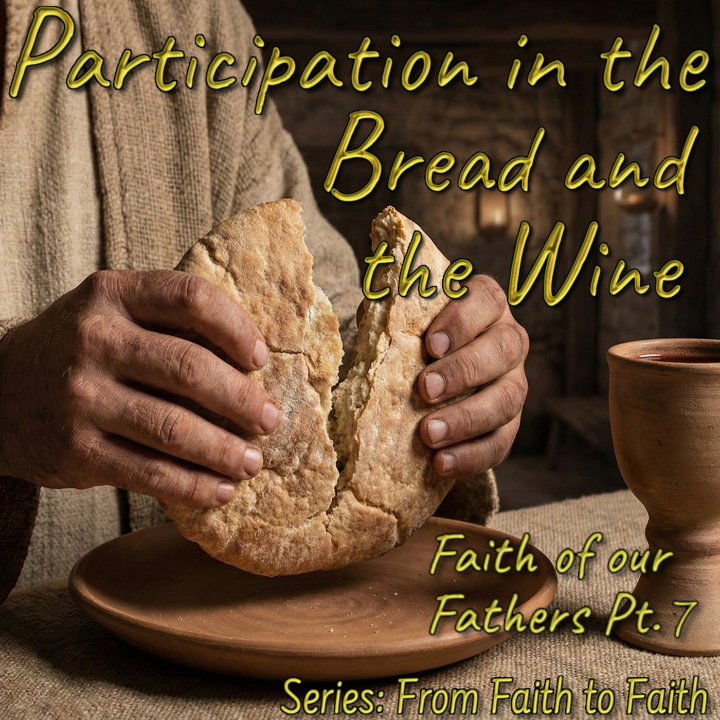
Participation in the Bread and the Wine

This week we finished up our segment on the early church’s second point of devotion which was to “THE FELLOWSHIP” and used our final two examples of the early church’s involvement in “the Fellowship” as a springboard into their 3rd point of devotion which was “the breaking of bread”.

The phrase “breaking of bread” includes two different things, both of which are illustrated in scripture and in extra-biblical historical literature. Primarily this phrase referred to partaking of communion from house to house which itself teaches us something, but we will not touch on that until next week. The second expression of this “breaking of bread” was simply meals eaten among the saints from house to house, as they communed over the word of God, the teaching of the apostles and prayers.

This week we only introduced the topic – focusing in upon its expression in the communion table.

Paul places a strong emphasis on communion as much more than a simple symbolic meal, but as an actual living declaration – a dramatization if you will, of our literal participation in the death, burial and resurrection of our Lord. Even as Paul said in 2 Corinthians 5:14, “…if one died for all then all died” and in his letter to the Romans where he said that if we have been crucified with Christ, then we have also entered into His death and resurrection with Him.

Next week we will explore this topic further both in communion, but also in the simple meals believers share in their homes together fellowshipping over the Word of God and in prayer.

Continue reading
Faith early church

Faith of our Fathers Pt. 6

This week we are examining the second point of absolute devotion the early believers had which helps us capture a clear image of the lofty heights from which the 7 churches in Asia Jesus addresses in Revelation 2 & 3 fell.

This second point of devotion was to “THE FELLOWSHIP”.

Now in English this sounds like an odd wording but it is consistent with the Greek and greatly impacts the meaning.

The Greek word koinonia implies partnership, sharing in common, and active participation. It was not merely socializing, but sharing one’s life, resources, and spiritual union in Christ.

It pointed to a specific, defined community and a concrete reality rather than an abstract concept of general friendship. It refers to a REAL partnership, sharing in common, and active participation with Christ and all who belong to Christ. It is not merely socializing, but sharing one’s life, resources, and spiritual union in Christ.

Today we began exploring examples of this in the letters of the New Testament.

Continue reading
Faith early church

Faith of our Fathers Pt. 5

Sound Doctrine, Sound Doctrine, Sound Doctrine… the need to be devoted to Sound Doctrine, its study, its eager examination and investigation was a primary focus of the early church. In fact it was FIRST in the list of 4 things the early church focused upon without ever even being told to – they were compelled from within by the Holy Spirit of God. The other things were THE fellowship (koinonia) of the brethren, the breaking of bread (including communion) from house to house and THE prayers.

We’ve been examining the Ephesian church in view of Jesus’ warning that He would remove their church if they did not repent (change their minds) and do the FIRST WORKS, by which Jesus was speaking of placing their love for Him as #1 in their lives in chronology and priority. These believers had their Sound Doctrine down, but their love life had been neglected. In our study of the Ephesian church AND the initial church found in Acts 2, we have uncovered the need for every believer to continue with the ardent strength of their first love for Christ and to allow THAT, along with their reverence for Him to generate a passion and urgency to study His words to be sound in doctrine.

Continue reading
Faith early church Unscripted

Faith of our Fathers Pt. 4

This week in our study of the 1st letter of Jesus to the churches in Asia – that of Ephesus.

We established the meanings of the two key words regarding their future judgment if they failed to repent which were “quickly” and “remove”. These English words may not be as clear a representation of what was said, it one might think.

Then we spent the rest of our time looking at the way the first believers – those coverts following Peter’s preaching at Pentecost since their love for Christ was fresh and strong – which is what Ephesus was lacking. We found that without a “script” to go by, they all unanimously found themselves – DEVOTING TEHMSELVES to – the teachings, the fellowship, the Lord’s Supper & THE prayers. The result was the reverential fear and awe of God fell on them all and they found favor in the eyes of the onlooking world.

Continue reading
Faith early church

Faith of our Fathers Pt. 3

This week we bore down hard on the warning and encouragement of Jesus to the church of Ephesus.

Key words were:
• Remember
• Repent
• Love
• Remove

All of this was spoken directly by Jesus to this precious church. He was saying…
• Remember the passion you possessed for Me at the beginning
• Change you mind (heart) about this and return to what you have neglected
• Love Me with ALL your heart – put Me first both in Chronology AND Priority
• If you fail to do this, I will remove your church (not physically, but Heaven will no longer recognize it and I, as your Chief Shepherd, will no longer walk among you.)

It is important to note that Jesus did NOT say, “You no longer love Me at all”. These Ephesian believers did in fact love Christ, it is just that over time and with the emphasis placed almost entirely upon sound doctrine, they grew (through neglect) to love Him less.

The coals were still hot, but the fire had died.

This represents a very rough outline of ALL that was covered, but we only truly expanded upon the need to remember and what kind of love the Ephesian church came to neglect in their relationship with Him.

We ended with the cliffhanger regarding living out this passionate love for Christ:
“How IS this accomplished?”

We will revisit this and move forward with the answer next week!

Continue reading