|
This is a text reader for the article below:
Getting your Trinity Audio player ready...
|
Sunday 5/24/26
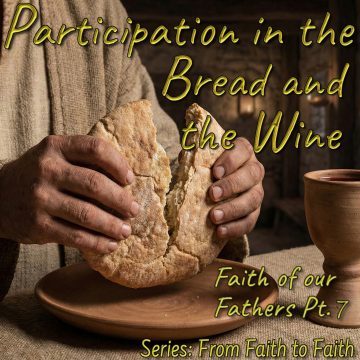
Title: Participation in the Bread and the Wine – Faith of our Fathers Pt. 7
Click for Message Video
Message Audio Player:
Podcast: Download (Duration: 1:28:15 — 153.2MB)
Participation in the Bread and the Wine – Faith of our Fathers Pt. 7
In the passage we left off with last week, Paul was addressing the Corinthians who by comparison had much in terms of provisions and while happy to pledge money a year earlier, Paul knew they were sometimes lagging in diligence and love. So he wrote them this letter to encourage them to follow through with their money pledges from a year prior, so that when Titus arrived he would find them ready. Might I suggest that if a letter or message like this were delivered to a typical 1st world country church today, it would be shot down as legalistic!
2 Cor. 9:8-15,
Paul was organizing a collection for the impoverished church in Jerusalem and his point was to shift the motivation behind it—moving it from a forced duty to a joyful, grace-based response. In that way they would be DEVOTED to participating in THE FELLOWSHIP.
“(8) And God is able to make every grace overflow to you, so that in every way, always having everything you need, you may excel in every good work.
(9) As it is written:
“He has scattered; He has given to the poor; His righteousness endures forever.” [Quote from Psalm 112:9]
“(10) Now the One who provides seed for the sower and bread for food will provide and multiply your seed and increase the harvest of your righteousness, (11) as you are enriched in every way for all generosity, which produces thanksgiving to God through us.” – [Derived from Isaiah 55:10 & Hosea 10:12]
“(12) For the ministry of this service is not only supplying the needs of the saints, but is also overflowing in many acts of thanksgiving to God. (13) Through the proof of this service, they will glorify God for YOUR OBEDIENCE TO THE CONFESSION OF THE GOSPEL OF CHRIST, and for your generosity in SHARING WITH THEM and with others. (14) And in their prayers for you they will have deep affection for you because of the surpassing grace of God on you.”
Remember as I was offering illustrative examples of “koinonia” as SHARED RESOURCES I mentioned the sharing of our grace gifts with each other – and this is one of them.
This is taught by Peter in 1 Peter 4:8-11,
“(8) Above all, keep your love for one another at full strength, since love covers a multitude of sins. (9) Be hospitable to one another without complaining. (10) Based on the gift they have received, everyone should use it to serve others, as good managers of the varied grace of God. (11) If anyone speaks, his speech should be like the oracles of God; if anyone serves, his service should be from the strength God provides, so that in everything God may be glorified through JesusChrist. To Him belong the glory and the power forever and ever. Amen.”
Paul ends his statement to the Corinthians in chapter 9 by saying,
“(15) Thanks be to God for His indescribable gift.” – Holman
Fellowship with the Godhead and the body through living out our union together –
1Jn. 1:1-4,
“(1) That which was from the beginning, which we have heard, which we have seen with our eyes, which we looked upon and have touched with our hands, concerning the word of life— (2) the life was made manifest, and we have seen it, and testify to it and proclaim to you the eternal life, which was with the Father and was made manifest to us— (3) that which we have seen and heard we proclaim also to you, so that you too may have FELLOWSHIP WITH US; and indeed our FELLOWSHIP is with the Father and with his Son Jesus Christ. (4) And we are writing these things so that our joy may be complete.
(5) THIS IS THE MESSAGE WE HAVE HEARD FROM HIM AND PROCLAIM TO YOU, that God is light, and in Him is no darkness at all.
(therefore…)
(6) If we say we have fellowship with Him while we walk in darkness, we lie and do not practice the truth. (7) But if we walk in the light, as He is in the light, we have FELLOWSHIP with one another, and the blood of Jesus His Son cleanses us from all sin.” – ESV
Php. 2:1-16,
“(1) If then there is any encouragement in Christ, if any consolation of love, if any FELLOWSHIP with the Spirit, if any affection and mercy, (2) fulfill my joy by thinking the same way, having the same love, sharing the same feelings, focusing on one goal.” [or sharing the same purpose]
“(3) Do nothing out of rivalry or conceit, but in humility consider others as more important than yourselves.
(4) Everyone should look out not only for his own interests, but also for the interests of others.
(5) Make your own attitude that of Christ Jesus, (6) Who, existing in the form of God, did not consider equality with God as something to be used for His own advantage. (7) Instead He emptied Himself by assuming the form of a slave, taking on the likeness of men. And when He had come as a man in His external form, (8) He humbled Himself by becoming obedient to the point of death–even to death on a cross.”
Now this requires a little cleaning up. The words “form of God” and then later “form of a slave” seem to contradict in the English. The word form is the same in both places but is further defined by surrounding qualifiers. The “form of God” is in the statement “existed in the form of God” which is a clear indicator of Who Jesus was in reality. The words “form of a servant” is followed by the words “likeness of men”. This Greek expression underlines the idea of “looking like other men” and is similar to Paul’s wording in Romans 8:3 where he says that Jesus came “in the likeness of sinful flesh”. The same word “likeness” is used in both passages. It implies that there is a form that does not necessarily correspond to reality. In Romans Paul was saying that Jesus came looking just like sinful men, but was Himself without sin in reality. In Philippians he is saying that Jesus WAS in His very person and nature God, but though equal with God, He did not hold onto that reality tightly so that He could be born a man as if that is all He was. So He WAS God, but took ON flesh like ours. The statement is NOT capitalizing on something Jesus left behind in heaven for He still was God, it is focused upon what He took on – which was human flesh.
In this regard the NIV and NLT do a superior job in conveying the original meaning.
- “Who, being in very nature God, did not consider equality with God something to be used to his own advantage;” – NIV
- “Though he was God, he did not think of equality with God as something to cling to.” – NLT
And by way of an example to us, this passage and the truths it places before us nicely serves as a great segue into the next “DEVOTION” of the early church which was “the breaking of bread”.
Jesus laid aside His privileges and prerogatives in order to serve not only as a sacrifice but an example as the passage said in verse 5, which in the NKJV words it this way, “Let this same mind be in you which was also in Christ Jesus”.
As we will read in a few moments, if we die the death He died, then we are destined to live the life He lives – ever to God. And if we so suffer in the flesh, we will be glorified which is a form of being “highly exalted.”
“(9) For this reason God also highly exalted Him and gave Him the name that is above every name, (10) so that at the name of Jesus every knee should bow–of those who are in heaven and on earth and under the earth– (11) and every tongue should confess that Jesus Christ is Lord, to the glory of God the Father.
(12) So then, my dear friends, just as you have always obeyed, not only in my presence, but now even more in my absence, work out your own salvation with fear and trembling. (13) For it is God Who is working in you, enabling you both to will and to act for His good purpose.
(14) Do everything without grumbling and arguing, (15) so that you may be blameless and pure, children of God who are faultless in a crooked and perverted generation, among whom you shine like stars in the world.
(16) Hold firmly the message of life. Then I can boast in the day of Christ that I didn’t run in vain or labor for nothing.” – Holman
James 4 – humble be exalted (Peter as well I think)
“(10) Humble yourselves before the Lord, and he will exalt you. (11) Do not speak evil against one another, brothers. The one who speaksagainst a brother or judges his brother, speaks evil against the law and judges the law. But if you judge the law, you are not a doer of the law but a judge. (12) There is only one lawgiver and judge, he who is able to save and to destroy. But who are you to judge your neighbor?”
1 Peter 5,
“(1) So I exhort the elders among you, as a fellow elder and a witness of the sufferings of Christ, as well as a partaker in the glory that is going to be revealed: (2) shepherd the flock of God that is among you, exercising oversight, not under compulsion, but willingly, as God would have you; not for shameful gain, but eagerly; (3) not domineering over those in your charge, but being examples to the flock. (4) And when the chief Shepherd appears, you will receive the unfading crown of glory. (5) Likewise, you who are younger, be subject to the elders. Clothe yourselves, all of you, with humility toward one another, for “God opposes the proud but gives grace to the humble.” (6) Humble yourselves, therefore, under the mighty hand of God so that at the proper time he may exalt you, (7) casting all your anxieties on him, because he cares for you.”
1 Cor. 11:17-34,
“(17) Now in giving these instructions I do not praise you, since you come together not for the better but for the worse. (18) For first of all, when you come together as a church, I hear that there are divisions among you, and in part I believe it. (19) For there must also be factions among you, that those who are approved may be recognized among you. (20) Therefore when you come together in one place, it is not to eat the Lord’s Supper. (21) For in eating, each one takes his own supper ahead of others; and one is hungry and another is drunk. (22) What! Do you not have houses to eat and drink in? Or do you despise the church of God and shame those who have nothing? What shall I say to you? Shall I praise you in this? I do not praise you. (23) For I received from the Lord that which I also delivered to you: that the Lord Jesus on the same night in which He was betrayed took bread; (24) and when He had given thanks, He broke it and said, “Take, eat; this is My body which is broken for you; do this in remembrance of Me.” (25) In the same manner He also took the cup after supper, saying, “This cup is the new covenant in My blood. This do, as often as you drink it, in remembrance of Me.” (26) For as often as you eat this bread and drink this cup, you proclaim the Lord’s death till He comes. (27) Therefore whoever eats this bread or drinks this cup of the Lord in an unworthy manner will be guilty of the body and blood of the Lord. (28) But let a man examine himself, and so let him eat of the bread and drink of the cup. (29) For he who eats and drinks in an unworthy manner eats and drinks judgment to himself, not discerning the Lord’s body. (30) For this reason many are weak and sick among you, and many sleep. (31) For if we would judge ourselves, we would not be judged. (32) But when we are judged, we are chastened by the Lord, that we may not be condemned with the world. (33) Therefore, my brethren, when you come together to eat, wait for one another. (34) But if anyone is hungry, let him eat at home, lest you come together for judgment. And the rest I will set in order when I come.”
Blessings!
Blessings!