|
This is a text reader for the article below:
Getting your Trinity Audio player ready...
|
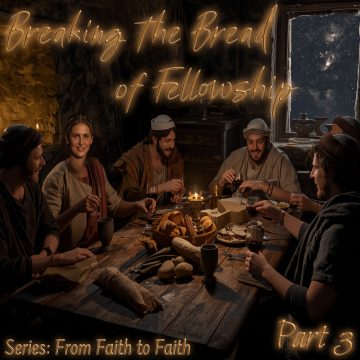
Sunday 6/21/26
Title: Breaking the Bread of Fellowship Pt. 3
Click for Message Video
Message Audio Player:
Podcast: Download (Duration: 1:39:45 — 61.7MB)
Breaking the Bread of Fellowship Pt. 3
Last week we finished up John 6 in our examination of what it meant for the fledgling church to devote themselves to…
- the apostle’s doctrine
- the Fellowship
- the breaking of bread
- the prayers.
The breaking of bread included both communion and love feasts.
A synopsis of Jesus’ teaching in John 6 was that we are to strive not for temporary satisfaction and fulfillment through natural provisions like food, but to find our true fulfillment in our union with Him which includes our fellowship or joint participation with Him in His death and resurrection.
Let’s read Jesus’ final words from last week beginning in John 6:48…
“(48) I am the bread of life.
(49) Your fathers ate the manna in the wilderness, and they died.”
Now remember that Deut. 8 tells us what God’s intended lesson of the manna was… what was it?
“Mankind cannot live by bread alone, but by every word that PROCEEDS out of the mouth of God.” – Deut. 8:3
Jesus makes a direct connection between this bread of His flesh and the words He speaks in a moment – both of which are addressed in the 4 devotions of the early church. Namely, the apostle’s doctrine and the fellowship.
“(50) This is the bread that comes down from heaven, so that one may eat of it and not die.
(51) I am the living bread that came down from heaven. If anyone eats of this bread, he will live forever. And the bread that I will give for the life of the world is My flesh.”
(52) The Jews then disputed among themselves, saying,
“How can this man give us His flesh to eat?”
(53) So Jesus said to them,
“Truly, truly, I say to you, unless you eat the flesh of the Son of Man and drink His blood, you have no life in you.”
The participation in the bread and the wine make this koinonia and therefore a shared life, shared experience and shared resources.
We enter into and in fact possess eternal life, because life eternal is in Christ.
“In Him was life and that life was the light of men.”
“(54) Whoever feeds on (a continual coming) My flesh and drinks My blood has eternal life, and I will raise him up on the last day. (55) For My flesh is true food, and My blood is true drink.
(56) Whoever feeds on My flesh and drinks My blood ABIDES IN ME, AND I IN HIM.
(57) As the living Father sent Me, and I live because of the Father, so whoever feeds on Me, he also will live because of Me.
(58) This is the bread that came down from heaven, not like the bread the fathers ate, and died. Whoever feeds on this bread will live forever.”
(59) Jesus said these things in the synagogue, as He taught at Capernaum.
(60) When many of His disciples heard it, they said,
“This is a hard saying; who can listen to it?”
Jesus was teaching them and therefore these people were being taught by God even as that verse said earlier but just because they were being taught didn’t mean they were truly listening or learning.
“(61) But Jesus, knowing in Himself that His disciples were grumbling about this, said to them,
“Do you take offense at this? (62) Then what if you were to see the Son of Man ascending to where He was before?
(63) It is the Spirit Who gives life; the flesh is no help at all. The words that I have spoken to you are spirit and life. (64) But there are some of you who do not believe.”
It is incumbent upon us to actively place our trust in his diligence and believe He is doing His job. But that also requires that our eyes remain on Jesus and not on just studying alone.
“(For Jesus knew from the beginning who those were who did not believe, and who it was who would betray Him.)
(65) And He said,
“This is why I told you that no one can come to Me unless it is granted him by the Father.”
(66) After this many of His disciples turned back and no longer walked with Him.
(67) So Jesus said to the twelve,
“Do you want to go away as well?”
(68) Simon Peter answered Him,
“Lord, to whom shall we go? You have the words of eternal life,”
The words of union with God.
“(69) and we have believed, and have come to know, that You are the Holy One of God.”
Of course we read from 1 Corinthians 10-11 in previous messages. The key points being:
Paul called the communion meal our participation in the body and the blood of Jesus.
It too was and is a living memorial or parable of continually pursuing and partaking of Jesus by faith and so entering into His death with Him as well as pressing through the grave into new life with Him.
In chapter 11 Paul links our love for the body of Christ, as in other Christians, with respect for His actual body which was sacrificed for us.
If we fail to show love and respect for each other, we fail to show it to Him.
If this is allowed and continual, then our external participation in the Communion meal is a lie and one that WILL BE judged – either by ourselves, which Paul encourages, or by God so that we will not be condemned with the world.
Now let’s read Jesus’ words
Matthew 26:26-29,
“(26) Now as they were eating, Jesus took bread, and after blessing it broke it and gave it to the disciples, and said,
“Take, eat; this is My body.”
(27) And He took a cup, and when He had given thanks He gave it to them, saying,
“Drink of it, all of you, (28) for this is My blood of the covenant, which is poured out for many for the forgiveness of sins. (29) I tell you I will not drink again of this fruit of the vine until that day when I drink it new with you in My Father’s kingdom.”
Now let’s consider some of the key highlights of Romans 6-8 in our closing of this first half of “devotion to the breaking of bread”.
Please hold in your mind the fact that this communion meal was partaken of regularly in the early church from house to house and that it is very likely that their understanding of all it symbolized, was far more robust than our own.
The participation in this meal was intentional as was the message it was communicating, or “preaching” as Jesus put it.
These people regularly participated in a solemn drama of entering into the death and resurrection of their Lord with Him, so that their lives looked a lot like what Paul describes in these chapters in Romans!
Are you there?
Read Romans 5-8
This was all symbolized in that expression of “the breaking of bread” which was realized in the communion meal, which the early church partook of regularly. But, these truths were driven home, explored and reinforced in the communion the early church had over the truths of the Gospel in their communal meals.
As far as food goes, history tells us that these were just regular, even simple meals. Meaning, its not like they had a BBQ or fondue or a pizza party. It was regular fare.
Though they did this daily early on, the practice continued on through to the 3 and 4th centuries, and though these became less frequent, they were still done weekly!
One expression was the Sabbath (Shabbat) Meal. You of course remember that Sabbath began Friday night and continued until sundown Saturday night. So it as that the early church, both Jews and Gentiles would begin a special meal on Friday night. It was a family and community meal which transforms a regular dinner into a sanctified boundary of time. Characterized by the blessings over the wine (Kiddush) and the bread (Hamotzi). This communal gathering created a type of sacred, highly valued, treasured and in fact protected space and time, emphasizing peace (Shalom Bayit), rest, and family unity.
Acts 20:7 also demonstrates the early church gathering on the first day of the week specifically to break bread.
Early historical church writings show how the early church viewed these communal meals (not the Lord’s supper). They were communal meals, known as the Agape meal or love feast, and were vital expressions of charity, unity, and radical equality.
Far from being simple potlucks, they were ritualized religious banquets designed to feed the poor, foster community, and reflect the kingdom of God. Now this again does not imply elaborate foods, but it does to some degree imply an ample supply of it.
Key historical writings which provide a window into how the early church viewed and regulated these feasts include the Didache, Ignatius, Tertullian and Clement.
Now let me say that these writings are extra-biblical and were no included in the canon of scripture for a reason, the great among which is it lacks a clear line of witness to the Lord or the apostles directly and therefore cannot be viewed as authoritative. I only mention it because it offers us at least some window into the past, but I cannot stress enough, that if such details were truly important or necessary, they would have been preserved in the New Testament. These writings span from the late 1st century to the early third century.
All they tell us is that communion was treated differently from the love feasts.
The communal meal was viewed as a time for sharing the actual fruits of the earth, explicitly tying the banquet to the charitable gathering of the local church.
Ignatius of Antioch (c. 107 AD) in his Letter to the Smyrnaeans, pointed out the ecclesial
This reinforces that the early church viewed communal meals as sacred, official gatherings of the church, requiring proper leadership and unity rather than unstructured, rogue gatherings.
Tertullian of Carthage (c. 197 AD) provides the most vivid, detailed description of how the early church viewed these love feasts, defending them as times where the participants prayed before reclining, ate only enough to satisfy hunger, and drank modestly.
He emphasized that the meal was an act of charity, chaste behavior, and spiritual discipline. The feasts began and ended with prayer. They featured hymns and scriptures, and any funds collected during the feasts were used to feed the poor, bury the dead, and support orphans.
This view to charity is further backed by Clement of Alexandria (c. 150–215 AD) who argued that the purpose of eating together was not for luxury or indulgence, but for the cultivation of genuine friendship and the relief of the needy.
Clement viewed the Agape Love Feasts as an earthly image of the heavenly banquet, stating that a true “love feast” must be focused on love and generosity rather than upon the food itself.
While these meals originally occurred in conjunction with the Lord’s Supper, the rapid growth of the church led to logistical challenges. By the 3rd and 4th centuries, church councils began separating the ritualized Communion meal from the communal Agape meal to prevent abuses and accommodate larger congregations.
Now, all that being said, I will be the first to admit to being at a bit of a loss in my ability to comprehend this from a personal experience perspective.
For me, eating and talking do not go together well. This may have a little to do with my upbringing, but I don’t think so.
I think the main reason is because there are SO MANY topics people talk about today, and so few of them brush up against anything I am truly invested in. I believe I have experienced this type of communal meal only a few times in my life, and so far as I can remember, they were never in a large group like those represented in scripture, but were more one on one. Additionally, there was no singing.
All that to one side, it would be hard to deny the impact and universal nature of communal meals and their benefits which God apparently baked into humanity.
I am one for well conducted double blind studies and so I thought I’d look for one regarding the benefits, if any, to communal meals across national boundaries and throughout time.
As it happens, one such study was conducted not long following the COVID shutdowns.
It found that people who eat more meals with others tend to be more satisfied with their lives and are more likely to express positive emotions, according to a study published in the annual World Happiness Report.
According to the finding’s authors, sharing meals is as predictive of happiness as income or employment status — across ages, genders, countries, cultures, and religions.
While over 150,000 people from 142 countries and territories collected by Gallup in 2022 and 2023 were part of the survey, it has its limits. In the end, the only thing that can be said with any certainty is that people who eat more meals with others than not, are strongly predictive of greater life evaluations, increased positive affect, and decreased negative affect. They also found that dining alone is at least as (if not even more) strongly associated with low levels of wellbeing.
One of the failings of this survey is its inability to identify the causal link. Does happiness in people predispose them to eat with others, or does eating with others generate the sense of well being?
There is also the issue of defining “well being” across cultures. What does it mean?
Additionally, there is the impact of those who willingly participate in surveys. It is likely that introverts would be far less likely to even volunteer to take it and so you are left with an overwhelming number of participants being of the extravert variety.
Nevertheless, the survey has value in that the expression is universal as are the results. Regardless of why you are eating with others, or alone, the impact at large seems to all lean in one directly. Communal meals are healthy, physically, socially, mentally and emotionally.
The early church, as we read, would read from scripture, talk about scripture, sing scripture oriented songs and doctrinal creeds. Prayers were prayed and pastoral oversight and involvement was common, if not expected.
Now these meals were part of the devotion of the early church. It was part and parcel with being part of the Christian faith and community. There is no evidence of an “opt-out” program for those with a disposition like my own.
Years ago, we used to do this when it was more feasible and when involvement was more willing, though it was never stellar.
A key difference I noticed in those times and the ones we just read about, was the type of conversation. Our conversation gravitated towards nature. Towards daily happenings and entertainment rather than Jesus and it was largely due to my inability to stir up the right type of interaction at each table, that I eventually just let those times fall away.
I am not suggesting that we do them again, at least not immediately, since our home is no longer home to just one family, but I DO believe the communal interaction to be more pertinent than the sharing of food, when that is not practical and I have encouraged this.
The more segregated and separate our lives are, the more our Christian walk becomes a largely solo affair and the power and influence gained through unity is lost. And I believe something HAS to be done about that.
There has been a huge departure from church at large and for many reasons, most of them eventuate in good.
We lose people who are not truly devoted to Christ, we disperse into smaller, more meaningfully familial groups whose focus is more upon Christ than on the emotional charge or theological reaffirming our flesh longs for.
But even in small groups like this, there can be a deadly familiarity that leads to complacency and that too is dangerous. In the end, there is no replacement for zeal, for passion, for love of Christ – meaning Who He really is, as opposed to who we want Him to be.
So I want you to hold these things in your heart. Think on them. Take them to God in prayer and return next week prepared for the 4th and final devotion of the early church which was “the Prayers”, which were NOT just ad hoc prayers we are most familiar with, but prewritten and structured prayers they prayed. I know it sounds odd – even somewhat Greek orthodox or Jewish or Catholic, but you know, we are not the sole repository of all that is right in Christendom. Others may have been faithful over things we let slip even as we are more faithful regarding things they may have lost sight of. We need to examine the scriptures with respect and honor what we find there!
Amen?!
Blessings!
Blessings!