|
This is a text reader for the article below:
Getting your Trinity Audio player ready...
|
Wednesday 6/17/26
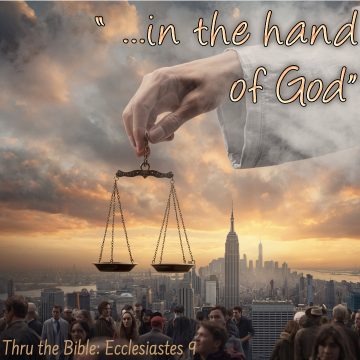
Thru the Bible: …in the hand of God
Message Video Player
Message Audio Player:
Podcast: Download (Duration: 47:26 — 87.6MB)
…in the hand of God
Ecclesiastes 9:1-18,
“(1) But all this I laid to heart, examining it all, how the righteous and the wise and their deeds are in the hand of God. Whether it is love or hate, man does not know; both are before him.”
“Both are before him”. The grammar of the Hebrew points to mankind as “him”. While it would be true of God as well, it seems to be pointing to us as the observers.
This verse begins with “But all THIS I laid to heart” [ “כִּ֤י אֶת־כָּל־זֶה֙ נָתַ֣תִּי אֶל־לִבִּ֔י” (lit. For all this I gave to my heart or set into my heart)] which is a retrospective phrase in the Hebrew, meaning that he is referring to what he had just written. While the end of chapter 8 is almost certainly the primary reference, I believe it includes all of chapters 7 & 8 of which the end of chapter 8 was Solomon’s concluding statement to which this is pointing.
Solomon was grappling with humanity’s inability to fully comprehend God’s works as well as what appears to us, from time to time, to be an unjust, unpredictable outcome relative to one’s actions which is captured in verse 14.
“There is a vanity that takes place on earth, that there are righteous people to whom it happens according to the deeds of the wicked, and there are wicked people to whom it happens according to the deeds of the righteous. I said that this also is vanity.” – Eccl. 8:14
The second half of the verse pivots forward, using the past reference as a type of groundwork to explain the bleak, unpredictable realities of life “under the sun” that he introduces in the second half of the verse on to verses 3-6.
When he says that he “set” or “laid” all of this to heart, the context implies an intensive mental review, assessment, and contemplation of the arguments and observations he just detailed.
When he says, “the righteous and the wise and their deeds are in the hand of God [“הַכֹּל כַּאֲשֶׁר לַכֹּל]” Solomon actually presents us with what appears to be a theological conundrum. Placing in deliberate tension with one another the sovereignty of God and the limited observations and conclusions of man. This highlights the huge gap between God’s understanding, power and authority and mankind’s ignorance.
“In the hand of” is just what it sounds like – it means in God’s power, authority or by means of the same. Knowing that there is no injustice with God, we know that individual choice is just that, yet God’s sovereignty is still present. Solomon is not questioning this, he is simply stating that since we do not know everything there is to know about any one single thing, it is impossible from the vantage point of human reasoning to always identify justice when we see it. Human beings and their actions do not always produce external results which we would identify as warranted.
Perhaps the easiest and most shocking example is when the righteous are martyred for their faithfulness to God. On a human level there could hardly be a greater expression of injustice. This however, is only part of what transpired in that transaction. There is a hereafter , which Solomon acknowledges in Proverbs 23:18,
“For surely there is a hereafter, And your hope will not be cut off.”
But as stated, time and again, Solomon’s conclusions in this book of Ecclesiastes are almost always relegated to what happens while mankind is physically alive or “in their brief existence under the sun.” And this is part of the point. We need to be slow to judge what we see as fair and unfair, just and unjust, because what we can observe “under the sun” is not the entirety of the story. This is something Solomon himself points out in the conclusion of this book in chapter 12:14, which in itself is a type of lesson to not draw conclusions until you have seen the totality of a matter.
As we will see in a moment it is not the actual people or actions Solomon is ultimately pointing to, but rather their outcomes while “under the sun” which is in fact the same for all, which is death. But even this is only true for the majority, for Enoch, Elijah and those of Christ’s body who are alive at His return will NOT experience physical death. So even in this, these statements are relative.
“(2) It is the same for all, since the same event happens to the righteous and the wicked, to the good and the evil, to the clean and the unclean, to him who sacrifices and him who does not sacrifice.
As the good one is, so is the sinner, and he who swears is as he who shuns an oath.
(3) This is an evil in all that is done under the sun, that the same event happens to all. Also, the hearts of the children of man are full of evil, and madness is in their hearts while they live, and after that they go to the dead.”
The following statements support my previous statements regarding the fact that this is largely, if not exclusively, being presented in light of conclusions or ends that – “all men die”!
“(4) But he who is joined with all the living has hope, for a living dog is better than a dead lion. (5) For the living know that they will die, but the dead know nothing, and they have no more reward, for the memory of them is forgotten.
(6) Their love and their hate and their envy have already perished, and forever they have no more share in all that is done under the sun.”
Now we face another conundrum where Solomon makes a sweeping statement without clarifying who his audience is.
“(7) Go, eat your bread with joy, and drink your wine with a merry heart, for God has already approved what you do.”
The words, “God has already approved what you do” can mean that those who are Solomon’s target audience who are presumably those who desire to live uprightly and not according to folly – God has approved them. But that is a little broad, since even with the Godly God cannot always approve of all they do. So it is likely that this is in reference to eating and drinking with a merry heart, because, according to Solomon, these are things God has already sanctioned and willed for mankind. He actively delights in our enjoyment of life’s basic, simple pleasures.
“(8) Let your garments be always white. Let not oil be lacking on your head. (9) Enjoy life with the wife whom you love, all the days of your vain life that He has given you under the sun, because that is your portion in life and in your toil at which you toil under the sun.
(10) Whatever your hand finds to do, do it with your might, for there is no work or thought or knowledge or wisdom in Sheol, to which you are going.”
Again, this is stated within the greater context of this book which was decidedly written with a focus on how to live lives which steer clear of folly and foolishness. That being true, Solomon can hardly be attributed with encouraging evil. So it stands to reason that he is not saying, if theft is all your hand can find to do, do it with all of your heart.
Additional to this is the fact that this is a Jewish/biblical idiom. The Hebrew verb for “finds” (תִּמְצָ֨א, timtza) when paired with “your hand” (יָֽדְךָ֤, yadecha) is referring to that which is practically within your reach, your ability, or your power to achieve.
So the overall point seems to be, whatever you find that you are apt, able or even gifted to do – is what your hand will likely gravitate to and you should be wholehearted in the doing of it.
Solomon says this in light of the fact that one day your toils “under the sun” will cease. Presumably this is also said in light of the fact that you only have today to make the decisions which will greatly impact your eternal existence, so make wise choices and do not be slack.
Now I know that I am overreaching a bit in saying this, in that I am reading into the passage something which I believe is being stated as a type of subtext. A lesson within a lesson so to speak. But if a person is “gifted” at something, then it stands to reason that such gifting came from God. If this is true, then it is also a stewardship and all stewardships should be done in view of the fact that there will be a day of accountability for what you did with what was given to you.
“(11) Again I saw that under the sun the race is not to the swift, nor the battle to the strong, nor bread to the wise, nor riches to the intelligent, nor favor to those with knowledge, but time and chance happen to them all.
(12) For man does not know his time. Like fish that are taken in an evil net, and like birds that are caught in a snare, so the children of man are snared at an evil time, when it suddenly falls upon them.”
Nearly every time I come across thoughts like this, it reminds me of two things:
- The common objection many people have to ordering your conduct according to scripture which usually manifests in the question, “Why do bad things happen to good people?” Which is of course a bad question to begin with since no one is truly good.
- The very singular passage which only appears in the gospel of Luke 13:1-5 which I believe captures in a few words, what Solomon has been saying for chapters in Ecclesiastes.
“(1) There were some present at that very time who told Him about the Galileans whose blood Pilate had mingled with their sacrifices. (2) And He answered them,
“Do you think that these Galileans were worse sinners than all the other Galileans, because they suffered in this way?
(3) No, I tell you; but unless you repent, you will all likewise perish.
(4) Or those eighteen on whom the tower in Siloam fell and killed them: do you think that they were worse offenders than all the others who lived in Jerusalem?
(5) No, I tell you; but unless you repent, you will all likewise perish.” – Luke 13:1-5
Now this was said in the greater context of Jesus encouraging them to be mindful of the times they were living in and acting accordingly. Meaning, your Messiah has come and the end of the age of righteousness by the works of the Law is coming to a close. It was given to you to be a tutor to bring you to faith in the Messiah. What do you think will happen if you refuse Him and fail to bear the fruit of repentance?
But here, it also fits to illustrate that what happens to mankind is not always an indicator of righteousness or wickedness. Additionally, all have sinned and deserve death, so the fact that towers are not falling on people all the time, is proof that life is more governed by mercy than justice. Also, that when justice does have its day, we should not be quick to call it injustice! Like Paul said in another place regarding something different but still relevant to this, “Not that we dare to classify or compare ourselves with some of those who are commending themselves. But when they measure themselves by one another and compare themselves with one another, they are without understanding.” – 2 Cor. 10:12
Meaning that just because a tower fell on some people does not mean they were greater sinners than you nor that you are more righteous than them because it did not fall on you. When what we compare ourselves with are other flawed human beings we are not using a wise measurement.
“(13) I have also seen this example of wisdom under the sun, and it seemed great to me.
(14) There was a little city with few men in it, and a great king came against it and besieged it, building great siegeworks against it. (15) But there was found in it a poor, wise man, and he by his wisdom delivered the city. Yet no one remembered that poor man.
(16) But I say that wisdom is better than might, though the poor man’s wisdom is despised and his words are not heard.
(17) The words of the wise heard in quiet are better than the shouting of a ruler among fools.
(18) Wisdom is better than weapons of war, but one sinner destroys much good.”
I think the point here is clear enough and it nicely ties together the entire chapter. Justice is not always seen while “under the sun” because while God does not show preference, man does. While God sees all things and judges perfectly, we only see in part and so our judgment is nearly always skewed. Man may honor a king because he is a king and fail to honor a fool even though he is wiser than the king.
In the cited example a powerful king besieged a small city and a poor wise man foiled his plans, so that “wisdom is better than weapons of war”. Notwithstanding, they failed to honor and recognize the poor man which given Solomon’s focus in these chapters represents a great evil. The wisdom and advice of this poor man did not serve him in terms of honor or prestige – he was forgotten. His words were literally heard, but in Solomon’s view they were not because the one who spoke them was forgotten, which to Solomon represented destroying what was good.
To which Solomon says, “The words of the wise heard in quiet are better than the shouting of a ruler among fools.”
The “sinners” mentioned in the final verse are those who favor outward appearances, do not recognize wisdom when they see it and whose honor is reserved for those who fit within their belief of who is worthy and honorable.
This does not, however, devalue wisdom.
Wisdom is very valuable regardless of who acknowledges it or you. But one thing stands sure, one sinner does much to destroy good or reduce it to some degree of disorder.
Blessings!