Song of Solomon Dazzling Unexpected

Dazzling & Unexpected

Song of Solomon 5 kicks off with a one verse depiction of the wedding night, followed by a fun-loving reimagining/retelling of the Shulamite’s dream from chapter 3. After this the Shulamite offers a descriptive Wasf, very much like that offered by Solomon in description of her beauty.

Our lesson concludes with connections made between the scenes in this chapter and the relationship we both have with Christ and that which we will experience in the future when we are joined with Him!

Continue reading
Dream matrimony poem wasfs

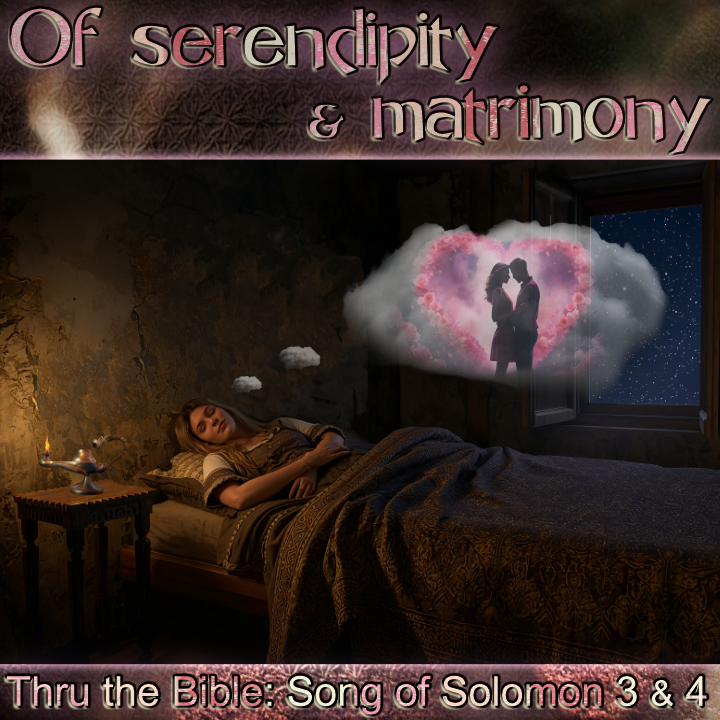
Of Serendipity & Matrimony

Well this one had me off balance at first! As I did my due diligence studying historical references to Jewish betrothals, parental involvement, scheduled and non-scheduled visits between the engaged couple leading up to the wedding attempting to reconcile the text to Jewish customs and the morality of the Law. Finally, as I was praying (a little frustrated in how things were going) it occurred to me that these initial verses in chapter 3 were probably a dream of the Shulamite. Only later was I to discover this is a commonly held thought among theologians and scholars. So I feel as if I heard correctly.

The person speaking in the second half of chapter 3 is unidentifiable and may just be an unnamed narrator. The other options are the Shulamite or her bride’s maids, the “daughters of Jerusalem”. This depicts Solomon coming, in traditional Jewish fashion to retrieve his bride from her father’s house and speed her away in a Palanquin to his estate where the consummation of the marriage will take place just before a 7 day wedding feast.

Nearly all of chapter 4 is Solomon, giving a traditional wasfs – which is a poetic description of the beauty of his bride-to-be.

That all of this is brilliant imagery depicting the believer’s relation to Jesus as “the bride” is sobering and telling. It really calls you out of your comfort zone and challenges notions and expectations of deity, you probably didn’t even know you had.

For example, to have Jesus – the Creator of the natural universe, look at the church (also His very Own creation) and say, “You have stolen my heart, with one glance of your eye” is something serious followers of Christ will have to take time with to allow the Spirit to capture it for you in ways you can comprehend and accept… and THAT is my challenge to anyone who reads the book or listens to this message.

Continue reading

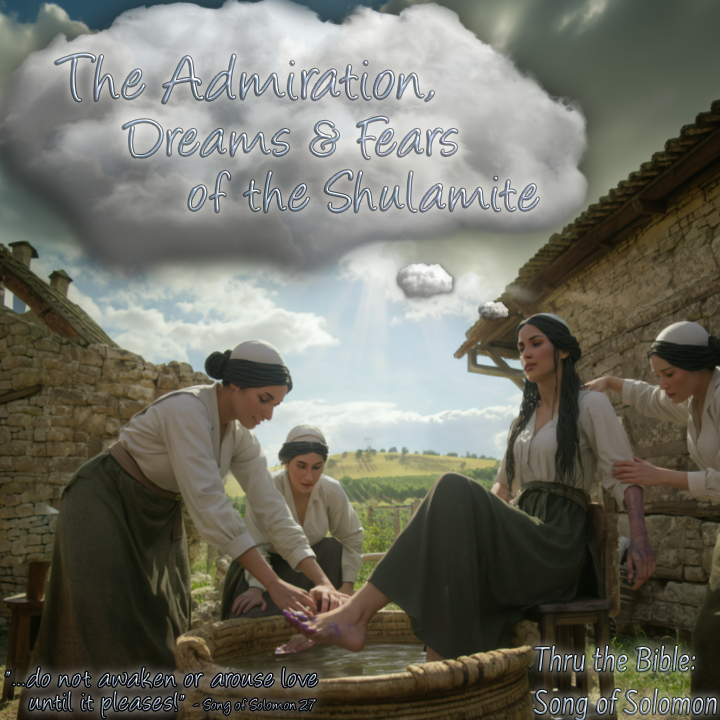
The Admiration, Dreams & Fears of the Shulamite

Chapter 2 of Song of Solomon starts off with the Lily of the Valley and the Rose of Sharon which contrary to its use in modern Christian circles is actually in reference to the Shulamite, Solomon’s bride, and is therefore representative of the church rather than Christ. Also, these flowers are not outstanding in beauty nor is the “rose” an actual rose – they were common wild crocus and meadow-saffron. In fact, it was due to their humble and common beauty that they were used as an illustration!

As the chapter progresses, it moves chiastically between the actual wedding feast, back to the time of their betrothal and finishes with Solomon coming to retrieve his bride for their celebratory wedding feast.

Like most of the Song of Solomon, nearly the entire chapter is from the Shulamite’s perspective. She moves from the heights of amorous admiration for her newly wed husband, to the celebration of their union in their wedding feast, to her dreams and fears during the “winter” of their separation during their betrothal to the excitement of the coming of her groom and his clear delight in her.

All of this so perfectly illustrates the various times, events and aspects of our union with Christ. There is much to learn and reconcile our hearts to in relation to the intimacy of this union, that it rejoices the heart as much as it challenges our understanding of “piety”.

Continue reading
Solomon Songs

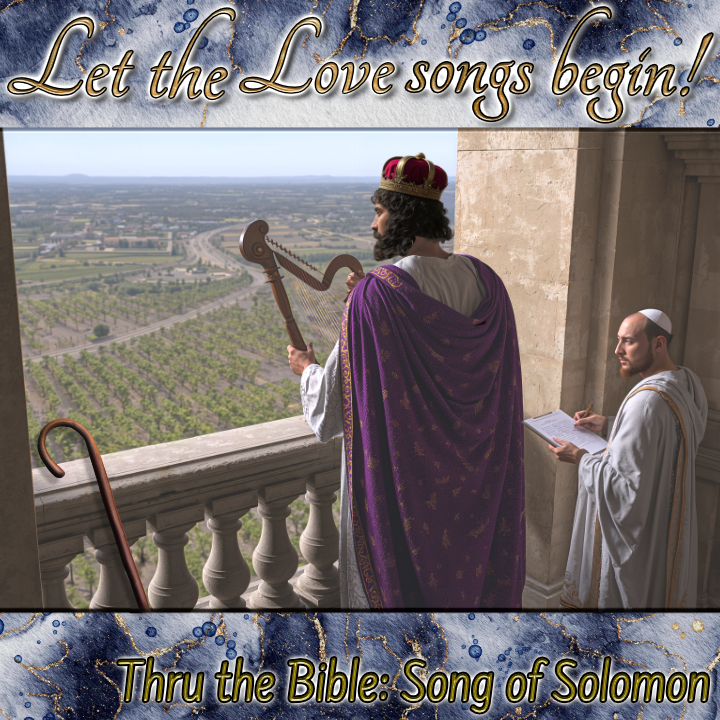
Let the Love Songs begin!

Now before we get started tonight, I want you to remember a few of the things we covered in our overview of this book.

First off, there are 5 players on the field:
• The Beloved who we believe to be Solomon
• The Shulamite who is his lover/bride
• The maidens/bride’s maids
• The family, friends and valiant men of Solomon and
• The brothers of the Shulamite bride.

There will be shifts in the dialogue from one speaker to another throughout. These will be announced. These lead-ins are NOT original to the text and are therefore not inspired NOR authoritative. A good 90%+ of them are, however, agreed upon by most people. This is because the content makes it rather clear.

This book is NOT for the faint of heart. It uses very blatant and clear sexual references in which both lovers express their longings and desires without shame.

As we read, it will be important – imperative really – that we do not lose sight of what this love story is illustrative of. This is inspired by God to reveal through human marital love, what Jesus desires with His bride.

The narrative in this book is characterized by a conversational style that alternates between dialogues and poetic reflections.

Also remember that this book is NOT in chronological order which will become immediately apparent in the first 7 verses alone.

Finally, the development of the Song of Solomon follows the Chiastic structure I explained last week.

As the curtain opens on this book, we begin with the couple already married and therefore the setting is Solomon’s palace – as it is throughout the entire book.

By the time we reach verse 5, the Shulamite woman is remembering a particularly frustrating portion of her courtship to Solomon when she still did not know his
true identity as king. She was overly tanned due to working the family vineyard and is talking about this to her maidens.

Continue reading
Intro Solomon Song

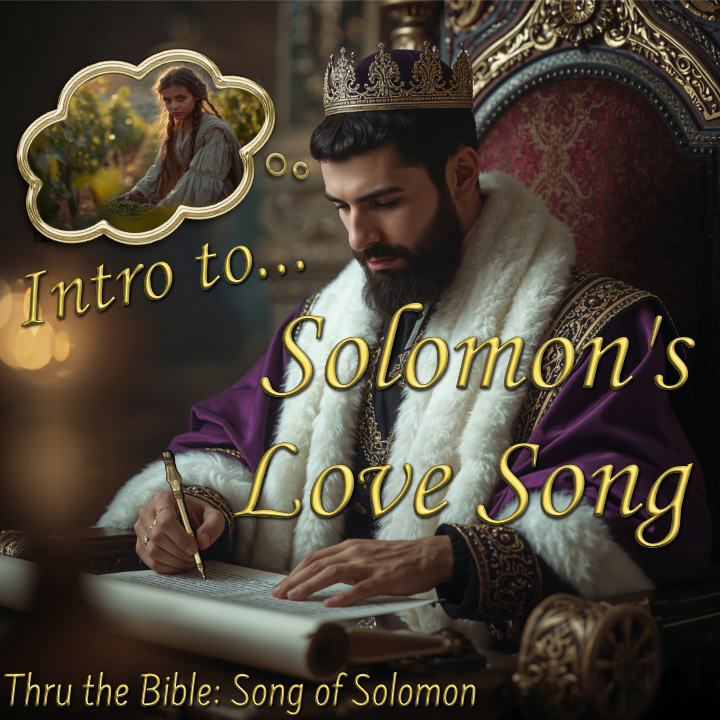
Intro to… Solomon’s Love Song

Tonight we are taking a somewhat “deep dive”introduction into the Song of Solomon.

The Song of Solomon is among those books of scripture classified as wisdom – poetic literature. Its structure is complex and unique in all of scripture. The development of the story is NOT linear and unless you understand the literary structure you are likely to miss a great deal of what is going on in this book.

There are only 8 chapters and 5 characters. There is of course the shepherd/king who we assume to be Solomon himself. There is the object of his affections known formally only as “the shulammite”. Then there are three theatrical “choruses” who interact with the main characters throughout the narrative. These are the “daughters of Jerusalem” (the bride’s maids), Solomon’s friends (or attendants), and the Shulammite’s brothers.

Nearly the entire story actually takes place in Solomon’s Palace where “flashbacks” to their time of courtship leading to marriage takes place.

Interestingly, the overwhelming majority of the story is written from the 1st person perspective of “the Shulammite” woman, rather than from the main protagonist whom we assume is King Solomon.

All together this is a very interesting book in terms of layout, story telling, story development and spiritual imagery.

Of course, being an inspired book, the main person being revealed is actually Jesus and the Shulammite represents the church – His bride. The choruses represent the church, the angels and the ministers of the New Covenant whose job is to present the church as a chaste bride to her Bridegroom.

Other than the book of Job, this is the most detailed book introduction in our entire trek ‘Thru the Bible’ so far, but I believe it was both necessary and beneficial.

Continue reading